

Even wins come with lessons in the Ontario Hockey League (OHL). The Windsor Spitfires earned two points against a division rival at home on Thursday, but it wasn’t without some serious effort.
As the 2025-26 OHL season heads into its final month, the Spitfires are in a battle with the Flint Firebirds, Kitchener Rangers, and Soo Greyhounds for the top seed in the Western Conference. On Thursday, they faced the Sarnia Sting, who are the ninth seed and seven points behind the eighth-seeded Saginaw Spirit. Neither club was ready to budge, and without some depth luck, this could have been a whole other story. Here are three takeaways from the WFCU Centre.
Mental Mistakes Almost Cost Spitfires
In the OHL, anyone can win regardless of the standings. While the Spitfires are the veteran contenders and the Sting are a young, rebuilding team, that didn’t really matter.
The Sting played aggressive from the start and put the Spitfires on their heels. Early in the first period, the home side found themselves on a power play. However, two turnovers and poor coverage gave the visitors two unexpected shorthanded goals on the same power play. Let’s call it a teachable moment.
However, the home side responded before the period ended thanks to Cole Davis. The Spitfires added another three in the second to make it 4-2 courtesy of Jack Nesbitt (Philadelphia Flyers), rookie John McLaughlin, and Ethan Belchetz. While the Sting added one late in the second on the power play, Belchetz and Ethan Garden gave them a 6-3 lead before making it a 6-4 Spitfires final.
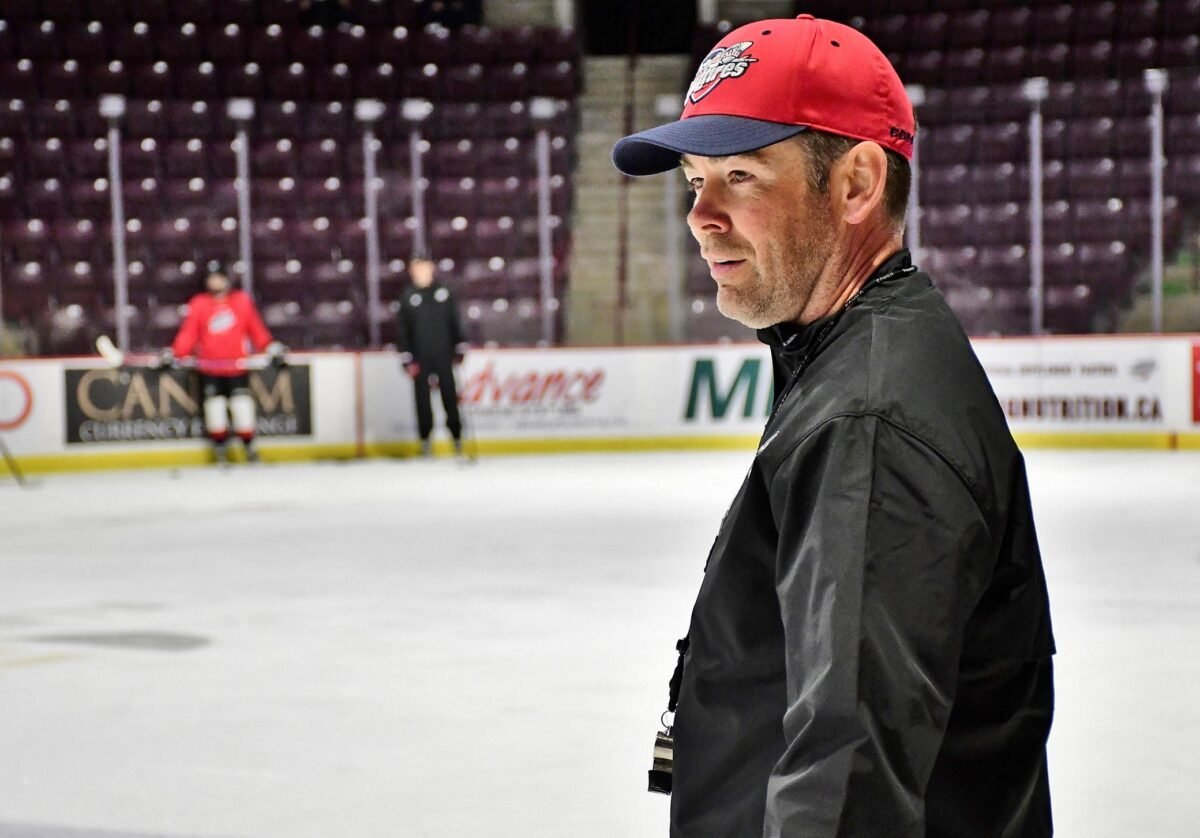
Despite being in the top conference seed with the win, it was the mental mistakes that almost cost them the game. From overthinking special teams to a lack of discipline, it was a rough ride at times. After the game, Spitfires’ head coach Greg Walters said simple is the best recipe.
“It’s just too much sometimes,” he said. “Just simple hockey. You saw what happened when we made some changes and managed the puck. Get pucks to the net. It’s a simple game, and we try to make it more difficult than we need to, and that’s why we were down.”
While the two points were big in the overall playoff race, Walters said efforts like this won’t cut it against the contenders from either conference.
“We went backwards in the first period,” he said. “You can’t go backwards. We’re battling for first place overall. (The Sting) competed extremely hard. If we’re playing against Brantford (Bulldogs) or Kitchener (Rangers), we probably don’t win that game with how we played in the first.”
What’s the solution? Walters said that they’re team-oriented, and having players sit for some shifts may help in the long term.
“As you saw tonight, guys are held accountable, and it’s going to continue,” he said. “It’s crest first, and they have to understand that. Everything is about the team and about winning. We did that in the second and third and were able to come out with a huge win.”
Spitfires’ Power Play Getting Too Complicated
One of the Spitfires’ biggest issues on Thursday, and for the last couple of weeks, has been their lack of simplicity on the power play. They complicate the game, which leads to forced plays and often turnovers at both ends of the rink. Last weekend, during their three-game Northern swing, the club allowed two shorthanded goals. On Thursday, they allowed two more in the same power play. It’s an unacceptable stat, and the team knows it.
After the game, Walters said the power play was becoming an issue by trying to do too much. Assistant coach Casey Torres showed them how Team Canada’s Men’s Olympic Hockey roster makes their special teams work by using simple, effective methods.
The Spitfires go the opposite route by getting too fancy, and it wound up on the Stings’ sticks. One change Walters used was putting newly-acquired defenceman Jakub Fibigr (Seattle Kraken) out there because his style fits the system.
“He’s safe, and he’s simple,” Walters said. “We’re not here in this situation without our guys. They just have to simplify their game … Most of our guys, just playing simple hockey.”
Related: 2026 Olympic Games Men’s Hockey Power Rankings
The Spitfires know that with players like Belchetz, Nesbitt, captain Liam Greentree (New York Rangers), defenceman-turned-forward Anthony Cristoforo, plus newcomers Nathan Villeneuve (Seattle Kraken) and Alex Pharand (Chicago Blackhawks), the power play should be effective. However, execution is another story. If you make it too complicated, like they did on Thursday, it will come back to haunt you. Keep it simple, and good things will happen.
Spitfires’ Depth Proves Essential
While there were issues throughout the game that the Spitfires need to work on, one area that they can build on is their depth scoring. It’s been an area of pride for them for much of the season. When the team is fully healthy, they can dress four productive lines every night. On Thursday, they had a full roster, and almost everyone contributed.
The top line of Belchetz, Nesbitt, and Cristoforo had three goals and four points. The second line added another goal and four points, the third had two points, and the fourth had a goal and four points. The only two players to not record a point were Villeneuve and Cristoforo.
The Windsor #Spitfires got scoring from all four lines on Thursday during a hard-earned 6-4 win over the Sarnia #Sting at the WFCU Centre. #OHL pic.twitter.com/OBLs5WMMJ2
— Dave Jewell (@DaveJewellOHL) February 13, 2026
Nesbitt, who had a goal and an assist, said having that scoring depth not only gives the players confidence but Walters and his staff, too.
“(It) gives Walters confidence in every player,” he said. “He knows he can put any line out there and they can score goals. It’s nice for him and nice for us.”
Walters has often praised his depth players. When you’re contending, the third and fourth lines don’t always get a lot of ice. That’s not the Spitfires’ method, and it’s paying off. He said one trio really stood out on Thursday in terms of how they want to play come the playoffs.
“I brought up three guys after the game in the dressing room – Johnny Mc(Laughlin), Davis, and (Beksultan) Makysh – they were animals,” Walters said. “They didn’t turn over one puck. This is playoff hockey. This is how we’re going to play. Everyone has to get on board.”
The fourth line consisted of McLaughlin, Makysh, and rookie Caden Harvey. They combined for four points, and Walters said he has no issue putting that line up against almost anything the league can throw at them.
“I’ll play them against most other lines in the league,” he said. “They’re going to work extremely smart, they’re smart, they manage the puck, and they’re competitive.”
Younger players don’t often get a chance to play big minutes on contending teams. However, it’s working for the Spitfires, and it will only benefit the players and the team next season once the veterans have moved on to the next level.
The Spitfires now get ready for a home-and-home with the Spirit – Saturday on the road and then Monday (Family Day) at the WFCU Centre.

