
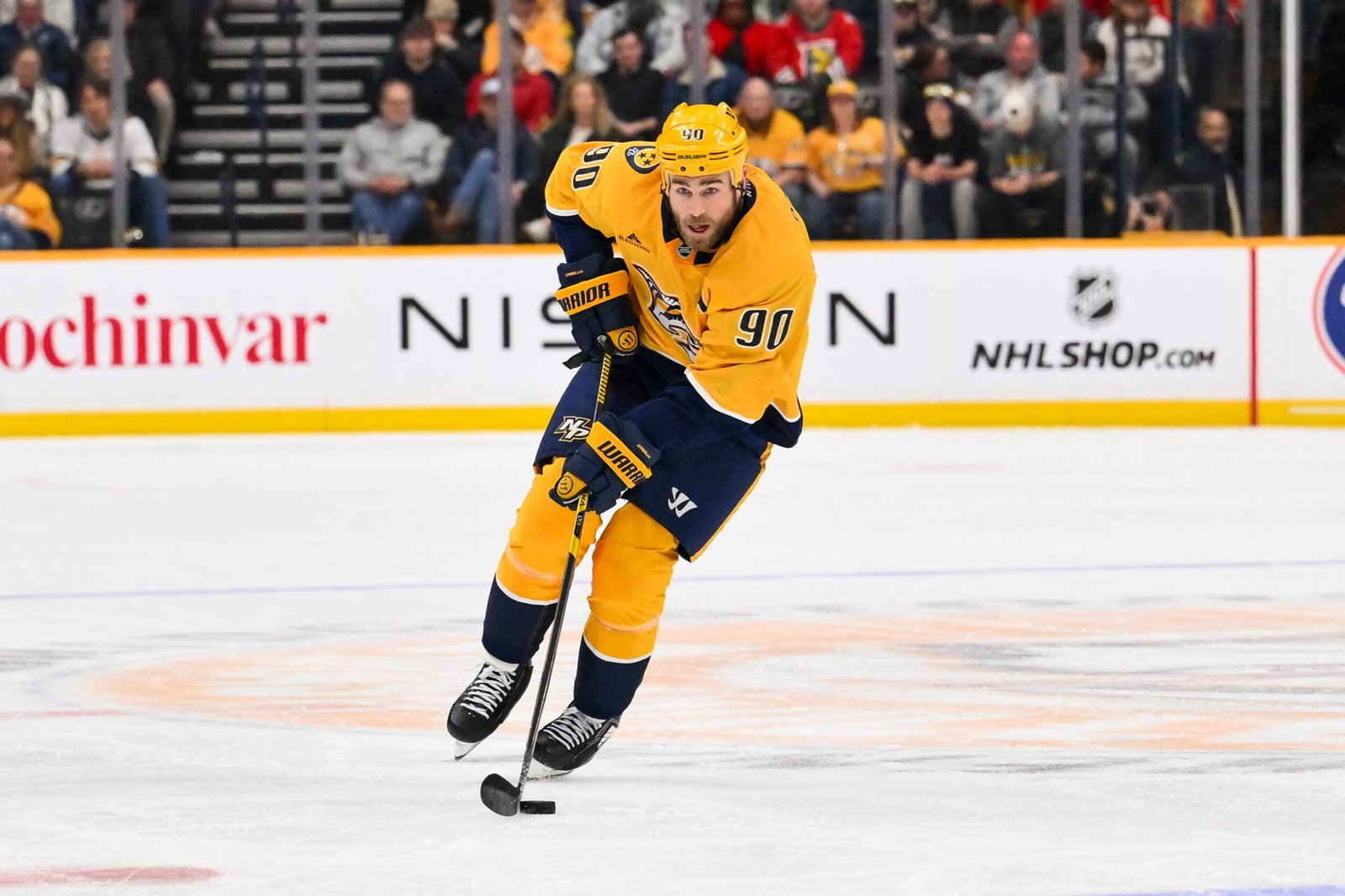
The Nashville Predators (29-27-9) surprised many people with their moves over the deadline. They sold a few pieces, which was expected, but they didn’t sell as much as people imagined.
They traded depth forwards Michael McCarron (Minnesota Wild) and Cole Smith (Vegas Golden Knights) to contending teams for second-round picks. They also traded middle-six winger Michael Bunting to the Dallas Stars for a 2026 third-round pick. Finally, Nick Blankenberg was shipped off to the Colorado Avalanche for a fifth-round pick.
Despite rumors of moving Ryan O’Reilly, Steven Stamkos, Nick Perbix, or Erik Haula, the Predators decided to keep all of those pieces. There were inklings that they weren’t going to sell everything off, but considering the age of the team, the shallow prospect pool behind Matthew Wood and Brady Martin, and the returns they got for depth forwards, many are confused about why Nashville didn’t tear it down.
Unsure Organizational Direction
The Predators are currently in a transition phase at general manager after Barry Trotz announced he’s stepping down at the end of the season. The thought was that they would find a replacement outside the organization to replace Trotz.
However, that’s just not how these searches work. The Predators’ next general manager might not be determined until the offseason, with a lot of candidates getting their shot to discuss their vision of the team.
With no succession plan for the general manager, Trotz probably thought it unwise to sell everything off. He probably wanted to make sure the new general manager had some trade assets or building blocks.
Wonky Value
The trade market was bizarre this season. It was considered a seller’s market, which should’ve been great for Nashville. They did well in trading away depth forwards that wouldn’t have been on the roster next season.
However, with the value they got for that depth (Bunting, McCarron, Blankenberg, Smith), they might have demanded too much for pieces like O’Reilly and Perbix. Very few first-line centers were traded during the trade deadline, with Nazem Kadri being the biggest example.
Related: 4 Reasons the Canadiens Didn’t Trade Patrik Laine
There’s also another year on the Perbix and O’Reilly contracts. If Nashville traded both of them away, would they settle for worse value than the market commands? They probably felt best to try next year with both of those pieces.
Clause Protection
Another thing that could’ve hindered Nashville in their plans was clause protection. This applies to Steven Stamkos and Jonathan Marchessault.
Stamkos has a no-movement clause on his deal, so he got to decide where he wanted to go. He gave the Predators three options: the Tampa Bay Lightning (his old team), the Wild, and the Stars. The Predators probably thought it unwise to trade him in-division, and the Lightning would’ve needed to unload a veteran on a pricy contract to the Predators (Oliver Bjorkstrand?) to clear the cap room. The Lightning decided on Corey Perry instead, reuniting with the winger to bring some scoring depth and leadership.
With Marchessault, it was always a pie-in-the-sky idea that Nashville would trade him. He had a 15-team no-trade list, and he’s signed for less per year than Stamkos. However, unlike Stamkos, who leads the team in goals (31) and provides solid offensive value, Marchessault has lagged. He has just 11 goals and 10 assists through 46 games. That didn’t do well for his trade value.
Playoff Push?
Yes, it sounds crazy to think the Predators could push for the playoffs, especially with how awful this core looked last season. However, the Western Conference is incredibly shallow. The Los Angeles Kings currently hold the last wild-card spot, with just 69 points on the season. The Predators have 67 points this season, so they’re a game away from it already.
For that reason, O’Reilly and Stamkos had informed the team that they didn’t want to be traded. They wanted to see the season through, and with at least a fighting chance, they wanted to prove they could lead this team to the Stanley Cup Playoffs.
The playoffs are always unpredictable. The Predators made their run to the 2017 Stanley Cup Final as a wild-card team. It’s a different circumstance, but perhaps Trotz wanted to give this core one last chance to dance.
The Haula Debacle
With all that being said, it’s still unbelievable the Predators didn’t trade Erik Haula. The bottom-six center would’ve been perfect for a contending team, and with the returns Nashville got, Haula could’ve netted them a premium.
Haula has 10 goals and 21 assists through 65 games. That’s an increase in production from last season (11-10-21), and he’s currently on pace to produce more than his 2023-24 season (16-19-35). Surely, there was a team that needed a two-way middle-six center like Haula. Plus, he’s an unrestricted free agent after this season, so he could walk away for nothing after this season anyway.
Conclusion
After the madness of the trade deadline, the Predators currently sit with the majority of their trade pieces still around. O’Reilly and Perbix are under contract until 2027, Stamkos until 2028, and Marchessault until 2029. It’s a bold decision from Trotz, and Nashville fans will anxiously wait to see if it pays off.

