

At its core, every great hockey story is a tale of suffering and ultimately redemption. What makes those stories compelling is that in them, we see the human condition and perhaps something of ourselves. In the words of “The Man in the Arena”, in our hockey heroes we see those who strive, their face marred by sweat and blood; who battle valiantly; coming up short again and again; who at their best know the triumph of victory and at worst, if they fail, at least do so daring greatly. Their place will never be with those cold and timid souls who neither know victory nor defeat.
The Stanley Cup Is Built on Failure
Hockey’s suffering is seen in the battle for the Stanley Cup itself. Every year, 32 teams embark on the quest to win that holy grail, and 31 of them will know nothing but wretched failure. Only the players on one team experience the joy of hoisting the Cup – something for which they began paying for in untold pain and suffering when they were just boys.
Hockey’s ultimate prize was created to ensure that suffering for all those seeking to take it is the norm. Success is the sweet exception. Any team that has won the Cup will attest to this. NHL champions aren’t defined by their wins as much as they are by the decades of pain that preceded them.
Here you can think of the Washington Capitals before their first and to date only Stanley Cup victory in 2018. That victory was 43 seasons in the making and ultimately came only after they had been eliminated from the playoffs despite winning the Presidents’ Trophy in the previous two regular seasons. The Capitals’ starting goaltender that season, Braden Holtby, captured the meaning of suffering and redemption, explaining after the victory: “It doesn’t come easy. It took years. Years of heartbreak. Years of breaking things down and trying again, and this group never gave up. And we finally did it.”
It’s hard to think of any Stanley Cup champion that didn’t know woe and misery on their way to ultimate victory. Perhaps their stories resonate with lovers of the game because of how long the pain lasted. And no other team has suffered longer striving for the Cup than the Toronto Maple Leafs. They last drank from the grail in 1967 – 59 long, agonizing years ago. Yet still they battle on – their fans suffering along with them.
Injury Is Often At the Heart of a Great NHL Story
Injuries and the way the game’s greatest players played through them to ultimately triumph are a wellspring of hockey mythology.
Related: Calgary Flames’ Great Gary Roberts
Stories of battling through injury in the NHL teach us that hockey greatness is never permanent, always fragile and paid for in pain. Think of Bobby Orr’s knees. The most gifted defenseman in history paid for his greatness with years-long chronic pain, leaving fans to wonder what might have been had he played longer than the 12 seasons his injuries allowed.
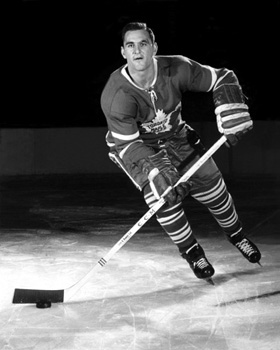
Orr’s story is just one of hundreds about pain and suffering that make up the hockey lore loved by so many fans. For those of a certain age, few forget the story of Leafs’ legend Bobby Baun scoring the winning goal on a broken leg in overtime in Game 6 of the 1964 Stanley Cup Final. He went on to play in Game 7 and win the Stanley Cup.
The long tradition of NHLers battling through injury to continue playing lives on today. Perhaps there is no better example than former Boston Bruins’ captain Patrice Bergeron in the 2013 Cup Final playing through torn rib cartilage, a broken rib, a separated shoulder and a collapsed lung. While the Bruins lost the Cup that year, his performance is regarded as one of the most resilient in NHL playoff history.
The Passion of the NHL Goaltender
No position absorbs suffering like the goalie. It’s always been that way. Think of Curtis Joseph in Toronto who will be remembered not for his excellence, but for what he didn’t win. In 1999 and 2002, “CuJo” backstopped the Leafs to the Eastern Conference Final with stellar play. Still, it wasn’t good enough to see his team close the deal and move on to the Stanley Cup Final. Those two years were as close to winning Lord Stanley’s silverware as the Leafs have come since 1967.
And who could forget Hall of Famer Roberto Luongo whose career will forever be overshadowed by his dreadful performances in Games 6 and 7 of the 2011 Stanley Cup Final against the Bruins. In the first, he allowed three goals on eight shots in the first ten minutes of the first period. In the second, he allowed three goals with his team going down to defeat 4-0 to lose the series.

Now in Ottawa, the Senators’ starting goalie Linus Ullmark is locked in a struggle with mental health challenges in very public fashion. Much to their discredit, many fans have blamed him for the team’s current woes and spread lurid and untrue rumours about the reasons for his absence.
By the very nature of their craft, goalies suffer alone and publicly. It makes them almost Christ-like in their suffering – often crucified and forsaken.
Fans Are Defined By Their Wounds
No fan base remembers joy in isolation. It only has meaning when set against memories of the pain and suffering that was endured to capture it, or that which comes after.
For fans of the Ottawa Senators, memories of their team’s magic 2015 “Hamburglar Run” are made all the sweeter when they recall how the Montreal Canadiens put an end to it all in the first round of the playoffs that spring. For the Canucks’ faithful, memories of losing the seventh game of the Stanley Cup Final in both 1994 and 2011 matter more than the stellar regular seasons that led them there. In Buffalo, a generation of Sabres fans was defined by the 1999 Stanley Cup-winning goal scored by the Dallas Stars’ Brett Hull that many say shouldn’t have counted.
Joy is never pure and always fleeting. It is made significant by the sting of failure. Wounds shape the character of hockey’s fans.
“Almost” – The Saddest of Hockey Stories
Hockey can seem obsessed with “almost”. Just ask the Flames after Game 6 of the 2004 Stanley Cup Final where a shot by Martin Gelinas looked like it had crossed the Tampa Bay Lightning’s goal line, but was disallowed. Tampa went on to win that game and the series.
In Edmonton, fans of the Oilers still talk wistfully of their team’s miracle run of 2006. That year, the eighth-seeded Oilers battled their way to the Stanley Cup Final against the Carolina Hurricanes, only to lose the seventh game 3-1.
In Ottawa, fans still lament the outcome of the 2017 Eastern Conference Final when they went down to defeat at the hands of the Pittsburgh Penguins in double overtime of the seventh game. They’ll recount how they were just one bounce, one goalpost, one overtime shift away from returning to the Stanley Cup Final.
Stories like these endure longer than tales of actual victories because they mirror the life we all lead – effort without guarantee of success. Even so, the satisfaction of having waged the good fight blunts the ache of coming so close to victory.
Hockey Both Honours and Punishes Loyalty
Loyalty often leads nowhere in hockey. Even so, it is held in the highest regard in the hockey world.
Think of Shane Doan who spent 20 seasons with the Phoenix Coyotes (later to become the Arizona Coyotes). He never got a whiff of the Stanley Cup and never asked for a trade to pursue one with another team. Mats Sundin spent 13 seasons with the Leafs before being allowed to drift off into free agency at the end of the 2007-08 season ending up with the Canucks for one last campaign in 2008-09.
Both players chose meaning over winning, even though that choice was a sacrifice. Neither realized their lifelong dream of thrusting the Cup over their head.
Hockey Culture Worships Pain
At the end of every season, reports emerge about the injuries players endured, especially those skating in the Stanley Cup Final. They are celebrated for hiding the injury and stoically enduring it. They are held up as what a hockey player should be.
Playing through broken ribs, overcoming concussions and blocking shots signify moral virtue. The story isn’t that a player was hurt – it’s that they kept going. They are hailed as warriors – the living embodiment of the hockey spirit.
Pain and Suffering Is Uniquely Hockey
It’s true that other sports celebrate dominance. But hockey celebrates survival. Perhaps that’s because of the country of its birth. In its early days, Canada was a harsh, unforgiving land of snow, ice and rugged terrain. For those who settled here, victory wasn’t conquering it, but rather just surviving it.
The same is true of hockey. NHL careers can be short, and bodies break. Games are low-scoring contests that are often decided by the random bounce of a puck. A season is long and grinding, and when it ends, a Stanley Cup champion must then win 16 of a possible 28 playoff games.
All of this means that the best hockey stories aren’t only about how good a player was. They are about how much they endured before it all came to an end.
The Meaning of Hockey
Hockey is designed to venerate suffering. Meaning is found in endurance, not triumph. Suffering in pursuit of victory tests and ultimately shapes character. In the realization that nothing worthwhile comes without struggle and sacrifice lies the game’s inspiration and the making of a great story.

