
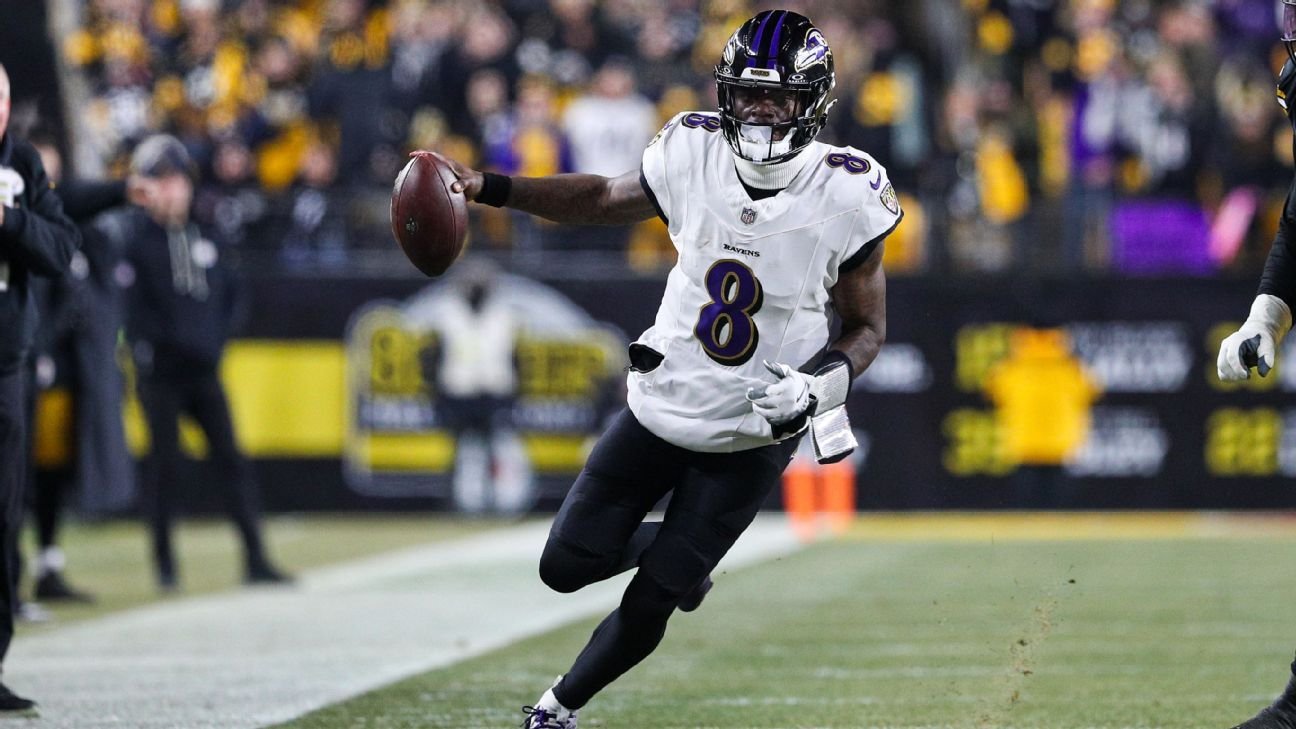
OWINGS MILLS, Md. — The clock is officially ticking on the Baltimore Ravens’ desired deadline with quarterback Lamar Jackson.
At the end of the season, Ravens owner Steve Bisciotti spoke to Jackson and stressed the urgency to get a contract extension completed by the start of free agency. The Ravens want to reduce Jackson’s ballooning $74.5 million salary cap hit — which is the second highest in the NFL — to free up room to re-sign their own free agents and pursue other available players to upgrade the roster after last season’s disappointing 8-9 season.
If Jackson chooses not to sign a new deal by the official start of free agency Wednesday, Baltimore can restructure the two-time NFL Most Valuable Player’s contract to create $30-plus million in cap room. But this move is problematic because it pushes a huge chunk of Jackson’s 2026 cap hit into next season, causes his 2027 cap figure to soar even higher and stirs up questions about his future with the Ravens.
Baltimore prefers to reach a new agreement with Jackson, who doesn’t have an agent and represents himself. By striking a deal, the Ravens can open up cap room and extend his contract beyond 2028, when he’s currently set to become an unrestricted free agent.
It’s clear that Jackson’s contact situation has significant ramifications. With a contract extension, the Ravens’ championship pursuit is prolonged. Without one, their relationship becomes complicated.
“You can play with that money all you want [by restructuring a contract],” Bisciotti said in January. “That’s not what we want. We want another window, and Lamar knows that.”

What would a new deal with Jackson look like?
Bisciotti’s hope has been this: plug a higher number in the same contract that he signed in April 2023 and move on.
How high should that number go? A year ago, when John Harbaugh was the Ravens coach, he made this prediction when discussing Jackson’s next contract: “When Lamar gets paid, he’s going to be the highest-paid player in football, just like he was last time.”
To become the NFL’s highest-paid player, Jackson would need to surpass Dallas Cowboys quarterback Dak Prescott, who is averaging $60 million per season on a four-year, $240 million contract he signed in September 2024. Prescott’s $80 million signing bonus also remains a league record. The most guaranteed money was given to Buffalo Bills quarterback Josh Allen, who totaled $250 million in guarantees in March 2025.
Jackson, 29, has two years and $104 million remaining on five-year, $260 million contract that he signed three years ago. At the time, his average of $52 million per year and his $72.5 million signing bonus both reset the quarterback market. Now, he ranks 10th among quarterbacks in average per year and fourth in signing bonus.
It took 27 months of challenging negotiations to get the last deal completed with Jackson. The sides don’t have that type of time right now, although Ravens general manager Eric DeCosta expressed optimism recently when asked if he was confident that a contract extension could be reached with Jackson.
“I am,” DeCosta said at the NFL combine last month. “I definitely am.”
What happens if Jackson doesn’t restructure his contract?
Jackson doesn’t have a say in the restructuring of his contract. There’s a clause in Jackson’s contract that says the Ravens can automatically lower his 2026 cap figure by converting a portion of his $51.25 million salary into a signing bonus and adding more void years.
The Ravens would then have to decide when they want to trigger the restructuring of Jackson’s contract and how much cap room they want to create by doing so.
Baltimore is projected to have between $9 million and $12 million in salary cap room heading into free agency, and DeCosta mentioned that Jackson’s contract isn’t necessarily the big domino in the team’s offseason plans. It doesn’t sound as if Baltimore has to restructure Jackson’s contract next week because of a desperate need for cap space.
“We never have as much cap room as we’d like to have,” DeCosta said. “But we feel like we can start at the beginning of the new league year and conduct business.”
If the Ravens want to create as much cap space as possible in restructuring Jackson’s contract, they would gain nearly $38 million in additional cap room by spreading out $50 million cap hit over his final two years of his contract and two void years. The good news is Baltimore would lower Jackson’s 2026 cap figure from $74.5 million to $37 million. The bad news is Jackson’s 2027 cap number would jump to $87 million, which would be the highest in the NFL.
What happens next offseason if there’s no contract extension?
This is when the drama really begins. Without a contract extension, Jackson would enter next offseason with one year left on his current deal.
If Jackson bounces back from a disappointing 2025 season, he would have all the leverage in a quarterback market that could explode. In 2027, four of the league’s best young quarterbacks — Caleb Williams, Jayden Daniels, Drake Maye and Bo Nix — are all eligible for contract extensions for the first time.
The pressure would be on Baltimore to get a deal done with Jackson or risk losing him to free agency a year later. The Ravens can’t use the franchise tag to keep Jackson from becoming a free agent the way they did in 2023 because he has a no-tag clause in his contract. If Baltimore would try to trade Jackson, he would have to sign off on where he would go because he also has a no-trade clause.
The other incentive to go into 2027 without a contract extension is it will give Jackson more time to decide if he wants to stay with the Ravens, who hired a new head coach in Jesse Minter and a new offensive coordinator in Declan Doyle this offseason.
Would it be a risk for Jackson to set his sights on becoming a free agent in 2028?
There’s always a gamble when projecting a player’s value two years from now, especially one like Jackson who will turn 31 in 2028 and has taken more hits (1,234) than any other quarterback since 2018. But it’s rare that a quarterback with Jackson’s résumé ever reaches free agency.
Jackson has proved he can still play at a high level despite the sustainability concerns that surrounds dual-threat quarterbacks. It was only two years ago when Jackson recorded career highs with 4,172 yards passing and 41 touchdown passes.
But durability has been an issue with Jackson. He has sat out at least four games because of injury in three of his past five seasons, including four last year because of a hamstring injury and a back bruise.
There have been some quarterbacks who’ve been mobile earlier in their career who’ve played into their late 30’s like Russell Wilson. There are other dual-threat quarterbacks like Cam Newton who were out of the league at 32.
If Jackson wants to test free agency for the first time in his career, he has to play out the final two years of his current contract. No one knows whether Jackson is even contemplating this because he doesn’t have an agent.
The last time Jackson was asked about his contract situation was at minicamp nine months ago.
“I don’t want to talk about it, if that’s OK with you,” Jackson said.
When asked if becoming the NFL’s highest-paid player sounds good to him, he replied, “It sounds good.”
