
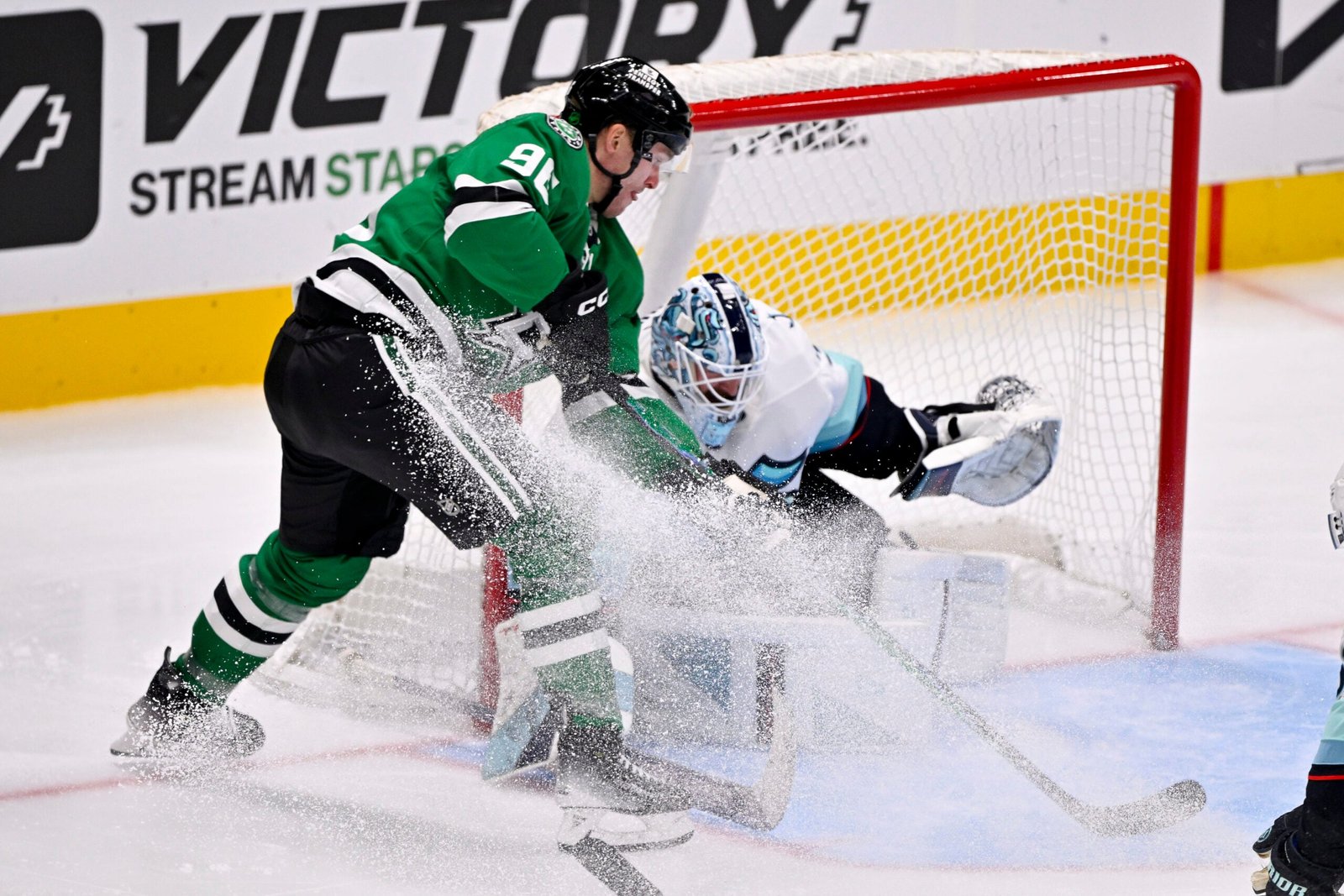
The Dallas Stars sit at 42-14-10, three points behind the Central Division-leading Colorado Avalanche, and have not lost in regulation in 15 games. All of that without the 6-foot-4 winger the franchise committed $96 million to last March. Mikko Rantanen skated on his own for the first time on March 10 and is targeting a return around March 24. The combination of the Stars looking strong going into the playoffs, combined with their main star set to return, leads to a lot of possibilities for the postseason and the winner of the Presidents’ Trophy.
The Injury and the Timeline
Rantanen sustained a lower-body injury in Finland’s Olympic semifinal against Canada on Feb. 20. The ailment kept him out of the bronze medal game against Slovakia, which Finland won 6-1. He was placed on injured reserve retroactive to that date and had not skated until 18 days later.
Coach Glen Gulutzan described the play as a freak incident in the final shifts of the Canada game, someone falling on Rantanen with no malice involved. Gulutzan’s latest update projects a return in two to two and a half weeks from March 10, which lines up with a home game against the New Jersey Devils on March 24 or a road trip to the New York Islanders on March 26.
An interesting note on that Islanders matchup. Earlier this season, Rantanen drove Alexander Romanov into the boards and caused a significant injury. Islanders coach Patrick Roy was publicly furious and promised a response the next time the teams met.
Stars’ Run Without Their Finnish Forwards
The numbers are difficult to argue with. Since the NHL resumed play after the Olympic break, the Stars have gone 14-0-1. That point streak matches the franchise record set by the 1998-99 Stanley Cup team. They have done it while missing Rantanen, Roope Hintz (lower body, out since March 6), Tyler Seguin (knee, done for the season), and Radek Faksa (Olympic injury with a subsequent setback). That is three of the top six forwards and the regular checking center, all unavailable at the same time.
Related: 3 Takeaways From Stars’ 7-2 Beatdown of Oilers
Wyatt Johnston has filled the space with a career season: 36 goals and 73 points, including seven goals and 14 points in the nine post-Olympic games. Mavrik Bourque has slid into a top-six role and averaged a point per game across his last nine appearances. The deadline acquisitions of Michael Bunting from the Nashville Predators and Tyler Myers from the Vancouver Canucks were made specifically to address the Olympic injury fallout. General manager (GM) Jim Nill was direct about the calculus: “Because of the injuries, that’s why we had to make the moves we made.”
This is not a team that seems to be suffering without their star player. Jake Oettinger has been steady in net. Miro Heiskanen and Esa Lindell returned from Milan and resumed anchoring the defense without missing a step. The power play, the best home unit in the league, has scored in 12 consecutive games. Dallas’s structure is doing what good structure does: absorb absences and keep winning.
What Changes When Rantanen Returns
Before the Olympics, Rantanen had points in five straight games and was producing at a 1.28 points-per-game clip (69 points in 54 games), close to his career-best 1.30. His Olympic performance confirmed the form: two goals and four assists in five games for Finland before the injury ended his tournament. None of that production vanished. It is sitting on injured reserve, waiting to re-enter a lineup that has gotten deeper in the meantime.
Related: Where Arttu Hyry Fits in the Dallas Stars’ NHL Picture Going Forward
Adding his catch-and-release shot back into the right circle on the power play is a tier change for a unit that is already converting at an elite rate. At five-on-five, his puck protection and vision on cycle plays give Dallas a dimension that Johnston and Bourque, for all their growth, do not replicate. That combination is why he posted nine goals and 22 points in 18 playoff games last spring, including a hat trick in Game 7 against the Avalanche.
The main risk with any returning player is rust and fit. By the time Rantanen returns, he will have missed roughly seven weeks of game action. Dallas has the standings cushion (94 points, second in the Western Conference) to manage his minutes through late March and early April without forcing him into high-leverage situations before he is ready.
The Hintz Factor
Hintz compounds the equation. He returned from illness on March 6, played one game against Colorado, and then suffered a lower-body injury after getting tangled with Nathan MacKinnon along the boards. No surgery is required. The team is hopeful he returns before the playoffs. His 15 goals and 29 assists in 53 games understate his value as Dallas’s top center and primary penalty kill forward. Both Rantanen and Hintz were hurt in sequences involving MacKinnon within weeks of each other.
What Comes Next
Rantanen’s skate-to-game ramp is the specific thing to track. If he returns March 24 against New Jersey and looks fluid, Dallas enters the playoffs with a forward group deeper and more tested than any version it has iced this season. Johnston’s breakout is not going away. Bunting adds a net-front presence that did not exist before the deadline. Layer Rantanen and (eventually) Hintz back on top of that foundation, and this is the most complete Stars roster since before the Logan Stankoven trade. The Finnish engine does not need to carry the car anymore. It just needs to run smoothly, like they have shown they can.

