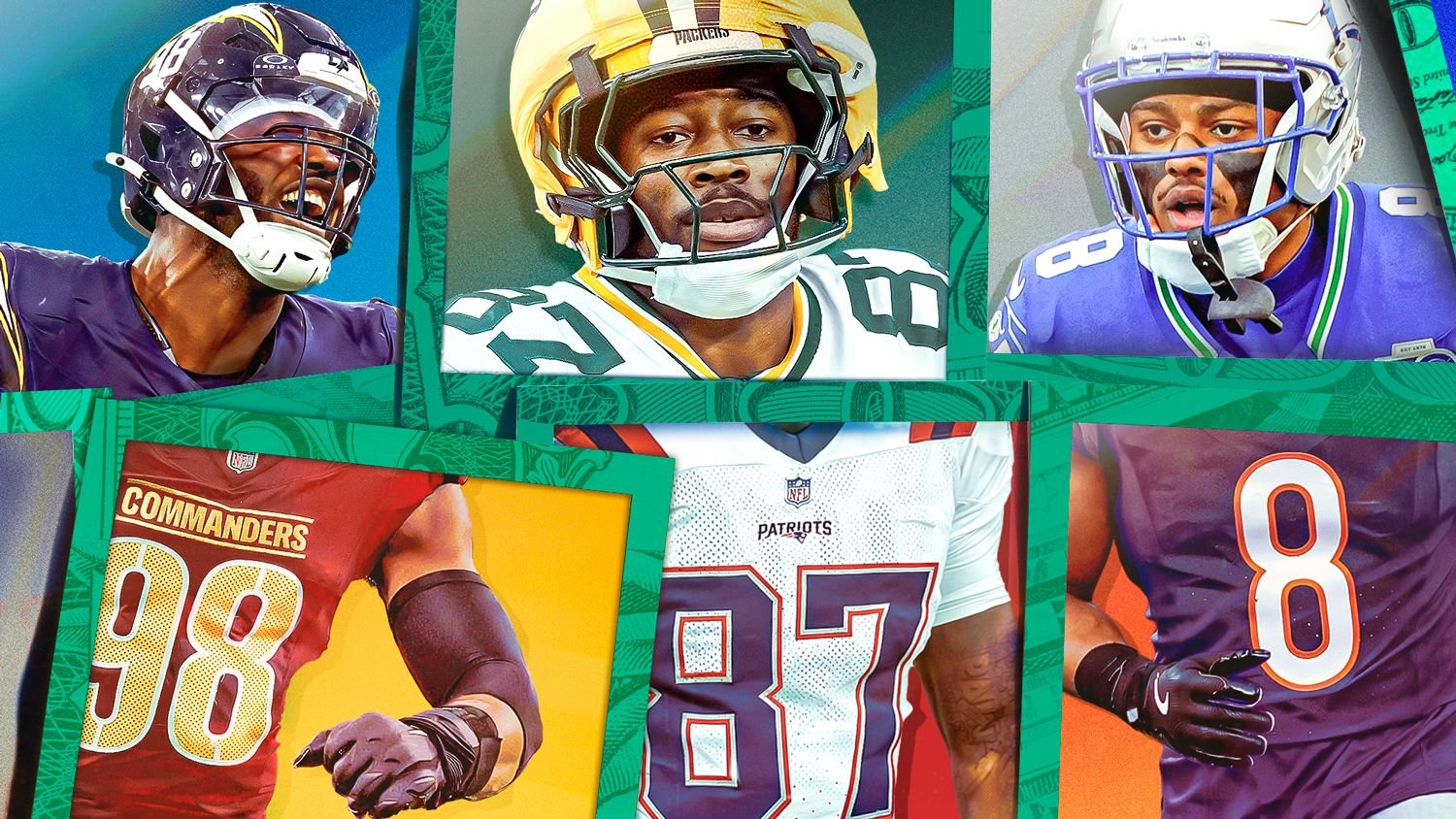
All right … NFL free agency should be over now. Of course, we aren’t quite there. Players such as Jauan Jennings, Kirk Cousins, Stefon Diggs, Calais Campbell, DJ Reader, Deebo Samuel, Aaron Rodgers, Haason Reddick, Joey Bosa and Cameron Jordan are all still unsigned and available.
But at some point, we have to sit down and take stock of how the NFL has done since the new league year began. So, I ranked all 32 teams’ free agency performances across signings, re-signings and trade acquisitions. I also tried to take into account departed talent.
These rankings are highly contextual. Any list of “the most improved teams in free agency” would start with the likes of the Raiders and Titans … who incidentally were the teams that had the most money to spend. Instead, I tried to rank the teams for:
-
The value they got for the money they spent
-
The flexibility of their roster approaching the draft
-
The contract details that provide them leverage
-
How they manipulated the compensatory pick formula
-
What they could have done but didn’t do
So, let’s get to it. Here’s 2026 NFL free agency by team, ranked 1-32.
Jump to:
ARI | ATL | BAL | BUF | CAR | CHI | CIN
CLE | DAL | DEN | DET | GB | HOU | IND
JAX | KC | LAC | LAR | LV | MIA | MIN
NE | NO | NYG | NYJ | PHI | PIT | SF
SEA | TB | TEN | WSH


Key acquisitions and returning players: Michael Pittman Jr., Rico Dowdle, Jamel Dean, Jaquan Brisker, Sebastian Joseph-Day, Asante Samuel Jr.
I loved: Getting Pittman on the late-round pick swap. The Colts were always going to trade him after they re-signed Alec Pierce, so they didn’t have a ton of leverage. And because Pittman is a true possession receiver, he needed to go to a team with a ton of targets to give out. There aren’t many such teams. But Pittsburgh is a great fit for him, as he pairs well with DK Metcalf (who is definitely a Steeler in 2026) and Aaron Rodgers (who is probably a Steeler in 2026).
The Steelers signed Pittman to an extension after the trade that guarantees him some money, which was an unnecessarily early commitment to his future on the roster, but a sixth-seventh pick swap for a starting receiver is great business.
I didn’t love: Nothing. It was a ton of doubles for Omar Khan and the Steelers’ brass. Dowdle has consistently proved he can moonlight as an RB1 if needed, and he has receiving chops in a committee. Dean is coming off a career year, but the Steelers didn’t pay him like he’s a CB1, so they might get a nice bargain there. Joseph-Day is a perennially valuable rotational defensive tackle, and Samuel looked healthy in the limited time he played last season. Brisker is a low-risk gamble on another health question mark in a secondary that needs depth to maximize Jalen Ramsey’s versatility. Great work this year.

Key acquisitions and returning players: Mike Evans, Osa Odighizuwa, Christian Kirk, Dre Greenlaw, Nate Hobbs, Eddy Pineiro
I loved: The Evans deal. This was one of the most team-friendly signings in this free agency period. With only $14 million guaranteed at signing and most of his 2027 and 2028 money tied into option bonuses, the 49ers are committed to Evans for only one season, which would be important should he look completely unplayable in his age-33 season. Far more likely, Evans should fill a valuable role of vertical specialist, third-down stick mover and red zone matchup nightmare.
Remember the short-yardage issues that the Niners endured against the Seahawks’ stifling run defense? Evans is the answer to that. If he’s even 75% of his prime self, the 49ers got an enormous deal on a ring-chasing veteran leader.
I didn’t love: Nothing. The Odighizuwa trade was an enormous boon. A third-round pick for a rising 28-year-old with three years of team control at a premium position of massive need? Home run! And the fliers on Hobbs and Greenlaw should be exactly the shot in the arm this defense needs. At worst, they will play rotational roles; at best, they could return to starting form.
I had WR depth questions, too, but in comes Kirk. If the 49ers can just keep Trent Williams in the building for one more year and get full recoveries from Mykel Williams (knee) and Nick Bosa (knee), I’ll be a full believer.

Key acquisitions and returning players: Cade Mays, D.J. Wonnum, Larry Borom, Isiah Pacheco, Rock Ya-Sin, Roger McCreary, Juice Scruggs
I loved: The dart throws. Detroit has more needs than it has money to throw around, but it did extremely well to take high-upside swings in the margins. Pacheco can’t be 100% of what David Montgomery was for them, but the Lions don’t want that anymore — they want a capable short-yardage, pass-protecting back to relieve Jahmyr Gibbs, and they got that for near the veteran minimum.
The Lions also got a functional starter at center in Mays for $8 million per year in an offseason in which the center market was exploding. Wonnum is ideally a No. 3 edge instead of a No. 2 option, but opposite Aidan Hutchinson, he can fill the Al-Quadin Muhammad shoes and then some. At corner, McCreary can start if he’s healthy, too. This class is filled with great value.
I didn’t love: Left tackle. Larry Borom is a good swing backup, but the Lions don’t want to live in a world where he starts 17 games on Jared Goff’s blind side. Goff, for all of his improvements and strengths, is simply not a springy mover. He needs clean pockets. With the 17th pick, the Lions are squarely in contention for a franchise left tackle, and I’d put a lot of theoretical chips on that being their first-round target.

Key acquisitions and returning players: David Edwards, Travis Etienne Jr., Kaden Elliss, Noah Fant
I loved: The overall approach. The Saints didn’t have a ton of cap space, as they’re still extricating themselves from void years of seasons past. But the light is on the horizon, and what space they had they used well.
Edwards is an older player, but guards can age well, and he was the most talented player on the market at that position. Etienne isn’t enough of a playmaker to be a dominant three-down back, but he’s an excellent 1A in a committee, bringing a well-rounded skill set. Elliss is a uniquely good blitzer who will give defensive coordinator Brandon Staley a useful curveball as an off-ball/on-ball hybrid. The Saints gave out only three significant contracts, but I like all three.
I didn’t love: Wide receiver depth was an issue in New Orleans even before Rashid Shaheed was traded at the deadline last year. Chris Olave (156 targets) rightfully dominates when he’s healthy and available, and Juwan Johnson (102 targets) enjoyed a little breakout as a high-volume stick mover. But Shaheed (66 targets) still ended the season as the third-highest target getter, and running back Alvin Kamara (fourth with 39 targets) has an uncertain future with the team.
The Saints desperately need a big-bodied receiver who can take six or more targets per game, and 10-plus when Olave misses time. Ohio State receiver Carnell Tate at No. 8 overall, anyone?

Key acquisitions and returning players: Jaylen Waddle, J.K. Dobbins, Alex Singleton, Adam Trautman, Justin Strnad
I loved: The Waddle trade. This is the sort of move that contending teams in rookie QB contract windows should make. With the 30th pick in a weak draft class, the Broncos were unlikely to get a needle-moving player for 2026. Instead, they used that pick (and a middle-round pick) to get Waddle. He’s a sudden playmaker with great deep speed, and he’s only 27 and comes with three years of team control. Waddle gives Denver more punch — not just for one season but for multiple years to come. Bo Nix needed a better target against zone coverage and a more dangerous YAC receiver. Terrific trade for Denver.
I didn’t love: Running it back at linebacker. My biggest complaint about the Broncos’ offseason was the lack of aggressive moves pre-Waddle trade. Now that they’ve made their big change, I’m largely pacified. I do think that the Broncos’ linebackers were often exposed in man coverage last season, and with both Singleton and Strnad back in-house, teams with good pass-catching backs will continue stressing Denver’s second level. But this was a great defense last season and should be a great defense again, even with that wart considered.
1:56
How Jaylen Waddle’s trade to Denver transpired
Adam Schefter joins “The Pat McAfee Show” and details the Dolphins’ decision to trade Jaylen Waddle to the Broncos for two first-round picks.

Key acquisitions and returning players: Alijah Vera-Tucker, Romeo Doubs, Reggie Gilliam, Dre’Mont Jones, Kevin Byard III, Julian Hill
I loved: The value plays. The Patriots are taking high-upside swings without paying big salaries. Doubs is being paid like an every-down WR2 but might have a higher ceiling as a WR1 now that he’s out of Green Bay’s spread-the-wealth offense; he certainly doesn’t prevent the Patriots from continuing their pursuit of A.J. Brown. Vera-Tucker got a bigger financial commitment than I expected, but he was nearly an All-Pro talent at guard with the Jets. Offensive line shuffling and injuries have robbed him of his best play.
Even the Gilliam signing stands out as an example of the Patriots’ continued excellence in evaluating their own roster; incumbent fullback Jack Westover lost too many reps in the hole last season. Mike Vrabel’s greatest strength continues to be his nose for personnel.
I didn’t love: The results of the defensive carousel. The Patriots replaced Jaylinn Hawkins with a Vrabel favorite in Byard, and I’m not sure betting on the 33-year-old to maintain his All-Pro form from last season is a reasonable alternative. And although Jones is certainly a step up from K’Lavon Chaisson in run defense, I think the Patriots will miss Chaisson’s speed off the edge.
Neither signing is bad in a vacuum. But New England lost a lot of snaps from a defense that dramatically exceeded expectations in 2025, and that sort of shake-up can be tough to endure.

Key acquisitions and returning players: Tyler Linderbaum, Quay Walker, Nakobe Dean, Jalen Nailor, Eric Stokes, Kwity Paye, Taron Johnson
I loved: Double-dipping at linebacker. The starting LB market is pretty reasonable, as both Walker and Dean got less money than players like Cor’Dale Flott, Bradley Chubb and Alijah Vera-Tucker. Walker and Dean were teammates at Georgia and complemented one another nicely. The Raiders’ linebacker play was unspeakably poor last season, and anything less than a total overhaul would have limited the defense.
There are still question marks at defensive tackle and outside corner, but don’t be surprised if the Raiders’ defense is a fringe top-10 unit now — at least as long as Maxx Crosby is back for another year.
I didn’t love: Paying Linderbaum 150% of Creed Humphrey’s deal. All of the context behind the Linderbaum number makes perfect sense. The Raiders had money to burn. They prioritized center because of their incoming rookie quarterback. Center was wrongfully a cheaper market than guard and deserved a splash of cash. All totally sound. He’s going to make the team better.
With that said, $27 million per year is an enormous leap, and it’s basically all guaranteed. This is one of the biggest “agent win” deals of the cycle. Even with all the data considered, I simply would not have done this deal for Linderbaum were I in general manager Jon Spytek’s shoes.

Key acquisitions and returning players: Odafe Oweh, Rachaad White, Leo Chenal, Amik Robertson, K’Lavon Chaisson, Chig Okonkwo, Tim Settle Jr.
I loved: Filling out the roster. GM Adam Peters wasn’t active at the top of free agency, but he was in the middle tiers, peppering the roster with rotational players who could start in a pinch. Robertson and Chenal in particular stand out as players who can win starting jobs and provide a much-needed jolt of speed and tackling to a Commanders defense that gave up more yards after missed tackles than any defense save for Cincinnati last season (per NFL Next Gen Stats). Even guys like Settle and Okonkwo can have big impacts as 30-40% snap getters. Great cycle.
I didn’t love: The Oweh signing. Going to $25 million per year for Oweh, who was the third edge rusher in Los Angeles and played only about 50% of the snaps, is an enormous bet. It felt at the time and still feels now that the Commanders got priced out on Jaelan Phillips and pivoted to Oweh with a ton of cash at the table.
It’s not the worst thing, and it happens a bunch in free agency. But I’m interested to see the sort of defense that first-time coordinator Daronte Jones runs, because spending this much money on an edge rusher who doesn’t really defend the run on a defense that blitzes a ton just doesn’t make sense to me.
Key acquisitions and returning players: Chris Rodriguez Jr., Montaric Brown, Dennis Gardeck
I loved: The compensatory pick approach. Those three players above are the only ones the Jaguars signed in this free agent period. Brown and Gardeck are internal retentions, which don’t count against the comp pick formula; Rodriguez’s deal is so small that it also doesn’t count against the Jaguars. OverTheCap projects Jacksonville to receive fourth-, fifth- and sixth-round selections for the departures of Devin Lloyd, Travis Etienne Jr. and Greg Newsome II. Don’t be surprised if GM James Gladstone is active at next year’s trade deadline in anticipation of the picks the Jaguars will receive.
I didn’t love: There’s little to complain about when the whole point of the period is to do nothing. The team clearly needs pass rush help and doesn’t have an obvious in-house heir to Devin Lloyd’s role at linebacker, but I’d expect the Jags to continue watching for releases and trade opportunities to fill those spots before September. They’ll slide lower if that doesn’t come to fruition, but I’m ranking on faith here.

Key acquisitions and returning players: Kyler Murray, Eric Wilson, James Pierre, Carson Wentz, Ryan Van Demark
I loved: The Murray deal. Of course I did. It’s the best signing of any team this cycle. Murray on a veterans minimum contract ($1.3 million) does more than just provide the Vikings with desperately needed cap relief as they unspool their aggressive spending of the past few offseasons. It also gives them a playoff-caliber quarterback.
Murray has a stronger history of recent quality play than quarterbacks like Baker Mayfield or Sam Darnold did before they kicked off their career restarts. The Vikings had one of the three worst quarterback rooms in the NFL last season, and now they have at least a league-average starter. Enormous, enormous leap at the most important position on the field.
I didn’t love: The Wilson extension. He was lights out in 2025. Brian Flores clearly trusts him, and the cost ($7.5 million per year) is small enough that it’s a fairly harmless investment. But a breakout season at 31 years old is generally worthy of suspicion. If Wilson just caught unsustainable fire last season and now returns to his career-average level of play — depth LB, special-teamer — then the Vikings have two 30-plus-year-old linebackers with little behind them.

Key acquisitions and returning players: Riq Woolen, Arnold Ebiketie, Hollywood Brown, Jonathan Jones, Dallas Goedert, Johnny Mundt, Elijah Moore, Marcus Epps
I loved: How general manager Howie Roseman walked the line of an A.J. Brown trade. He kept his asking price high and kept the cap open by delaying Goedert’s void date, which centralized Brown in the WR trade market. Although no deal got done, the Broncos-Dolphins Jaylen Waddle trade certainly strengthened the Eagles’ case for getting a first-round pick for Brown (who is only a year older than Waddle).
We’ll wait to see which teams remain in need of a star receiver after June 1, when the cap hit of a Brown trade becomes far more palatable. The hay isn’t in the barn yet — the Eagles still need a dance partner come June. But Roseman is playing this well.
I didn’t love: The lack of moves at safety. The Eagles lost Reed Blankenship — who has been a paragon of availability — and made no major moves to replace him. They even traded away backup Sydney Brown to the Falcons for a paltry rise in draft capital. Veteran Marcus Epps returns on a one-year deal to start beside rising sophomore Andrew Mukuba, with only career special teamers and potential nickel-to-safety converts on the depth chart behind them. This is one of the worst safety rooms in football as it currently stands, and it’s not a position to take lightly in a Vic Fangio defense.

Key acquisitions and returning players: Trent McDuffie, Jaylen Watson, Kam Curl
I loved: The fearlessness. I enjoy watching an uncorked Les Snead wheeling and dealing his way into building quick contenders. The Rams don’t get any bonus points here for “winning” what I thought was an even Trent McDuffie trade. But McDuffie is a scheme fit, and the Rams are on an expiring Matthew Stafford timeline, so they do get points for making an aggressive trade when an aggressive trade was justified.
The acquisition of Watson, who brings a press coverage skill set that was noticeably absent in Los Angeles last season, is compounded by his familiarity with McDuffie. Those two will help one another hit the ground running in a new system.
I didn’t love: Nothing at receiver … yet. I don’t think they need a splash so much as they need security. The Rams’ receiver duo of Puka Nacua and Davante Adams dominates target share when on the field: Nacua led all receivers last season with a 37% target rate on routes run, and Adams was 14th at 27%. Although I like Konata Mumpfield as a developmental receiver, the Rams need a WR3 who can shoulder the load for a month should Nacua or Adams get banged up. Deebo Samuel feels like a fun fit, but the Rams have been focused on getting younger as of late.

Key acquisitions and returning players: Reed Blankenship, Braden Smith, David Montgomery, Wyatt Teller, Sheldon Rankins, Ed Ingram
I loved: The Blankenship deal. The Texans’ secondary was one Infinity Stone away from reaching maximal power, and that empty spot was the strong safety position. Blankenship isn’t a perennial Pro Bowl talent, but he just needs to be a well-rounded, assignment-sound leader playing next to star young’uns like Calen Bullock, Derek Stingley Jr. and Kamari Lassiter. Blankenship signing for only $8.25 million per year mere days after Kam Curl got $12 million per year and Jalen Thompson got $11 million per year is a huge feather in Nick Caserio’s cap.
I didn’t love: The individual moves along the offensive line (even if I liked the number of moves made). It’s good that the Texans continued hammering their line with options. They retained Trent Brown and signed Smith at tackle. They retained Ingram and signed Teller at guard. But I still struggle to figure out how it all comes together. They’ve typically prioritized supersized tackles … so is Smith — an undersized tackle — really moving to guard? How does he fit with Teller and Ingram, then?
Plus, this line is built for run blocking. Are Montgomery and Woody Marks capable of being the engine of a dominant rushing attack? The Texans are acknowledging and addressing the problem, but I still need to see it to believe it in Houston.

Key acquisitions and returning players: Coby Bryant, Devin Bush, Garrett Bradbury, Braxton Jones, Neville Gallimore, Cam Lewis
I loved: The Bryant signing. Chicago endured an avalanche of departures in the defensive backfield, as Nahshon Wright (1,177 snaps), Kevin Byard III (1,220), Jaquan Brisker (1,221) and C.J. Gardner-Johnson (612 snaps) have all signed elsewhere this cycle. The Bears needed a starter at safety — a new culture-setter and leader — and Bryant was one of my favorite free agents of the cycle. He’s highly versatile, has explosive stopping power as a tackler and shows great on-field instincts. He’s going to shine for coordinator Dennis Allen.
I didn’t love: How the chips fell at offensive line. The Bears were put in a tricky spot by a brutal patellar injury to left tackle Ozzy Trapilo and then a surprise retirement from center Drew Dalman. Bradbury is a good quick solution at center, but NFC North fans will remember his struggles in pass protection when he was with the Vikings. The Bears still might improve upon him in the draft.
Returning Jones at left tackle is another acceptable Band-Aid. The hope there is that his 2025 season was never healthy, and he’ll return to 2024 form. But Chicago’s line, which was generally very healthy last season, is now thinner. The Bears need to nail this position at the draft.
0:46
Schrager: Devin Bush a great signing for Bears
Peter Schrager is a big fan of the Bears signing LB Devin Bush.

Key acquisitions and returning players: Tua Tagovailoa, Kyle Pitts Sr., Jahan Dotson, Olamide Zaccheaus, Austin Hooper, Samson Ebukam, Brian Robinson Jr.
I loved: Getting Tagovailoa. Although I’ve generally been a doubter of Tagovailoa and critical of the Dolphins for the extension they gave him, there’s no doubt that he’s far, far better than a veterans minimum contract ($1.3 million). The QB of 2027 and beyond might not yet be on the Falcons’ roster, but adding Tagovailoa gives the team a second dart throw at functional QB play in 2026. With that offensive line and the collective talent of Pitts, Drake London and Bijan Robinson, the Falcons’ offense might surprise people next season.
I didn’t love: The CB2 approach. I know the market for starting cornerbacks has taken a big leap, but I thought the Falcons would add some competition to the CB2 spot opposite A.J. Terrell Jr.
Mike Hughes, who was extended last offseason, was an oft-targeted weak point last season. Darnay Holmes, the only veteran addition, is likely more slot insurance behind Billy Bowman Jr. than a legit candidate to play outside. Atlanta doesn’t have a first-round pick this year, so it’ll likely be a middle-round pick challenging Hughes for those snaps.

Key acquisitions and returning players: Isaac Seumalo, Tyler Allgeier, Gardner Minshew, Kendrick Bourne, Roy Lopez
I loved: The midlevel deals. The Cardinals got solid value for Seumalo, who is a better player than higher-paid free agent guards like Ed Ingram and Zion Johnson. He is just older (turning 33 in October) and thereby less attractive on the open market.
And although I’m surprised the Cardinals pursued Allgeier when his skill set is fairly redundant with James Conner (who they retained on an adjusted one-year deal), they got a good player on an affordable contract.
I didn’t love: The plan at quarterback. I’d guess the Cardinals checked in on Malik Willis’ market but were unwilling to pay him a contract as large as the Dolphins’ offer — a fair and prudent choice. But I sure wish there was a Plan B somewhere between Willis and signing Minshew to compete with Jacoby Brissett! What year is it? 2021? The Cardinals are at least still able to draft a middle-round quarterback or trade for a young passer before camp, which would improve their stock here.

Key acquisitions and returning players: Jaelan Phillips, Devin Lloyd, Rasheed Walker, Luke Fortner
I loved: The Walker deal. One of the most team-friendly contracts of the 2026 cycle is the one-year, $4 million deal Walker signed with the Panthers (incentives can get it up to $10 million). A multiyear starter at left tackle, Walker is far from a perfect player. He’s far better in pass protection than moving folks in the running game. But a starting tackle is still a starting tackle! Walker is on essentially a prove-it deal, trying to show he can hang outside of Green Bay’s offense. He’ll provide critical insurance for the Panthers as they wait to see Ikem Ekwonu’s return from injury.
I didn’t love: The Phillips deal. Last offseason, the Panthers thought they had a blockbuster deal in place for an Eagles defensive lineman … then the Patriots swooped in and paid Milton Williams $26 million per year, and the Panthers watched glumly as he played in a Super Bowl for New England. No mistakes this time: Carolina put $30 million per year on the table for Phillips, along with $60 million in full guarantees. The deal is essentially a two-year, $60 million commitment, so it won’t debilitate the Panthers’ cap if Phillips gets hurt (he has two season-ending injuries in the past three years).
The Panthers desperately needed edge rushing help, and Phillips’ run-defending prowess will make Ejiro Evero’s defensive structure a lot more functional on run downs. But man … that’s a lot of cash.

Key acquisitions and returning players: Geno Smith, T’Vondre Sweat, David Onyemata, Demario Davis, Dylan Parham, Kingsley Enagbare, Joseph Ossai, Nahshon Wright, Minkah Fitzpatrick, Dane Belton … is that everyone? No, wait … Max Mitchell, Andre Cisco
I loved: The one-year commitments. The only players to get guaranteed money beyond the first year of their contracts with the Jets this year were Ossai and Davis. Jets GM Darren Mougey continues to admirably accept the long-term reality of New York’s rebuild.
The Jets do not need to soften their roster and “tank” (which of course is not even a real thing in the NFL). They have the future draft capital to trade up in the first round in 2027, when they’re likely to target a starting quarterback. And the Jets are currently projected to be second in 2027 cap space, which will allow them to extend any of these prove-it players who break out (looking at you, Enagbare) while also loading up the roster around that rookie quarterback.
I didn’t love: Doing nothing at receiver. Almost all of the Jets’ moves were centralized on fielding a functional defense, which is reasonable. But I’m stunned that they were OK running it back with Adonai Mitchell as WR2 (and quasi-WR1 when Garrett Wilson is banged up). Although there’s no receiver worth the second pick, it seems inevitable that the Jets will use that 16th selection to either move up or down for a viable wideout opposite Wilson. Ideally, they’ll make multiple middle-round picks at the position, as well — they have no depth at all.

Key acquisitions and returning players: Boye Mafe, Jonathan Allen, Bryan Cook, Joe Flacco
I loved: Getting Mafe. The top of the edge market got much bigger money than I expected across the board. The Bengals took the smallest risk with Mafe’s three-year, $60 million deal. As always with Cincinnati’s contracts, all of Mafe’s guarantees are in Year 1 of his deal, which means the team can cut bait easily if he underperforms. But Mafe has the size and toughness to win against the run, and his pressure numbers as a rotational player in Seattle detail an eight-plus-sack player on full-time snaps.
I didn’t love: Leaving linebacker untouched. I understand that the Bengals are bullish on their duo of 2025 draft picks at linebacker. But Demetrius Knight Jr. and Barrett Carter were victimized by opposing offenses on a weekly basis last season, and banking on two second-year leaps (including one for a Day 3 pick) is an enormous gamble at the position. Adding another rookie, even highly drafted, doesn’t solve the experience issue. The Bengals need a veteran in this room.

Key acquisitions and returning players: Rashan Gary, George Pickens, Jalen Thompson, Cobie Durant
I loved: Keeping Pickens on the tag. He would have made somewhere near $40 million per year in free agency. Instead, the Cowboys get another crack at a passing offense centralized on CeeDee Lamb, Dak Prescott and Pickens. Prescott generated 141.9 EPA on targeted passes (not throwaways) this past season, and Pickens and Lamb accounted for 67% of that output. The trio has a chance to be among the league’s best. With a new defensive coordinator and an improved defensive depth chart, Dallas is a sneaky team to make a deep playoff run in this one-year window.
I didn’t love: The failure to address linebacker. It wasn’t for lack of trying; as ESPN’s Todd Archer reported, Dallas was “deep into talks with Quay Walker and Nakobe Dean,” both of whom ended up Raiders. The current talent at linebacker is prohibitive to a playoff defense. With Marist Liufau moving to an on-ball role, the Cowboys have only three rostered off-ball linebackers, and DeMarvion Overshown is still rounding into form following his major 2024 knee injury.
Dallas needs a big trade or an early draft pick that hits. That should be doable in a solid draft class and with an extra first-round pick to play with, but it’s never good to enter April with this dire need.

Key acquisitions and returning players: Zion Johnson, Elgton Jenkins, Tytus Howard, Teven Jenkins, Quincy Williams, AJ Epenesa
I loved: Taking the leap on Elgton Jenkins. His fall-off in Green Bay was peculiar. A Pro Bowl-caliber player at left guard who got All-Pro votes to boot, Jenkins got bumped into center when the Packers signed a big-money free agent guard in Aaron Banks. He even held out of offseason workouts to pursue an amended contract following Banks’ signing. His play at center was only average, but the Browns seem destined to keep him there, in that they signed Jenkins after Johnson, a left guard on a much bigger contract.
I think sour grapes spoiled Jenkins’ 2025 season in Green Bay, and he could be one of the biggest free agent steals of the cycle — a win Cleveland desperately needs on its accounting sheet.
I didn’t love: That Johnson deal. He is one of those players who always makes way more in free agency than the fans of his previous team can believe. To Cleveland, Johnson is a young (only 26!), athletic guard with a ton of experience and durability (65 starts over four years). To Los Angeles, he’s the first-round pick who constantly struggled in pass protection in key moments.
I thought the Browns would sign cheaper deals on the offensive line, anticipating a long road to cap recovery once Deshaun Watson is inevitably released. I still don’t understand why they became the team to make Johnson the 15th-highest-paid guard in the league.

Key acquisitions and returning players: Alex Anzalone, Cade Otton, Kenneth Gainwell, A’Shawn Robinson, Al-Quadin Muhammad
I loved: Passing on the top of the edge market. I know Bucs fans were hoping for a Maxx Crosby trade or a Trey Hendrickson signing, but I think the edge rusher market got out of control this offseason, and I don’t fault GM Jason Licht for skipping out. Tampa Bay still needs more at the position, but Muhammad and Yaya Diaby are two good rotation guys, and David Walker (2025 fourth-round pick) still has his rookie season upcoming as he returns from a summer ACL tear. An early pick at the position should solidify the group.
I didn’t love: The Gainwell addition. I know I’m alone on this island, but I don’t like an RB room with two smaller players. Bucky Irving was banged up for much of 2025, and the Buccaneers should be careful with his workload. But can Gainwell be an 18-plus-touch player if Irving misses a month? The Buccaneers did retain Sean Tucker, but three-headed backfields exist more in theory than in practice. I think Irving’s electric talent is maximized in more of a 50-50 split, and I’m not sure that’s achievable with the current group.

Key acquisitions and returning players: John Simpson, Trey Hendrickson, Jaylinn Hawkins, Durham Smythe, Chidobe Awuzie, Danny Pinter, Maxx Crosby
I loved: Bringing Simpson home. The Ravens had the worst guard duo in the NFL last season, and constant interior penetration limited Derrick Henry’s efficacy and exposed Lamar Jackson’s hampered mobility. Simpson takes Daniel Faalele’s vacant right guard spot while Emery Jones Jr. fights Andrew Vorhees for the left spot. The Ravens still need an early draft pick on the interior to account for Tyler Linderbaum’s departure, but they’re on the path to resuscitating their O-line.
I didn’t love: Running to Hendrickson after missing out on Crosby. The Ravens are paying tippy-tippy-top of the market for a designated pass rusher in Hendrickson. Among 325 edge rusher seasons over the past three years, Hendrickson’s run stop win rates rank 274th, 300th and 302nd. New Ravens coach Jesse Minter is coming from Los Angeles, where premier run-defending edges Tuli Tuipulotu and Khalil Mack made his light boxes a lot more viable.
Hendrickson will alleviate the Ravens’ pass rusher problem, which has been a big issue for years — but I’m not sure he’s an every-down player, and Minter will need to scheme around him in a way Crosby would not have demanded.

Key acquisitions and returning players: Kenneth Walker III, Travis Kelce, Khyiris Tonga, Alohi Gilman, Kader Kohou, Justin Fields
I loved: Getting Walker. This is one that I’m not going to overthink. The 2025 Chiefs had the lowest explosive run rate on RB carries of any offense in the past 25 years. (And the 2024 Chiefs were third lowest.) Walker was third in explosive run rate among high-volume RBs last season.
Free agency is about directly addressing short-term needs with known commodities. Even if Walker’s 2025 postseason was his peak and he doesn’t become a true three-down, 20-plus-touch back, we know for a fact he’s explosive … and we know for a fact the Chiefs needed that.
I didn’t love: No receiver changes. The Chiefs returned speedster Tyquan Thornton to officially fill Hollywood Brown’s role. But I continue to rate their WR room substantially lower than most. They lack size and ball-winning ability above the rim, let alone any blocking prowess for their running game or heavy dose of screens. The issues that have plagued the Chiefs’ offense for the past few years might fade, but they won’t fully go away until they reimagine their wide receiver group. They’re simply too one-dimensional right now.
2:32
Orlovsky: Kenneth Walker III can ‘100%’ change everything for Chiefs
Dan Orlovsky, Peter Schrager and Pat McAfee react to the news that Kenneth Wallker III is signing with the Chiefs.

Key acquisitions and returning players: Rashid Shaheed, Josh Jobe, Emanuel Wilson, Drake Thomas, Noah Igbinoghene
I loved: The comp pick approach. Seattle has signed no free agent players who count against it in the compensatory pick formula. Why is this significant? Because the Seahawks are currently projected by OverTheCap to receive a fourth-round pick and three fifth-round picks in the 2027 draft in recompense for the departures of Boye Mafe, Kenneth Walker III, Coby Bryant and Riq Woolen. That incoming draft capital would allow Seattle to be more aggressive executing trades at midseason as it fills gaps on a roster looking to repeat. More picks also mean more rookie contracts, which will come in handy when the Devon Witherspoon extension hits the books.
I didn’t love: Just how much talent left the building. The Seahawks had five major rising free agents in my eyes. The only one they were able to retain was Shaheed. A couple of them, Mafe and Woolen, were always going to leave for more playing time on other rosters. But Walker’s 2025 breakout was real, and Seattle will miss his explosiveness. Bryant was a key cog in that secondary, and his contract in Chicago is very reasonable.
Seattle prioritized smaller deals for Thomas and Jobe, and general manager John Schneider’s freedom to dip into future cap years is likely dramatically limited by the potential sale of the team in months to come. It’s just hard to watch that much talent end up elsewhere.

Key acquisitions and returning players: Isaiah Likely, Tremaine Edmunds, Darnell Mooney, Greg Newsome II, Patrick Ricard
I loved: The first half of the linebacker plan. Moving on from Bobby Okereke and using that cap relief (and then a little extra) to grab Edmunds is good business. Edmunds is younger, has far greater range and should bounce back after an injury-riddled 2025. But he needs a running mate, as the Giants had a Micah McFadden issue before he suffered a major foot injury in Week 1 of last season. Once I see the Sonny Styles pick at No. 5 in April, I’ll really love the plan.
I didn’t love: The redundancy at wide receiver. The Giants added Calvin Austin III and Mooney to a depth chart featuring Malik Nabers and Darius Slayton. I’m not sure what these additions accomplish. Mooney and Slayton are both drop-prone field stretchers. Austin fills some of the Wan’Dale Robinson role, but was the slot role in desperate need of help with Nabers serving as a wonderful slot option and flex tight end Likely also spending time there?
The Chiefs ran into running game problems under Matt Nagy in large part because they had no receivers who could block. It feels like Nagy’s Giants might suffer the same issue.

Key acquisitions and returning players: Daniel Jones, Alec Pierce, Arden Key, Colby Wooden, Micheal Clemons, Cam Taylor-Britt, Akeem Davis-Gaither, Nick Westbrook-Ikhine
I loved: Retaining Pierce and tagging Jones. The Colts rightfully prioritized the young rising star wide receiver and let the injured mercenary quarterback “test the market” on the transition tag. Although Pierce’s $28.5 million per year has some sticker shock at first, it will quickly be outstripped by an ever-rising wide receiver market.
I would have liked to see the Colts earnestly investigate quarterback alternatives (read: sign Kyler Murray), but they were always going to bring back Jones, who looked like the final solution to their QB woes for about nine weeks last season. Jones’ two-year deal is extremely cuttable after one season, giving the Colts the flexibility they need as they navigate his Achilles recovery.
I didn’t love: The defensive back seven. This is about as thin of a linebacker and safety room as I’ve seen in the post-free agency, predraft space. The current projected starters at linebacker are Austin Ajiake, Jaylon Carlies and Davis-Gaither. At safety, Hunter Wohler will replace Nick Cross. The Colts have tried to find viable starters on minimum contracts in Juanyeh Thomas and Jonathan Owens, but it’s a bleak outlook in the back seven for Indianapolis. Without a first-round pick, the Colts will struggle to fill all of their current gaps.

Key acquisitions and returning players: Wan’Dale Robinson, Jermaine Johnson, John Franklin-Myers, Alontae Taylor, Cor’Dale Flott, Daniel Bellinger, Austin Schlottmann, Jordan Elliott
I loved: The Franklin-Myers deal. At first, I thought $21 million per year for a 30-year-old defensive tackle was a bold stroke. But it actually slots in nicely below Kenny Clark’s and Zach Sieler’s deals. Getting market rate on the only splashy defensive tackle in the market is a big win for Tennessee, which needs to build through Jeffery Simmons and its defensive tackle room as the cornerstone of the defense. Franklin-Myers is a unique player with outside/inside versatility, but coach Robert Saleh knows him well. In this one instance, the Titans paying top dollar for a known player-coach connection felt justified.
I didn’t love: The rest of the deals. Although I understand the value of familiarity, I do think the Titans got the worse end of the Johnson/Sweat trade and overpaid for Robinson. I liked both Taylor and Flott on the corner market, but I also thought both would require smaller deals than they got.
I won’t knock the Titans too much for doing what struggling teams have to do in free agency — overpay veterans to ensure the roster is functional and the locker room has leaders. The Titans got a lot better over the past month. But it doesn’t feel like it did for the Patriots last season, when the resulting ceiling seemed sky-high. This rebuild is more than a one-year effort.

Key acquisitions and returning players: DJ Moore, Connor McGovern, Bradley Chubb, Dee Alford, Geno Stone, C.J. Gardner-Johnson, Kyle Allen
I loved: Keeping McGovern. The Bills had two big free agents on the interior in McGovern and guard David Edwards. The price to sign McGovern came in at $13 million per year over a four-year deal, while Edwards was at $15 million over the same four-year period. I wouldn’t have minded either signing in Buffalo, but the important thing was that the Bills didn’t lose both. The Bills have enjoyed great continuity along their offensive line in the past two seasons, and although a breakup was inevitable, they minimized the damage.
I didn’t love: The Moore trade. I’ve had a lower opinion than consensus on Moore going back to his Carolina days, and I continue to have my suspicions. He’s fast but not fast enough to be a true field-stretching threat. He has YAC ability but lacks the toughness and intensity of a true tackle breaker. And his mental lapses in route running over the past few seasons in Chicago have dramatically hampered his impact as a high-volume WR1 who gets targets at all three levels of the field.
Moore is the best receiver rostered by the Bills, and his best days came with Joe Brady in Carolina. The bet is that he’ll unlock a new level of play when catching passes from an elite quarterback like Josh Allen … but I’m dubious.

Key acquisitions and returning players: Sean Rhyan, Zaire Franklin, Javon Hargrave, Benjamin St-Juste, Skyy Moore
I loved: The return of the Hargrave-Gannon connection. He is built like a nose tackle but plays like a penetrating 3-tech. I’ve never seen him better used than in Philadelphia under then-coordinator Jonathan Gannon, when he had 18.5 sacks in two seasons at defensive tackle. Hargrave doesn’t have the same first-step juice he did back then, but he should still return to his pocket-wrecking ways now reunited with Gannon in Green Bay.
I didn’t love: The whole philosophy, frankly. On defense, the Packers lost over 3,000 snaps following the departures of Colby Wooden, Rashan Gary, Kingsley Enagbare, Quay Walker and Nate Hobbs. The offensive line lost another 1,018 snaps when Rasheed Walker left and 516 when Elgton Jenkins was cut. And Romeo Doubs’ consistent availability (795 snaps) mattered a lot in a receiver room otherwise plagued with injury.
It’s OK to draft and develop, but guys such as Enagbare and Walker signed extremely palatable one-year deals elsewhere. Green Bay’s payroll got a lot cheaper this cycle and the team expects four compensatory picks in the 2027 draft — a huge haul. But it didn’t need relief that badly. And it sure didn’t get better.
Key acquisitions and returning players: Malik Willis, Jamaree Salyer, Joshua Uche, Tutu Atwell, Jalen Tolbert, Darrell Baker Jr., David Ojabo, Lonnie Johnson Jr., Greg Dulcich
I loved: The willingness to try stuff. The Dolphins signed an enormous number of one-year deals to fill the staggering gaps in their roster. Players such as Baker, Uche, Atwell and Johnson have all had flashes of starting-caliber play and at the very least can fill a rotation acceptably. Over 60% of Miami’s cap space in 2026 is tied up in dead money for its outgoing deals, so the plan this season was always to give fliers on smaller deals an opportunity to win jobs beyond 2026.
I didn’t love: The Willis deal (in the above context). On paper, there’s nothing wrong with Willis’ contract. He has a three-year deal with $45 million guaranteed. But the Dolphins, who are presumably OK with being very bad in 2026, have guaranteed all of Willis’ $21.5 million salary in 2027. Essentially, they’re promising him a spot to compete for that starting job in 2027, no matter how bad he looks in 2026.
Will Willis, who has only six career starts, develop at all in this Dolphins ecosystem that lacks viable pass catchers? I don’t really see the vision here.

Key acquisitions and returning players: Khalil Mack, Tyler Biadasz, Cole Strange, Charlie Kolar, Dalvin Tomlinson, Alec Ingold, Keaton Mitchell, Tony Jefferson
I loved: Pairing Mitchell with coordinator Mike McDaniel. All football geeks grinned when it was reported that Mitchell, one of the fastest ball carriers in the league, joined McDaniel in Los Angeles. Nobody is more creative in the running game than McDaniel, and his ability to get Mitchell the ball in space behind blockers will create easy explosives. Mitchell will not even need to pass protect, as the Chargers have Kimani Vidal for that. Good fit.
I didn’t love: The lack of splash. The Chargers moved very tepidly for a team without huge extensions on the horizon. None of Tuli Tuipulotu, Daiyan Henley, Tarheeb Still or Ladd McConkey is going to break the bank. The Chargers are third in 2026 cap space and fifth in 2027 cap space, but they still seem content to sit on their hands.
This team had plenty of room for a three-year deal for an impactful guard, but it went the Strange route, all but guaranteeing another year of excessive shots on Justin Herbert. The funniest part: Strange’s signing will likely cancel out the fourth-round comp pick the Chargers would have otherwise received for losing Zion Johnson. They added nobody to replace Odafe Oweh despite the huge impact he had on the defense when acquired at the deadline last year, too.
I still think the Chargers are quite a good team, but when they exit the AFC playoffs after getting dominated up front for the third consecutive season, I’ll point to this month as the reason.
