
The Stanley Cup Playoffs are almost here. The matchups are nearly set, and those late-season games that lack what makes NHL hockey compelling are finally behind us. Nothing in sports compares to playoff hockey. The intensity stands alone, matched only by the level of sacrifice. To lift the Cup, a team must win 16 games across four best-of-seven series. It can be swift, over before it feels possible. More often, it drags on, four rounds, seven games at a time, each one taking something with it.
Players absorb punishment that would sideline athletes in any other league or competition. Cuts, broken noses, and missing teeth are routine. Some play through injuries that linger long after the handshake line. It is relentless, and that is the point. The playoffs strip the game back to what it is. No three-on-three. No shootout. When a game is tied after regulation time, it continues five-on-five, sudden death, until someone scores, for as long as it takes.
If you’ve never done it, watch the NHL Playoffs closely this season. Watch as many games as you can, all the way through to the final, Cup-clinching game, and then tell me the shootout still belongs, even in the regular season.
From Fix to Friction
If you weren’t watching the NHL 20 years ago, it might feel like the shootout has always been part of the game. It hasn’t. It arrived in 2005 because the league wanted games to end with a winner. For years before that, the NHL tried to find a way forward. Overtime returned in 1983 as five minutes of five-on-five sudden death. It brought urgency back but still allowed ties. In 1999, the league moved to four-on-four, opening the ice and encouraging risk, but ties remained.
After the 2004–05 lockout, the NHL, under Gary Bettman, eliminated ties. When five minutes of overtime solved nothing, the game went to a shootout. Three shooters each. A winner every night. In 2015, three-on-three overtime was introduced to reduce the frequency with which games reached that point. Fewer games went to a shootout, but shootouts remained.

Fans accepted it when it arrived. Most prefer a clear result, a winner and a loser. The appeal didn’t last, especially in traditional hockey markets, where the novelty eventually wore off. The shootout decides games, but it has become increasingly anticlimactic, reduced to little more than a means of awarding the extra point.
The reaction has shifted, even if the rule has not. A Bluesky poll I ran, with roughly 50 respondents, mostly Canadian fans, pointed in one direction. Only 24 percent supported the shootout. Half preferred longer overtime. A quarter said they would accept ties.
Related: NHL Shootouts Need to End Once & For All
A preseason survey from The Hockey News leaned the same way, with extended overtime coming out ahead. Linus Ullmark put it plainly: “There should be a change,” he said. “We’ve already changed the offensive game a lot in general, with 3-on-3 and overtime. My two cents, we should add five more minutes of overtime like at the 4 Nations.” That openness to ties used to be unthinkable. It no longer is.

One issue is that not every market sees it the same way. Stronger markets have a greater attachment to how the game plays out over 60 minutes. The shootout feels separate from that. Newer markets don’t have that same attachment to tradition. The shootout is easy to follow and therefore brings a level of excitement that is lacking when spectators don’t know the rules. They are easier to present and easier to sell. These differences prevent the debate from settling. It is not only about the rules. It is about what people expect when they sit down to watch.
A Tiebreaker That Doesn’t Fit
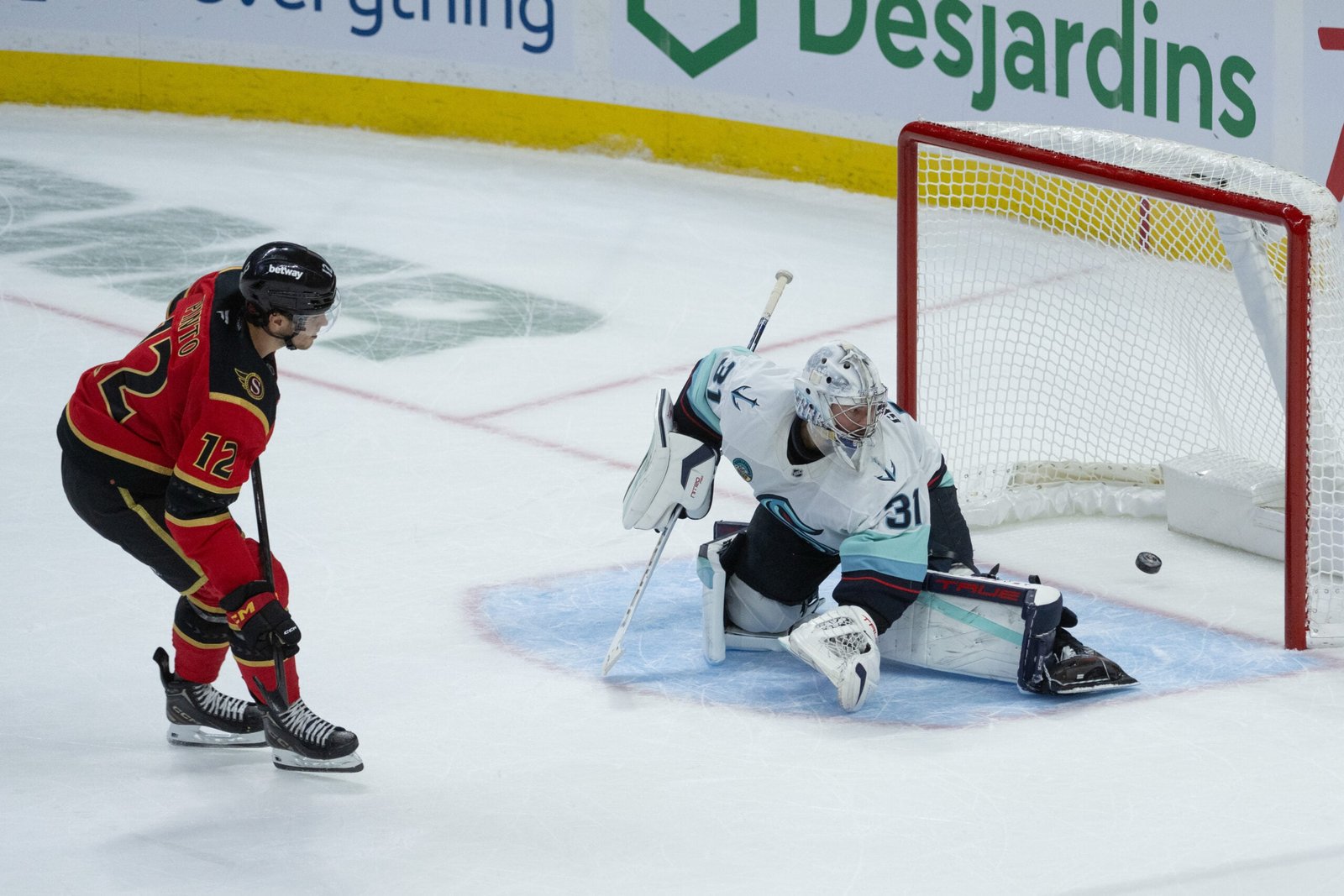
The shootout is not completely out of place in hockey. Breakaways and penalty shots have always been part of the game, and some players do work on them, but mostly in the offseason, if at all. But after 60 minutes of five-on-five play, the shift is hard to ignore. A scorer skates in alone. A goalie waits. Everyone else, who shaped everything that led there, is reduced to watching.
Longer three-on-three overtime could push more games toward a more natural result, but it would raise its own concerns. Coaches already lean on their best players in a short window. Add more time, and fatigue becomes a factor. Bringing back ties would settle some of this, but that option has been off the table for a long time, especially under Bettman.
There is another idea already in use. The Champions Hockey League, working with the International Ice Hockey Federation, implemented the “No Return Rule.” This new rule prohibits attacking teams from retreating into the neutral zone during overtime. “Should the rule be infringed, play will be stopped, and the ensuing face-off will take place in the offending team’s defending zone with the offending team not allowed to make line changes.”
This Comes Down to What the League Wants
The NHL does not rush into changes, especially when the current setup still works for them. The shootout guarantees a result and creates moments that fit cleanly into highlights. That is enough to keep it in place. Fan opinion is somewhat divided. However, it is much easier to leave things as they are. Owners and general managers tend to wait until there is clear proof that a change will not create new problems, and that slows everything down.
Still, the direction is not hard to see. The shootout solved a problem that has already been reduced. What it offers now does not carry the same weight. The criticisms have not changed, but the alternatives are there and evolving. Every spring, the playoffs show what the game looks like when it is left alone. The regular season is different, but the gap between the two shouldn’t have to be this wide.

