
As if dropping Game 1 of their first round series with the Carolina Hurricanes in a 2-0 shutout wasn’t enough, the Ottawa Senators’ injury woes continue – this time, with one of their most trustworthy defensive defenders in Artem Zub. After jumping up from the point and throwing a hit on Hurricanes’ forward Seth Jarvis in the second period, Zub got up in discomfort, went straight to the bench and was taken to the locker room soon after.
Senators’ head coach Travis Green offered no clear update on the Russian defenceman’s status postgame, and there haven’t been any updates released at this point. This leaves another hole on Ottawa’s blue line. They already lost Nick Jensen after he underwent season-ending surgery for a torn meniscus last month. Tyler Kleven, another reliable defensive piece on the back end, broke his jaw earlier in the month, and his status is up in the air as well. Thomas Chabot has already made a miraculous return after breaking his right forearm on March 23, but there is no guarantee that he is at 100 percent either.
Now, this injury takes Zub out of Ottawa’s sturdy top pair with Jake Sanderson, who also missed 13 games late in the season with a shoulder injury and might be banged up as well. Sanderson and Zub played over 900 minutes together in the regular season – higher than any Senators defensive pairing or forward line, and the 14th highest time among all defence pairs in the league. The two averaged 2.59 expected goals for per 60 minutes (xGF/60) and 1.87 expected goals against per 60 minutes (xGA/60), which was tops amongst all league defensive pairs averaging over 700 minutes.
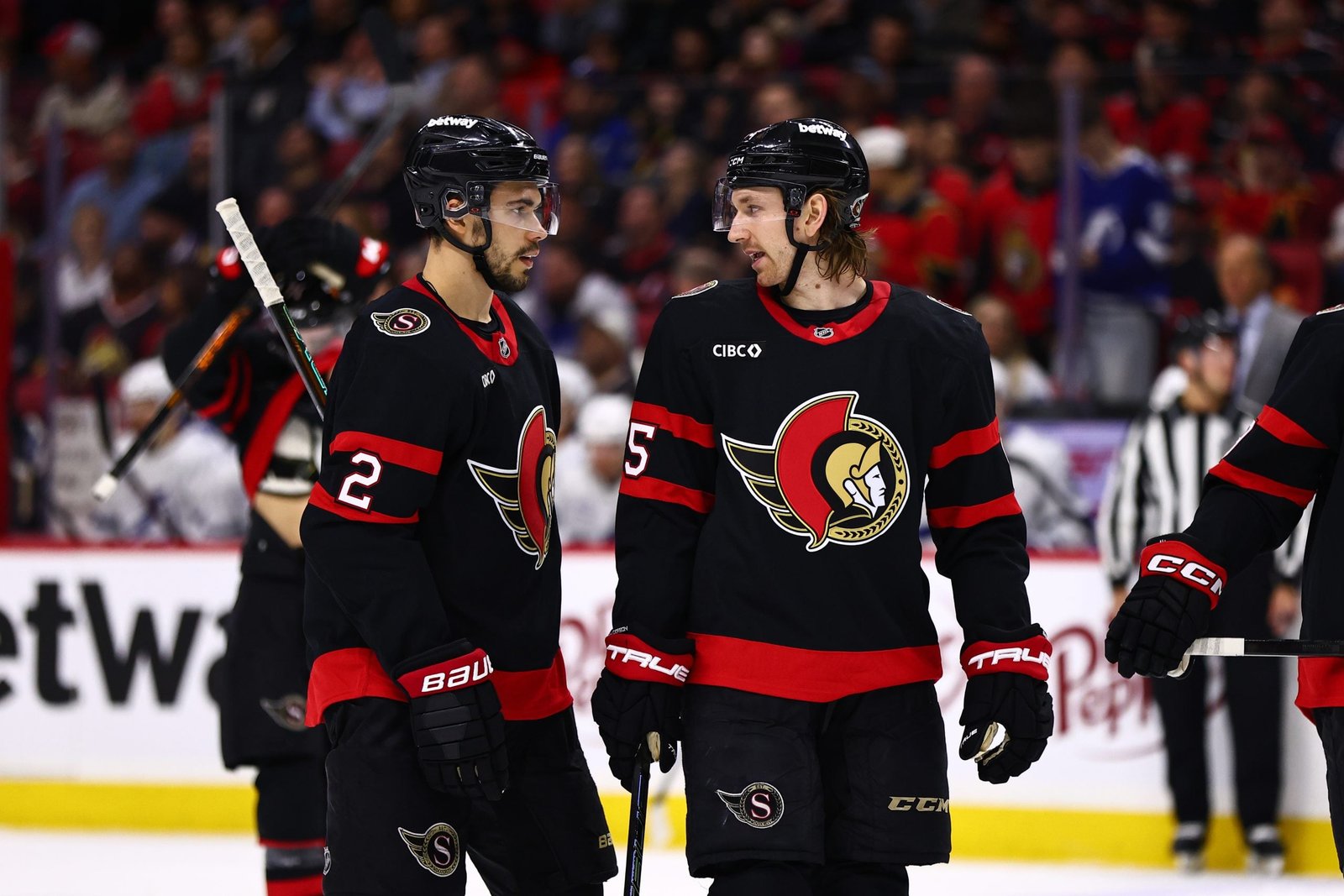
With Zub now out of the fold for the foreseeable future, many have one question in mind: who will roll with Sanderson on the Senators’ first defensive pair? Though a few blueliners are either out or still banged up, there are still a few options for Green to consider.
Jordan Spence
A buy-low acquisition from the Los Angeles Kings last offseason, Jordan Spence put up 31 points in 73 games in his first season with the Sens – all for the low cost of last year’s 67th overall pick, which was eventually moved to Carolina, and this year’s sixth-round pick from the Colorado Avalanche. The 25-year-old Australian native finished with a 62% shot attempt percentage, second only to Carolina’s Shayne Gostisbehere, and was also third amongst all defencemen that played 500-plus minutes in on-ice expected goals percentage at 61.4%.
TRADE: We have acquired defenceman Jordan Spence from the LA Kings in exchange for the 67th overall selection in the 2025 NHL Draft and a 2026 6th round pick (acquired from Colorado).
Les #Sens font l’acquisition du défenseur Jordan Spence, de Los Angeles, en échange de deux… pic.twitter.com/de5jxKJNAG
— x – Ottawa Senators (@Senators) June 28, 2025
As if his offensive analytics weren’t enough, Spence has already played with Sanderson for over 140 minutes this season. That is no 900 minutes, but the two recorded a team-leading 67.7% expected goals percentage (xG%) among all pairings averaging 50 minutes. This includes an xGF/60 of 3.84 and an xGA/60 of 1.83 – also first among all team pairings at 50 minutes or more.
So, you have a young, evolving defenceman who generates offence by getting shots through and moving the puck while being fairly disciplined with just 22 penalty minutes on the season. While it sounds compelling, Sanderson plays in a near identical way, except he also eats up plenty of defensive minutes. Spence makes the most sense to pair with Sanderson based on their experience, but would coach Green want to put two identical defencemen back together? It might work, but Spence has also benefited this next blueliner in more minutes this season.
Thomas Chabot
In his ninth full season with the Senators, Thomas Chabot put up the same number of points and penalty minutes as Spence, but in 16 fewer games. Analytically, he was top-50 amongst all full-time defencemen in the league in just about every statistic during the regular season, including top-30 in shot blocks per game with 1.9 – just like Sanderson.
It would be a pure power move to pair the Sens’ top two d-men together, but if they keep struggling offensively, Green might have to force himself into that decision to generate more shots. The same case can be made as a Sanderson-Spence pair in the sense that Chabot is a solid two-way defender in his own right, but he has played the left side for most of his career.
Nick Jensen was Chabot’s usual regular season partner as the two played over 575 minutes together and recorded a fairly even xGF and xGA, each at over 2.2/60. However, Spence and Chabot were also paired for 46 games and most of the back half of the season. They averaged 3.46 xGF/60 and 1.91 xGA/60 – similar to Sanderson-Zub. Keep in mind, Spence also put up identical expected goals for and against with Sanderson.
To overpower one unit or to spread the love? That’s what pairing Ottawa’s top two blueliners comes down to. Based on analytics, keeping the most recent pair of Chabot-Spence can help to – at least – maintain the two-way stability that Sanderson-Zub provided. Besides, if we do get a Sanderson-Chabot pairing, what good would that do for depth between the aforementioned Spence, Nikolas Matinpalo, Dennis Gilbert and Lassi Thomson? Speaking of which, another solution to maintain stability on the Senators’ blue line comes from an unlikely candidate.
Lassi Thomson
Thomson is seen as the obvious seventh defenceman to slot in, especially in light of Carter Yakemchuk still recovering from a concussion suffered in Florida at the end of March, but is there a real possibility for him to get a shot with Sanderson on the top pair? With eight points in 29 NHL games spanning back to the 2021-22 season, the 25-year-old Finnish defender might not have fully developed into the offensive dynamo the Sens had hoped for when selecting him 19th overall in the 2019 Draft, but he might be getting his biggest chance yet.
Despite getting 11 games in the regular season, Thomson played in Ottawa’s last 10 to end off with the injuries to Chabot, Jensen, Kleven and company. Each time out, however, he has been solid, averaging over 13 minutes in eight of those games while finishing as a minus player only once in this stretch – a minus-2 in New Jersey in the second-last game of the regular season. His on-ice expected goals percentage was almost 58%, the fourth highest on the team. If Thomson has averaged 15-plus shifts in nine of his 11 games – with seven of them coming on special teams – then why not give him a shot to see how he handles the big minutes to avoid further changes?
If Thomson is paired with Sanderson, it allows for Chabot-Spence to keep the strong two-way play they provide as a unit. Gilbert and Matinpalo would then be left as the Sens’ shutdown third pair, a role they have carried for eight games this season. However, if Kleven – who is back practicing – comes back, he would no doubt slot back in with Matinpalo as those two averaged an xGA/60 of 2.16 in the regular season.
Overall, if the Senators want to replace Zub while maintaining what has worked for them, moving just one guy up on the back end would be more ideal than shuffling all pairings around – especially against a Carolina team that can easily match them on the defensive front. Then again, we won’t fully know Green’s intentions until tonight’s pre-game warmups at the latest. Game 2 gets going at 7:30 pm from Raleigh as Ottawa looks to avoid falling behind 2-0 in the first round for a second straight year.
All advanced stats were courtesy of MoneyPuck.
Free Newsletter
Get Ottawa Senators coverage delivered to your inbox
In-depth analysis, breaking news, and insider takes – free.
