
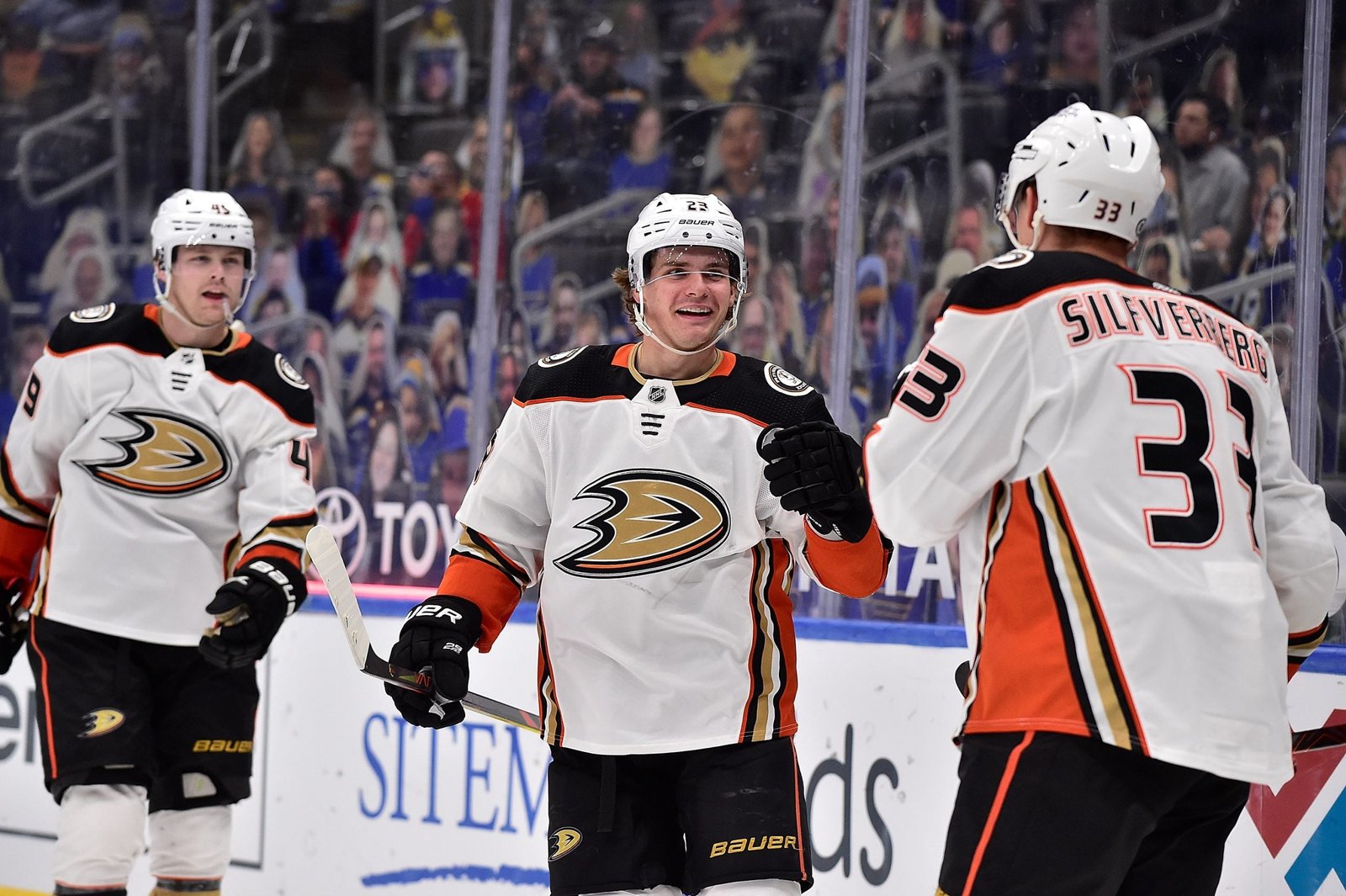
Before the days of Leo Carlsson, Cutter Gauthier, and Pavel Mintyukov, after the era of Corey Perry and Ryan Getzlaf, there was a middle era. It had hope, and that hope rested on players like Sam Steel and Max Jones.
It’s okay if those names don’t ring a bell; to be honest, they really shouldn’t. These players weren’t hyped like the young superstars are today. That doesn’t mean the talent or the organizational push for them to take the Ducks to the next level wasn’t there, though.
Sam Steel: The Skilled Center Who Couldn’t Break Through
Steel was drafted 30th overall in the first round of the 2016 NHL Entry Draft. The 5-foot-10, highly skilled and speedy center dominated at every level he’d played thus far and, to no surprise at the time, was projected as a second-line center. The hype really hit an all-time high when he became the youngest player in Ducks history to score a hat trick at just 21 years old, a record since beaten by Carlsson at 18.
Steel’s game was built on elusiveness and hockey IQ. He wasn’t going to overpower defenders or win board battles with physicality; instead, he relied on quick cuts, deceptive skating, and vision to create offense. In junior with the Regina Pats, he posted back-to-back 100-plus point seasons, showcasing the kind of offensive instincts that made scouts salivate. His playmaking ability stood out, threading passes through tight windows and quarterbacking the power play with patience beyond his years.
The problem? That game never fully translated to the NHL level. Steel’s lack of size became a legitimate hindrance when facing stronger, faster competition night after night. He struggled to protect the puck along the boards and couldn’t create the same separation he enjoyed in junior. His defensive game, while not a complete liability, wasn’t strong enough to earn consistent ice time in all situations. By the time he reached the NHL, the Ducks needed him to be more than a perimeter playmaker, and he couldn’t adjust.
At the time, this seemed like an impressive developmental trajectory. However, after the 2020-21 season and not seeing much improvement beyond 20-plus points, Anaheim decided to move on from the Alberta native. The Ducks opted not to qualify Steel in 2022, making him an unrestricted free agent. He landed with the Minnesota Wild before signing a one-year deal with the Dallas Stars on July 1, 2023, after a solid season in Minnesota.
Steel’s pre-draft rankings showed legitimate promise:
- Ranked No. 55 by Hockeyprospect.com
- Ranked No. 40 by ISS Hockey
- Ranked No. 35 by Future Considerations
- Ranked No. 35 by McKeen’s Hockey
- Ranked No. 30 by NHL Central Scouting (North American Skaters)
- Ranked No. 41 by TSN/McKenzie
Max Jones: The Power Forward Who Never Arrived
The other piece of this puzzle was a power forward by the name of Max Jones. He was selected ahead of Steel in the same draft class at 24th overall and was seen as the perfect complementary piece: a big, strong left winger who produced great numbers with the London Knights. Standing 6-foot-3 and weighing 220 pounds, Jones had the prototypical power forward build that NHL teams covet.
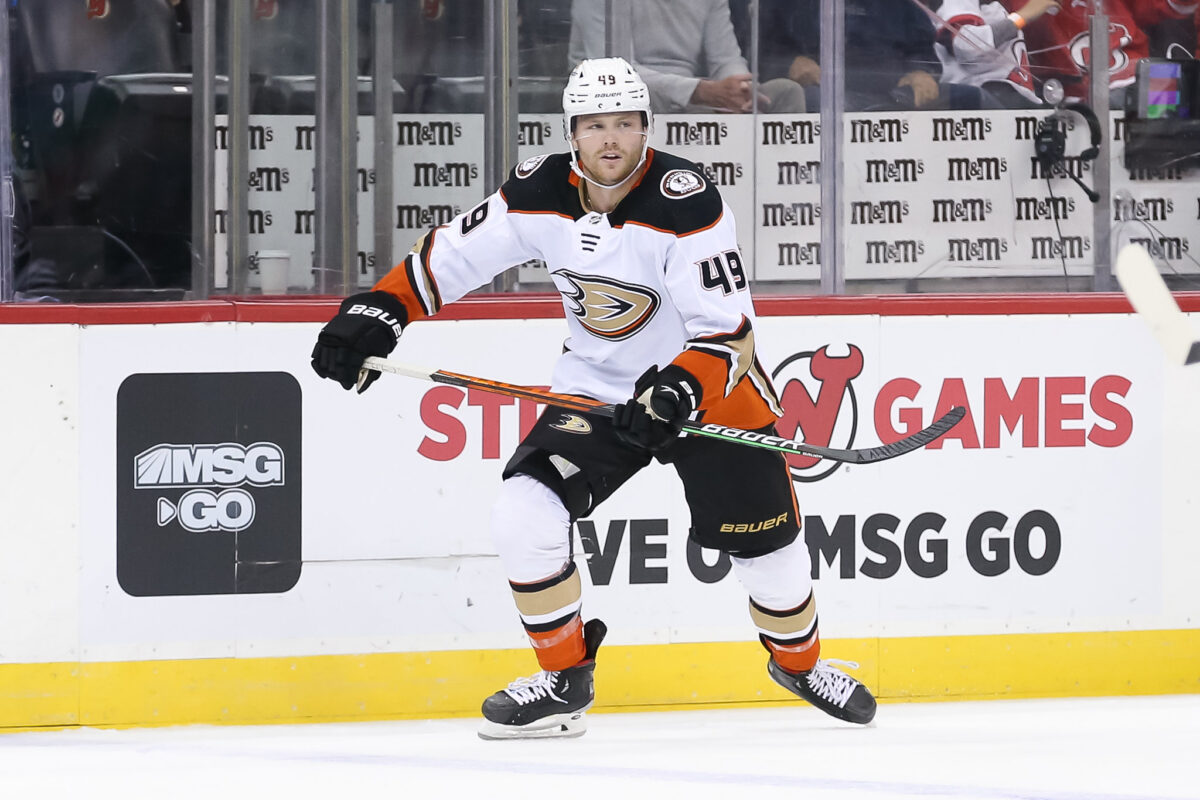
His playstyle was supposed to be the antithesis of Steel’s finesse game. Jones was advertised as a north-south player who could drive the net, finish checks, and create chaos in front of the opposing goaltender. He possessed a hard, heavy shot and wasn’t afraid to go to the dirty areas. In London, he was part of an excellent junior team consisting of Mitch Marner, Robert Thomas, Matthew Tkachuk, and Christian Dvorak, learning what it took to win from some of the best young players in hockey.
The issue with Jones was consistency and hockey sense. While he could dominate shifts with his physicality and forechecking, he’d disappear for long stretches. His decision-making with the puck was questionable at times, leading to turnovers in critical moments. Unlike Tkachuk, who combined power with elite skill and compete level, Jones never developed the offensive touch or the relentless motor required to be an impact player at the NHL level.
Injuries also played a role in derailing his development. He missed significant time throughout his Ducks tenure, making it difficult to build rhythm or chemistry with linemates. When he was healthy, flashes of the player Anaheim hoped for would appear, moments where he’d barrel through defenders or score a crucial goal. But those moments became fewer and farther between as the years passed.
Unfortunately, Jones did not live up to the potential. Much like Steel, he did not see much improvement in his statistics and therefore was not given a qualifying offer. As a restricted free agent in 2024, the Ducks chose not to extend an offer to keep his rights, signaling their intention to move on from the 2016 first-round pick.
The Team Context: A Franchise in Transition
To understand why Steel and Jones failed to develop into impact players, you need to understand the Ducks team they were joining. This wasn’t the powerhouse that won the Stanley Cup in 2007 or even the competitive playoff team from the early 2010s. This was a franchise caught between eras, clinging to the fading glory of Perry and Getzlaf while desperately trying to inject youth into an aging roster.
Today’s #TBT presented by @UCIrvineHealth goes back five years ago on this very date, when Max Jones was selected 24th overall and Sam Steel was picked 30th at the NHL Draft in Buffalo. pic.twitter.com/xSwoN6o2h3
— x – Anaheim Ducks (@AnaheimDucks) June 24, 2021
When Steel made his NHL debut in 2018-19, the Ducks were already trending downward. Getzlaf was 33 years old, Perry was dealt to Dallas, and the supporting cast consisted of veterans like Ryan Kesler, who was battling injuries, and defensemen like Cam Fowler trying to hold together a leaky blue line. The team finished 27th overall that season, missing the playoffs for the first time since 2011-12.
The coaching situation didn’t help, either. Randy Carlyle was behind the bench during the early years, preaching a defensive, grinding style that didn’t suit Steel’s skill set. Young, skilled players needed ice time and opportunity to make mistakes and grow; instead, they were often stapled to the bench after turnovers. The development environment was far from ideal.
Jones entered a similar situation. The Ducks needed him to be a net-front presence and physical force, but the team lacked the playmaking talent to consistently get him the puck in dangerous areas. He was often deployed on checking lines and asked to play a defensive role when his offensive game was still raw. Without consistent linemates or stable coaching, his development stagnated.
By the time both players were reaching what should have been their prime years, the Ducks had fully committed to a rebuild. General manager Bob Murray was fired in 2021, replaced by Pat Verbeek, who had no allegiance to the previous regime’s draft picks. Verbeek’s vision was clear: build around high-end young talent like Trevor Zegras, Mason McTavish, and eventually Carlsson. Steel and Jones didn’t fit that timeline or talent level.
The Ironic Twist
The interesting underlying story is that the Ducks are now in the playoffs with a talented and young competitive team. The core that Verbeek has assembled, Carlsson, Gauthier, Mintyukov, and McTavish, is exactly what the organization hoped Steel and Jones would become. These players have the skill, the size, and, perhaps most importantly, the development structure around them to succeed.
Also worth mentioning is that both Steel and Jones have found themselves on teams currently in the playoffs. Steel is playing a bottom-nine role for the Stars, contributing as a depth piece on a legitimate Stanley Cup contender. It’s a far cry from the second-line center projections, but he’s carved out an NHL career nonetheless. Jones has found himself on a talented Edmonton Oilers team but is out with a lower-body injury, ruled out for two to three weeks, and has provided physical depth for his current team when healthy.
Lessons From a Lost Core
Sometimes the core you think will lead you to glory becomes the bridge generation, the players who paved the way for the next wave. Steel and Jones weren’t busts in the traditional sense; they were good junior players who couldn’t make the leap. They were victims of poor organizational timing, inconsistent development environments, and perhaps their own limitations.
For Anaheim, that next wave has finally arrived. The lessons learned from Steel and Jones, patience in development, building a proper support structure, and committing fully to youth rather than half-measures, have informed how the Ducks are handling their current up-and-coming young players. Carlsson isn’t being asked to save a sinking ship; he’s being built around a floating ship. Gauthier has offensive weapons alongside him. Mintyukov has veteran defensemen to learn from.
Free Newsletter
Get Anaheim Ducks coverage delivered to your inbox
In-depth analysis, breaking news, and insider takes – free.
