
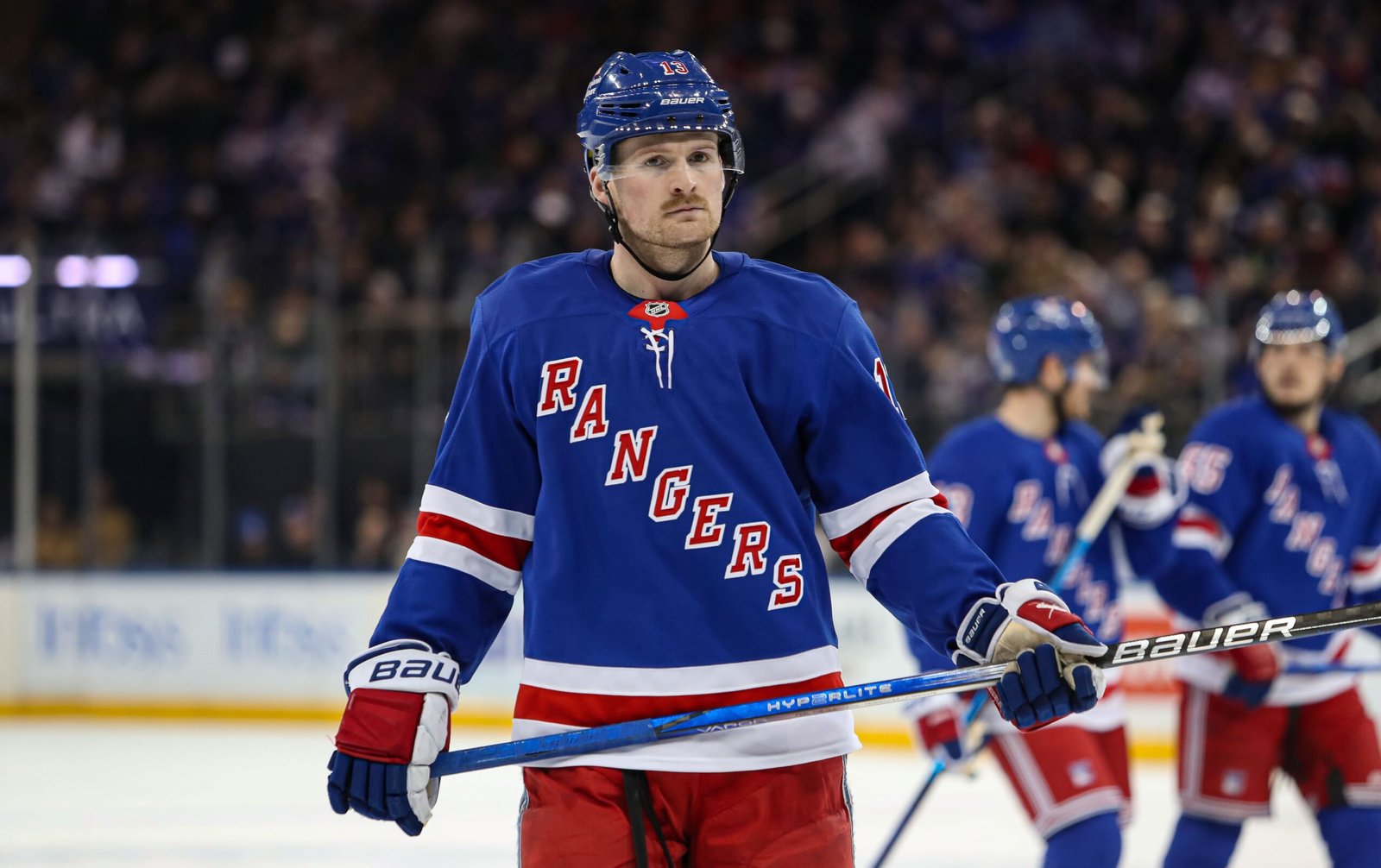
It was six years ago that the New York Rangers won the draft lottery, which got them the first overall pick. They selected Alexis Lafreniere, who was the consensus number one pick before the draft, as many believed he had all the tools to become the next superstar in the NHL. Six seasons later, and nothing could be further from the truth, as Lafreniere has yet to even establish himself as a legit top-six player. In this piece, we are going over why his poor development has a major impact on the Rangers’ retooling plans going forward.
Six Seasons With Little Signs of Improvement
Over these past six seasons, fans have gone back and forth over who is to blame for Lafreniere’s poor development. Is it the Rangers’ coaching and development staff, the player himself, or a mix of both? Many feel that it is a mix of both because during his time with the team, Lafreniere has had players above him blocking him from getting consistent top-six playing time, but the player also looked like he wasn’t interested in taking the next step. Both of these can be true, and it has led us to now, where he looks like he could maybe be a good third-line scoring winger on a Stanley Cup-contending team.
When he first arrived in New York, the Rangers already had Chris Kreider and Artemi Panarin playing the left wing, so he was immediately the team’s third-best left winger. While he would get chances to play in the top-six, those didn’t last long, and for his first three seasons, he played mostly third-line minutes while getting little to no power-play time. It wasn’t until two seasons ago, when he shifted to right wing, that he showed improvement, but that didn’t last, and over the past two seasons, he has looked nothing like the player fans hoped he would be.
Trading Panarin Would Hurt Less Had Lafreniere Developed Properly
When the Rangers sent out the letter announcing this retool, many knew that the trading of Panarin was coming sooner rather than later. The trade was made official before the Olympic roster freeze, and he was traded to the Los Angeles Kings in exchange for prospect Liam Greentree, a 2026 conditional third-round pick, and a 2028 conditional fourth-round pick. This return seemed very underwhelming to many fans, but it hurts even more because the Rangers don’t have a player like Panarin in their lineup that can help produce offense, which has been a struggle for this team all season long.
Related: Rangers’ Zibanejad Continues Bounce-Back Season in the Olympics
Now, some might see this as Lafreniere’s chance to finally get the consistent top-six minutes and power-play time he has yet to earn so far in his career. However, had he turned into the player he was projected to be, he would have already gotten this playing time, and maybe the Rangers wouldn’t be in this situation at all. They could have kept Panarin and been Stanley Cup contenders right now had Lafreniere reached his potential. Instead, they had to trade their best offensive player for pennies on the dollar, and their offense going forward looks very bleak.
Rangers Can’t Build Around Lafreniere Like Other Teams Can With Their First Overall Picks
With the Rangers wanting to build around their younger players, Lafreniere is likely going to be part of that group, but right now, he’s not a player the team should be building around. He hasn’t proved himself at the NHL level, and he doesn’t have the talent and skill like Connor Bedard and Macklin Celebrini have. Those players alone have helped turn their teams around, and both the Chicago Blackhawks and San Jose Sharks have a brighter future and could be seen as better teams than the Rangers right now. With Lafreniere, he’s more of a side character than the main attraction at the moment, and that is a problem.
If the Rangers can’t see themselves building around Lafeniere, they could consider trading him to find another young player whom they see as a better fit for the team. However, selling him now would be selling him at his lowest, and they can’t afford to keep trading players and not getting good value back. It feels like the Rangers want to try to fix Lafreniere themselves, but they have to realize that what they have done in the past is wrong, and they need to fix these issues going forward.
Lafreniere was once considered the prized prospect with superstar potential, and he was viewed as a major addition to a rebuilding Rangers team. Six years later, and the Rangers are back to being a retooling team, and this player could be considered part of the problem and not the solution going forward. His future with the team is very up in the air, and the Rangers’ retooling plans could have been more solid had Lafreniere developed into the player they hoped he would be.

