
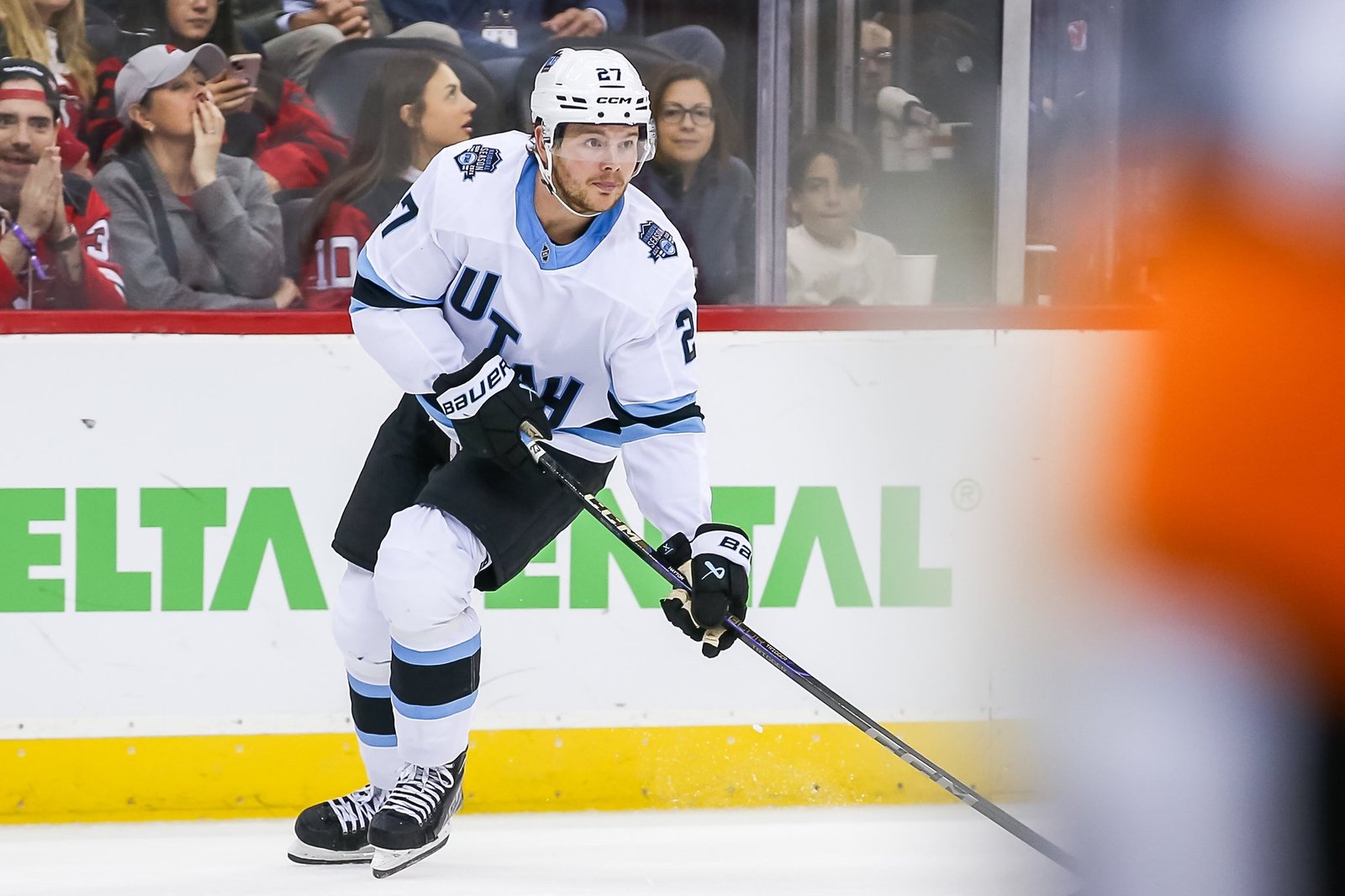
The Utah Mammoth have a couple of big decisions to make this offseason. The obvious, and so far most talked about, is Nick Schmaltz’s expiring contract and whether they will be able to afford the raise he rightfully deserves.
The other significant decision general manager Bill Armstrong and his staff will have to make concerns Barrett Hayton‘s next contract.
Hayton, now 25 years old, turning 26 in June, will be a restricted free agent one last time before he is eligible for unrestricted free agency after his next contract. So, for the Mammoth, this will be the deal where they really have to decide whether they’re going to keep him long-term as a future franchise pillar or if it’s time to let their 2018 fifth-overall pick move on.
Impact vs Production: A Challenging Conversation With Hayton
The part that will make this negotiation challenging is that Hayton’s impact on the ice is hard to measure, since his production doesn’t correlate to the chances he gets in the offensive zone.
At the Olympic break, Hayton is one of four players in the NHL with three goals or fewer among the 66 players who have 50 high-danger chances or more this season at five-on-five. Along similar lines, he is also in a group of 114 players with 89 or more scoring chances and one of three in that group with three goals or fewer at five-on-five.
You could potentially chalk this up to bad puck luck, with Hayton on pace to shoot a career-worst percentage of only 2.70% at five-on-five. However, this is a trend that I have been discussing since last season.
Related: Utah Hockey Club Underutilizing Barrett Hayton & Josh Doan
In the past, I was willing to chalk this up to poor puck luck, and given the number of quality chances he was producing, it seemed an uptick in his shooting percentage had to be coming. But that just hasn’t been the case.
To put it another way, since the beginning of last season, Hayton has the 12th-most expected goals (31.25) in the NHL, but ranks tied-265th in actual goals scored (13) at five-on-five. With this type of trend going on for 134 games over the past couple of seasons, it may be time to admit that Hayton will continue to be one of the worst finishers in the NHL compared to the volume of chances.
Hayton’s Value Is Not Entirely Reliant on Offense
Per Hockey Stat Cards‘ net ratings, Hayton is a top-30 defensive forward with his plus-2.9 rating. This can also be evidenced by Hockey Stats ranking him in the 92nd percentile in defensive wins above replacement, and the Mammoth allowing only 2.07 expected goals per 60 minutes with Hayton on the ice, compared to every other forward’s on-ice expected goal per 60 average being above 2.40.
He is incredibly reliable in the defensive end and has really improved in the faceoff circle over the past two seasons, ranking 35th in faceoff percentage among NHL centers who have played 1,000 minutes over the last two seasons.
Right now, if Hayton were playing in a third-line center role, the perception of him would be much different, as he’d be elite in that role. However, with Utah being weak down the middle, Hayton’s defensive strength is overshadowed by the offensive production expected of a top-six player.
How Should the Mammoth Value Hayton?
According to The Athletic’s model, Hayton was valued at $6.8 million last season based on his production (from ‘NHL Player Cards: Central Division,’ The Athletic, March 9, 2025).
That was after a career-high 20 goals and 46 points. However, this season we’ll likely see that number come back down with Hayton projecting to score 13 fewer goals and record 15 fewer points.
While his development and production have been inconsistent, I think a long-term gamble on Hayton will be worth it, if it’s at a price where the team can stomach potentially having one of the higher-paid third-line centers (if that’s all Hayton amounts to).
Related: Barrett Hayton Continues to Be Utah’s Streakiest Player
And even though this stretch of horrendous finishing has gone on for quite some time, you have to look past the box score numbers. Hayton is in the top 17% of players in scoring chances created, top 10% in high-danger chances at five-on-five, and the top 16% in high-danger chances on the power play.
Hayton has a knack for finding space in dangerous areas on the ice; his only weakness is capitalizing on those chances. This is something I think will improve with age, as he continues to develop an understanding of how to beat goalies in tight to the net.
You’d love to see more production on the stat sheet before committing to someone long-term. But with a weak free-agent class coming up, I’d much rather have Hayton, who is excellent defensively and has shown he creates high-danger chances at a top-six pace.
Even at 25, Hayton still has a ton of upside. If he ever figures out the finishing part of his game, he could be one of the best two-way players in the NHL, which is why I believe the Mammoth should look to lock him up for as long as they can. There is serious potential that a deal would turn into one of the best-value contracts in the league as soon as he starts finishing at a league-average rate.
Stats via Natural Stat Trick unless specified.

