
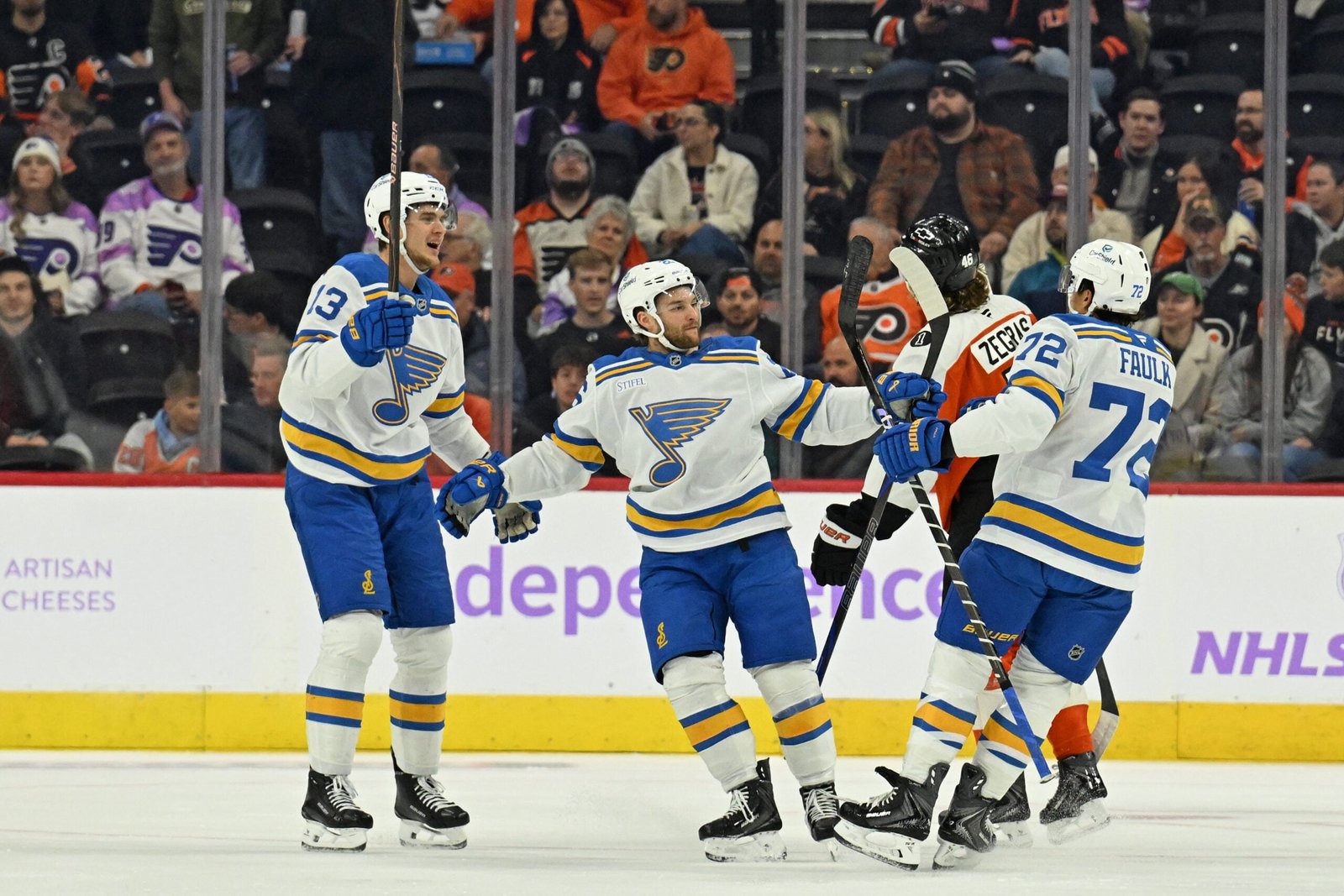
The 2026 trade deadline has passed. The St. Louis Blues were sellers this season, and general manager Doug Armstrong had a successful showing. He was able to move two veterans while adding two additional first-round picks. While the deadline was a success for the Blues, there were some hiccups. Let’s take a look at the highs and lows of the deadline for the Blues.
Lows of the Deadline
Let’s get the lows out of the way first so we can finish on a high note.
No Binnington Market?
A Jordan Binnington trade seemed like a certainty. The 2019 Stanley Cup champion, 4 Nations Face-Off champion, and Olympic silver medalist has big-game experience and is under contract through next season. It seemed like a great opportunity for a team to upgrade at the goaltending position and have him under contract.
As it turned out, there was seemingly little Binnington buzz on deadline day. This was common across the league, as none of the goaltenders expected to be on the move actually moved. TSN’s Cameron Gaunce offered an explanation, stating that teams would have preferred to bring a new goalie earlier to give them time to adapt to their new team’s defensive style. This does make sense, and Blues fans have experienced this firsthand when Ryan Miller joined the team in 2014.
While the explanation makes sense, it is disappointing that there was not more buzz, especially coming off the Olympics.
The No-Trade Clause Conundrum
The Blues had a deal in place to send Colton Parayko to the Buffalo Sabres. Parayko ultimately exercised his no-trade clause to veto the trade.
The Blues could have gotten a nice return for Parayko, but the defenseman was within his rights to nix the trade. However, that is not the frustrating part of this situation.
Armstrong and the no-trade conundrum are something that rests heavily on Blues fans’ minds. This is not the first time a no-trade clause nixed a possible trade. In 2023, Armstrong had a deal in place to send Torey Krug to the Philadelphia Flyers, but Krug vetoed the trade.
So, we have two trades nullified by a no-trade clause, which is frustrating enough, but then there is the Alex Pietrangelo situation. It is common knowledge in St. Louis that Armstrong refused to give Pietrangelo a no-movement clause during negotiations. Armstrong did not want to give up the clause to maintain some control over the roster. Pietrangelo left the team, and the Blues were without the backbone of their Stanley Cup-winning team.
There is a big difference between a no-movement clause and a no-trade clause. A no-movement clause protects a player from trades, waivers, or being sent to the minors without consent, while a no-trade clause only protects against a trade. However, would it not have been worth it to retain someone like Pietrangelo? Pietrangelo left over a clause, while Armstrong has now been handcuffed twice by another clause, players who did not offer what Pietrangelo did.
Armstrong is a great general manager, but the clause conundrum is one of the blotches on his otherwise impressive resume.
Highs of the Deadline
Now, let’s talk about the fun stuff!
Capitalizing on Schenn and Faulk
Trading Brayden Schenn and Justin Faulk could have been considered the “bare minimum” going into the deadline. If Armstrong could only achieve two things during this deadline, trading those two would have been it.
Why? Well, their value may not have gotten any higher. Faulk is an offensive-minded defenseman. He can hold his own defensively, but his offense is where he stands out. His offense also helps balance out his defensive shortcomings. This season has been just that for Faulk. He has recorded 32 points in 61 games. The 33-year-old has already matched last season’s point totals. If Armstrong did not trade Faulk now, there was no guarantee his value would have stayed as high as it was.
As for Schenn, he is still a reliable forward, but he has shown signs of regression over the last few seasons. However, he is likely to reach the 15-goal mark for the 13th straight season. He plays a physical game and is not afraid to drop the gloves. As he gets older, some of those traits that still make him valuable may start to regress further.
Armstrong struck when the iron was hot. He traded two players while their value was at its peak and received a nice return on both.
Speaking of those returns…
Two First-Round Picks?
I did not expect either Schenn or Faulk to get the Blues a first-round pick in return. Even with the seasons attached to their current contracts, I did not expect teams to view either player as worth giving up a first-round pick. Granted, the New York Islanders did have an additional first-round pick, and they did give the Blues one likely to come later in the first round (the pick originally belonged to the Colorado Avalanche), but it is still great to see the Blues now have three first-round picks.
Related: Grading the Islanders’ Trade for the Blues’ Brayden Schenn
The last time the Blues had three first-round picks was in 2023. The team added Dalibor Dvorsky, Otto Stenberg, and Theo Lindstein. Dvorsky and Stenberg have had an impact on the team this season, so hopefully the Blues have similar success this time around. Of course, it is also possible a pick gets flipped in a trade.
Trade Deadline Grade
I think Armstrong deserves an A-plus for this deadline. He was able to trade Schenn and Faulk while their value was at its highest, turning them into two additional first-round picks. Furthermore, even though the Parayko trade fell through and the Binnington market was low, those conversations may pick up again after the season. There could still be more on the way.

