
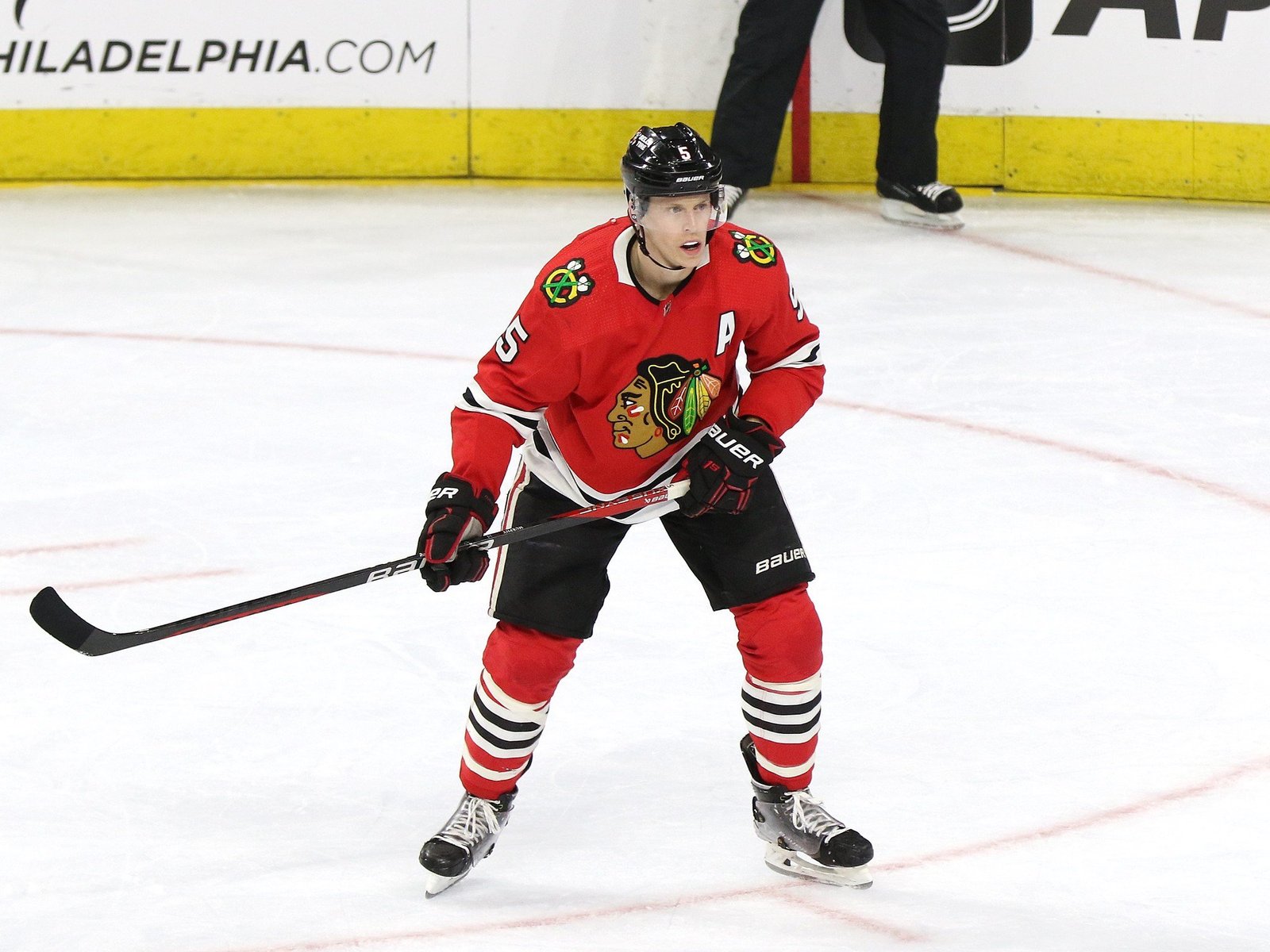
You never really believe it until it actually happens. But after years of being a top trade target seemingly every deadline and every offseason, defenseman Connor Murphy is officially no longer a member of the Chicago Blackhawks. On Monday (Mar. 2), just four days before the 2026 trade deadline, the veteran blueliner was traded to the Edmonton Oilers.
The official package is Murphy to the Oilers for a 2028 second-round draft pick, and Chicago will retain half of Murphy’s $4.4 million cap hit on his contract that expires at the end of this season. It certainly makes sense for the Blackhawks to move Murphy, and it was expected. He’s a dinosaur of sorts on a team that’s getting younger and younger as they rebuild, and has one of the deepest defensive prospect pools in the league.
But that’s the business side of things. On the human side of things, it’s a tough blow for the organization, and especially for this young locker room. Murphy was a beloved teammate and friend. He led by example, and often-times took on the dirtier tasks that come with being an alternate captain. His steady presence and easygoing personality will be sorely missed. Before we wish Murphy farewell and a happy postseason in Edmonton (hopefully), let’s revisit what he meant to the Blackhawks.
Losing Murphy a Changing of the Guard
Murphy was the longest tenured member of the Blackhawks, having been with the organization for the past nine seasons. He was acquired in the 2017 offseason from the Arizona Coyotes, in exchange for 30-year-old Niklas Hjalmarsson. Yes, none other than Hjalmarsson, beloved warrior of the blue line who won three Stanley Cups with Chicago. Can you imagine having to fill those shoes?! Be the guy that comes in while a renowned and revered veteran gets shipped out?!
Well, that was Murphy. He was 24 years old at the time, and he thought he was joining a contending team. Little did he know he was just in time for the beginning of the Blackhawks’ downfall. Nevertheless, Murphy played with the likes of Jonathan Toews, Patrick Kane, Brent Seabrook and Duncan Keith, to name a few. He established himself as a solid stay-at-home defenseman, and his affable personality won the fans over despite themselves.
Murphy wasn’t a member of the “dynasty” the Blackhawks built. But he crossed paths with them. Slowly but surely the older veterans went their separate ways or retired. Father time waits for no one, and the one constant in life is change.
In the 2021-22 season, Murphy was 28 years old and in his fifth season with the Blackhawks. He had also just signed a four-year contract extension with a $4.4 million annual cap hit. Who better than to wear an “A” on his sweater?!
The Dublin, Ohio native has been an alternate captain ever since, proudly taking on that responsibility of being a leader to the team and a contributor to the community. Heck, he’s been nominated for the King Clancy Trophy each of the last five seasons for his charitable work in the community.
Related – NHL Trade Grades: Edmonton Oilers Boost Defense With Connor Murphy Addition
Fast forward to the present, and a 32-year-old Murphy (he turns 33 on Mar. 26) is now ironically the one on his way out. He really is the last tie to the dynasty days of old. In his stead, Alex Vlasic is now the most tenured member of the team, now in just his third full season with the organization. He’s only 24 years old; the same age Murphy was when he came to the Blackhawks. It seems as if things have somehow come full circle.
A Papa Bear on Defense
Murphy was one of the first players I introduced myself to this past September in training camp earlier this season when I first became credentialed with The Hockey Writers. After all, it’s important to meet the leaders of the team.
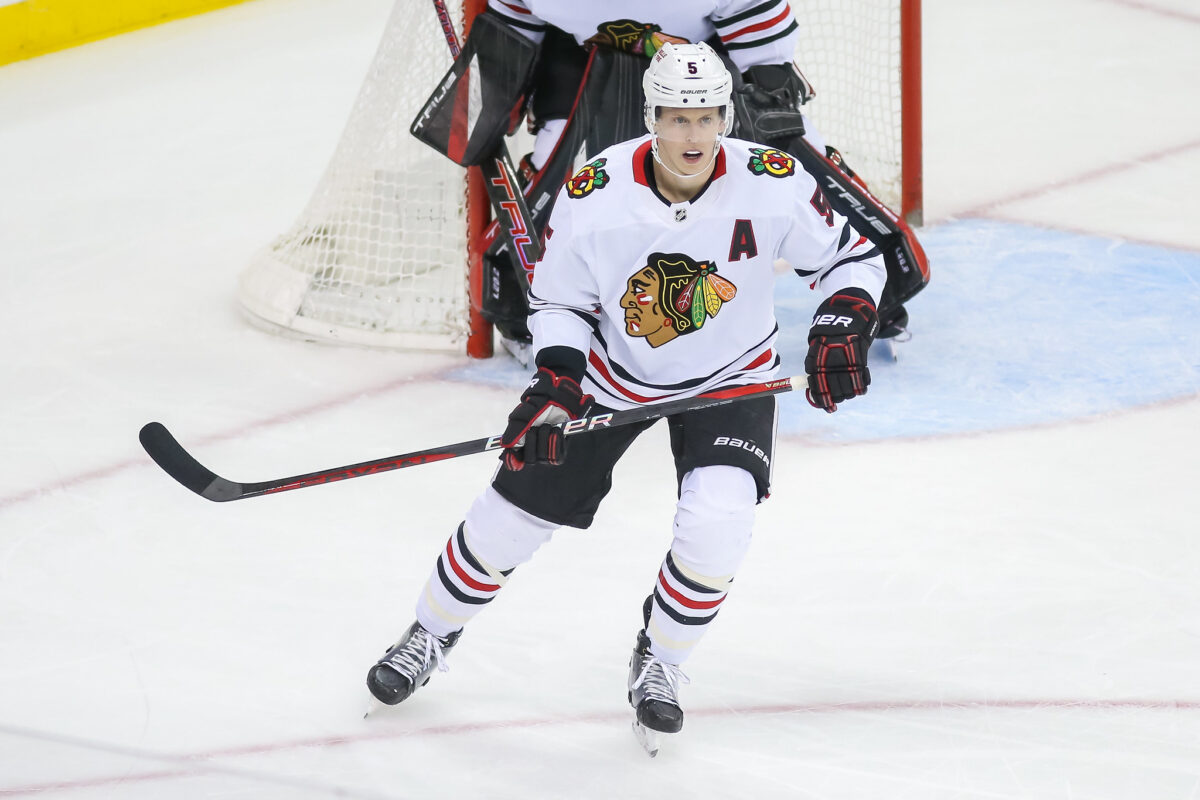
I asked him how he balanced being the best he could be with also being a mentor to the younger guys. His response was very humble and sincere.
I think everyone is kind of a leader in their own way. A lot of it is just staying true to yourself by being focused on your game. Then there’s just natural things that come up. That’s what I’ve loved about being a D-man, is every guy seems to look after each other, whether guys are older or younger. It’s a group of six or eight that seems to look after how each other are holding up or different areas to give each other pointers on. So I think it’s something that just comes natural, that when you’re worried about your own game, you’re gonna pick up and see and bring along guys around you.
At the time, we were also assessing the new head coach, Jeff Blashill. Everyone was picking his brain and asking what this player could bring to the team, or what that player might need to improve on. In Murphy’s case, Blashill seemed to have nothing but respect for the veteran D-man.
I think it’s an important role for him and any of our vet players to kind of, I use the verb Papa Bears. Be guys that can really help guide, or be an extension of our coaching staff. But just in a guiding way. I’ll be the disciplinarian. Their role is to help; put an arm around them. Help guide them. Help, kind of teach them the little nuances; in his case, the little nuances of defense …
He’s been a good defender for his career. I coached him at the World Championships, my first world championship a number of years ago. I walked away and I really liked him. He’s smart. He’s got really, really good defensive habits. He knows his limitations in a sense that he doesn’t try to do more than he should. He moves the puck to the open guy and defends well. So that will be the expectation for him.
It’s safe to say Murphy’s had his work cut out for him. 32-year-old Matt Grzelcyk is a veteran on the blue line as well, but he was also brand new to the organization, and new to the city. Everyone else was 24 years old or younger. Basically two old guys and a bunch of greenhorns. But it appears Murphy knew how to take things in stride; just by being himself and leading by example.
Missing Murphy on the Ice as Well as off It
Once again, let’s fast forward to the present. Everyone over the past month or so has seen the writing on the wall that Murphy would most likely be traded. With that in mind, a topic of discussion has been about the impact he’s had on the team this season. Blashill’s now worked with Murphy up-close-and-personal for over six months. Not surprisingly, his appreciation has only intensified.
I can’t say enough good things about Murph. He’s been great. First off, I think he’s played really, really well. There was a time early in the year where he wasn’t given lots of minutes. He’s really had to earn it. He’s really, really done a good job of earning ice time on a consistent basis. He’s a huge reason why our (penalty ) kill has been really successful. I think he’s defended really, really well. He’s moved the puck well, he’s showing some scoring, he’s been physical, he’s fought. All those things are an important part of leadership. Your play probably is the most important part. Then beyond that; his dad played, his dad coached. He’s been around the game a long time. He’s got a real level head to him. I think he’s done a good job of being a Papa Bear to our young players and helping them along. And so I can’t say enough positive things about him as a person, and the impact he’s had in our locker room.
I haven’t really touched on this up until now, but the Blackhawks are likely going to miss Murphy on the ice as much as off of it. He was averaging 16:34 minutes of ice time, which is actually sixth among defensemen. However, he led the team in total penalty kill time (177:17 minutes). Murphy also led the team with 87 blocked shots, and was third with 62 hits.
Related – Blackhawks’ Levshunov Showing Improvement Post-Olympic Break
All these things will not be easy to replace. Not to mention Murphy was the only experienced right-handed defenseman on the team. Louis Crevier (113 NHL games), Artyom Levshunov (73 games) and Sam Rinzel (41 games) are mere babies when it comes to the experience Murphy has under his belt (805 NHL career games).
Murphy in His Element: The Psychology of Competitiveness
I had a chance to sit down again with Murphy on Feb. 17, the first day the Blackhawks started up practices after the Olympic break. I was lucky, because for obvious reasons Murphy’s been a much sought-after quote of late. But this was an optional practice, and many members of the media were getting one final day of off-time in.
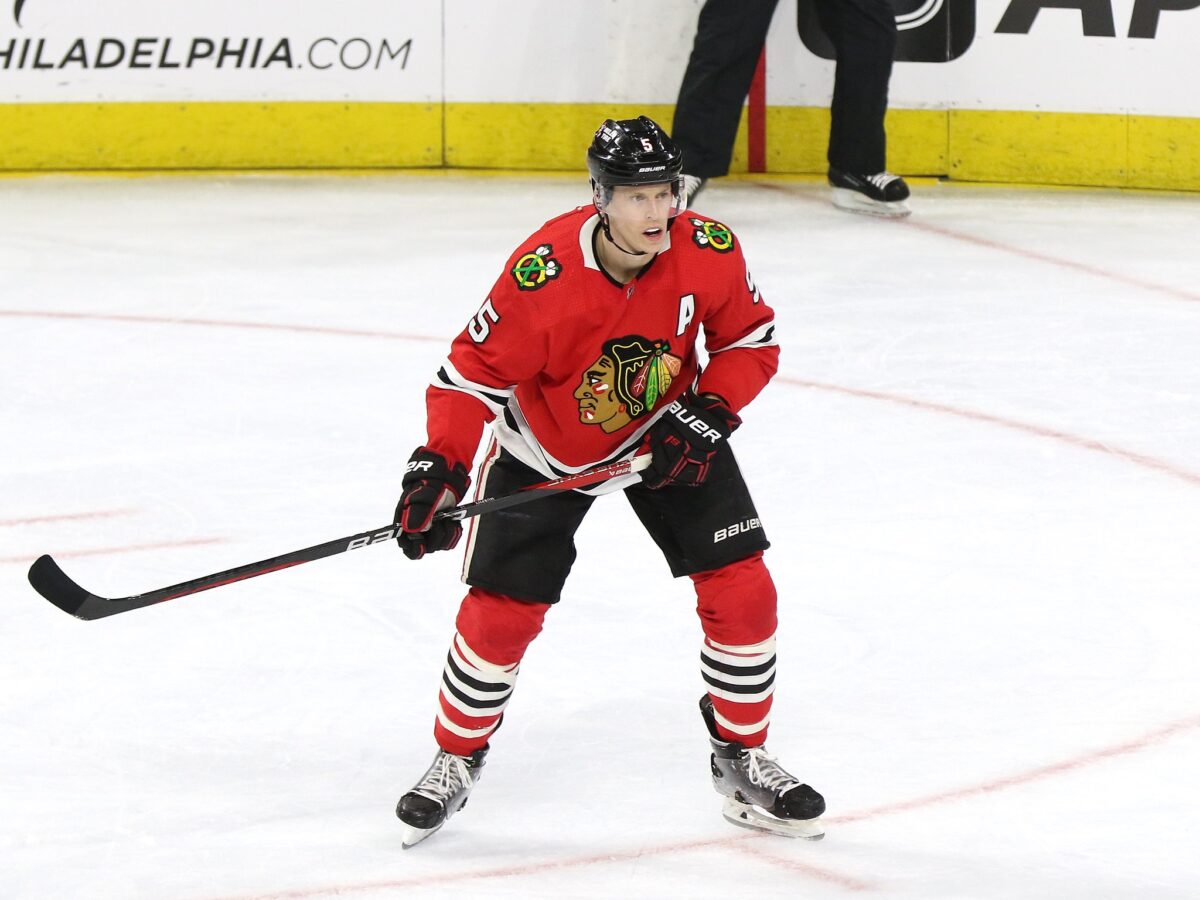
It was a laid-back atmosphere in the locker room, and Murphy and Landon Slaggert were joking around when I approached them. I’m going to put this in Q&A format to give a better gist of the conversation, with my questions and comments in bold.
Question: You’ve got this reputation for being this good, wholesome guy, right?
Murphy’s Answer: (He and Slaggert immediately start laughing) “I was waiting. When you said reputation, I was like, where is this going?” (more laughing) “I don’t know about that.”
Q: But with the media you’re very pleasant, sincere and yet accountable. You’re a leader, a mentor. A: (laughs) “Come on.”
Q: You’ve got this reputation and you know it. A: (under his breath, jokingly) “I don’t think so.”
Q: How do you change gears? Because, like, everybody hates you on the ice. A: “Yeah, that’s true!”
How do you always get in fights, and how do you change into the mean guy? “It’s just part of my competitiveness, I guess. I think most guys are like that. Nick Foligno is like, the nicest guy in the world, and he’s a tough fighter out there. So I think there’s a lot of guys that have, their alter ego on the ice. Everyone’s competitive, and I think it helps you in the game to be a little angry and mean sometimes. Whether that means you’re hitting someone or whether it means you just want to beat the other team. It’s kind of what sports are based on a little bit. Hockey and contact sports, at least. So I think it fuels sometimes the best competitiveness in you when you get a little angry out there. So I think that’s something that I’ve maybe even tried to do. And when you can bring emotion out of yourself, you usually can bring out a better performance.”
How do you get angry? “It comes natural, I think. Because it’s a contact sport. So as soon as a guy hits your player, or he hits you, or if even a guy beats you in a situation, or you remember he beat you a year ago (laughs). It’s easy to get motivated that way and to get competitive. Sometimes you get up against your own guys. Like, sometimes at practice, if you watch closely. Guys will give each other a cross-check or a slash, and it’s nothing personal. It’s more you just get fired up. It’s kind of like you’re in your basement with your brother playing knee hockey and getting emotional and angry because you want to win whatever activity is going on.”
“You don’t feel that at all, ever?” (Me thinking).
“Everyone has it, they just use it differently, right? Like some guys get; like Bedard will get angry, and then he goes out and wants to challenge a guy one-on-one and score, right? So everyone uses it differently, based on the tools you have. If I could go down and score every time, I would do that with my anger (laughs again). But I think it’s easier just to use your body and get a little physical sometimes.”
Yes, I guess I think back to when I played tennis back in the day. I would get competitive, angry, and kind of take it out on the shot. (Author’s Note: I actually used to take it out on my racquet by slamming it on the court. But back to Murphy.)
“Of course! And some people do the opposite. Some people get angry and they get into a shell. Or when people do both. It depends what’s going on with them; personally, or in the game, or time of year, health, or whatever. But then I’d say the best players, like you see the McDavid’s, Crosby’s, Bedard’s, everyone. I think they get where they get super competitive, when they get emotional and angry, and it makes them performers, and it makes them turn their game to another level that sometimes they can’t reach to without that emotion.”
So there you have it! Psychology 101 with Connor Murphy. The dynamics of being competitive, and how to shape it to your advantage. It was a fun and insightful conversation, and it embodied the human side of hockey players.
Murphy won’t be the first player you think of when you talk about the Blackhawks’ greats. As a matter of fact, he’s always been a bit underrated and undervalued. I mean, he’s a stay-at-home defenseman. He’s not flashy. He doesn’t use his competitive anger to score highlight reel goals. He hasn’t won any Stanley Cups. Heck, he’s never even been in the playoffs!
But for this team, and this organization right now, and all the people that knew Murphy while he slogged through all the losing and struggling with a smile on his face, he’s been pretty darned valuable.
thank you for leading by example, Murph🫶 pic.twitter.com/s4kgtvgg3D
— Chicago Blackhawks (@NHLBlackhawks) March 2, 2026
The Blackhawks have lost the most senior member of their team. They’ve lost an experienced defenseman who will be hard to replace on the ice. They’ve lost a leader, a mentor, a friend, a philosopher and an all-around genuine guy.
Now don’t get me wrong. There are happy endings here too. A younger defenseman or two will get their opportunity to shine and become a lasting part of the future in Chicago. Other players will step up as leaders. Murphy and his former teammates will still be friends; they’ll exchange texts and go out to dinner when they play against each other in their respective cities. And heck, hopefully Murphy will finally have that chance to play meaningful postseason hockey.
Related – Blackhawks’ Vlasic & Crevier Building Strong Partnership as Top Shutdown Defensive Pairing
It’s a business, and these things happen all the time. The show must go on. But just like Hjalmarsson, and Toews and Kane and all the rest of them. It’s ok to appreciate these players for the impact they’ve made with the Blackhawks, the city of Chicago, and the fans.
Now we can add Murphy to that list.

