
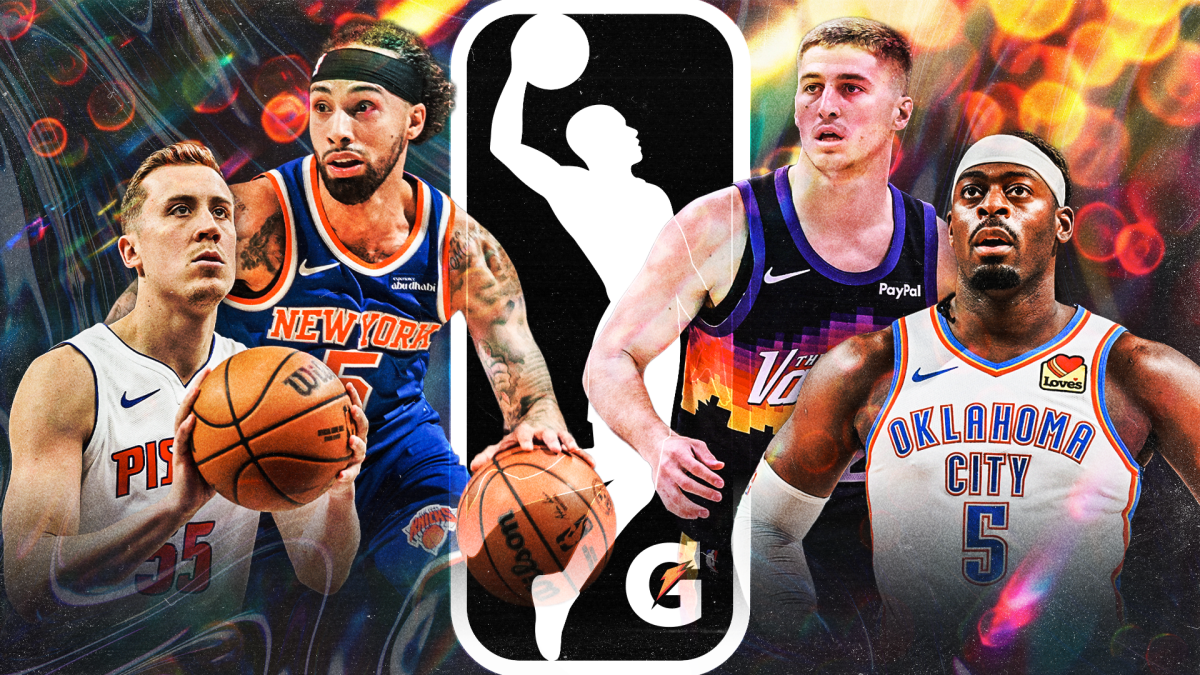
Alex Caruso is the blueprint for just how successful NBA players on two-way contracts can become. That’s certainly not what the Thunder guard envisioned after going undrafted in 2016, a year before the idea for two-way contracts was even a concept in the league. But in the years since, players have come up to the two-time champion saying that they saw his path and knew that it was possible to follow it.
But Caruso himself didn’t have that roadmap. He spent a full season on the Thunder’s G League team, then became part of that first class of two-way contract players when the Lakers signed him to a deal in July 2017. Because it was the first year that teams were implementing two-way contracts, Caruso called it a “learning experience on the job.”
“Luckily for me, I was in a really good situation with our G League team,” Caruso said. I’ll give a shoutout to my coach, [former South Bay Lakers coach] Coby Carl for being able to get me mentally to refocus when I was down there, because it is a little disappointing at times. I think he did a great job of helping navigate that, because it was the first time that anybody had ever gone through it.”
Caruso went from playing on a two-way contract to earning a standard deal with the Lakers ahead of the 2019-20 season. That same year, he played a significant role in helping the Lakers win their first championship in a decade. In the summer of 2021, Caruso signed a four-year, $36 million deal with the Chicago Bulls. He’s since come full circle as a member of the Thunder again, where his defensive acumen and shooting helped OKC win its first championship last season. Along the way, he’s also picked up two All-Defensive selections to go with his two championship rings.
Caruso’s story is one that has been retold dozens of times. It’s one that’s instantly recalled by coaches, players and league executives when talking about a player’s determination and work ethic to get to the league. So it makes sense to be the gold standard of two-way success stories. But when two-way deals were introduced with the start of the 2017-18 season, the intention was never about finding potential All-Star players or All-Defensive level guys.
Adam Simon, the assistant general manager of the Miami Heat, was part of a committee that spearheaded the idea of adding two-way contracts to the NBA. He helped present the idea to the league with the hope of adding just one two-way spot. The league instead added two spots at first, then expanded to a third with the start of the 2023-24 season.
“It was mostly about protecting like, hey, you sat there all summer and developed a player, and they go to camp with you, and now you’re giving them a bonus to go to your G League team, and boom, some team was poaching your player,” Simon told CBS Sports. “And the second was having enough players for practices that they could be on your roster, because you weren’t allowed to have extra players hanging around.”
No G League player is bound to a contract by their respective team. Instead, they sign a contract with the G League on a year-to-year basis. They could be called up to play for any NBA team, regardless of what G League jersey they wear. But the addition of the two-way contract allows teams to protect up to three players who are essentially off-limits to other teams trying to sign them.
The reaction to the idea of adding two-way roster spots was positive. However, it wasn’t without some pushback. Some teams preferred to have a giant pool of free agents in the G League as opposed to having a set number of players assigned to particular teams, a league executive who was instrumental in the creation of two-way contracts told CBS Sports. But whatever criticism existed was drowned out by the overwhelming support for the idea, and it became part of the league’s CBA in 2017.
Despite the initial idea being a way for teams to have extra bodies around for practice or to keep other teams from stealing their talent, it quickly became an avenue for teams to find some of the best role players in the league.
Not every player on a two-way contract is going to have the success Caruso has had to this point. But the groundwork that Caruso and others laid has made younger players like Denver Nuggets forward Spencer Jones look at two-way contracts as a viable path into the NBA.
“I knew the numbers, so I knew it was unlikely [to make the jump to the NBA], but I did see it as a path,” Jones said.
Jones didn’t expect to get much playing time the first year on a two-way deal with the Nuggets. But when they brought him back on another two-way contract this season, his mentality shifted. “The second year is much more about earning the [NBA] contract,” Jones said. “But the first year is proving the potential that they saw, and that the development is there.”
The Nuggets converted Jones’ two-way contract to a standard NBA deal on Feb. 19, and rightfully so. He’s been a necessary stopgap for the Nuggets as they’ve dealt with injuries. Jones’ 3-point shooting (39.6%) and his emergence as a capable defender has been a life raft for a Nuggets team that is trying to earn a top-four seed in the West.
Warriors guard Pat Spencer didn’t just look at players as evidence that he could make an improbable jump from star collegiate lacrosse player to trying to make the NBA. He keyed in on specific teams that he felt “utilized the G League” and gave guys an opportunity. “The Warriors have a history of valuing guys who play the game the right way and do things the right way,” Spencer said. Spencer previously saw that the Warriors trusted guard Damion Lee, who also started on a two-way contract, and felt like he could come in and fill a similar role.
Spencer’s been on consecutive two-way contracts with the Warriors, but has had them converted to standard deals each time. This season, though, has been his biggest opportunity. He’s averaging seven points a game while playing 17.8 minutes a night. In December, Warriors coach Steve Kerr said Spencer’s “energy and competitive spirit” have “changed” Golden State this season.
Spencer and Jones are just two of the more recent stories where two-way players have been given more opportunity to showcase their skills and then get rewarded for their efforts. This season alone, there have been 20 players who started the season on two-way contracts and have since signed multiyear deals with their respective teams. Another five players, Jones and Spencer included, have had their contracts converted for the remainder of the season. Just 18 players had their two-way contracts converted in the first two seasons of its existence combined.
Two-way contract conversions in recent years
|
2025-26 |
25 |
|
2024-25 |
26 |
|
2023-24 |
29 |
|
2022-23 |
18 |
|
2021-22 |
23 |
But why is this happening more often? Detroit Pistons sharpshooter and one of the earlier two-way success stories Duncan Robinson attributes it to more second-round picks getting those deals. “When I was starting out, it was mostly just undrafted guys,” Robinson said. The level of talent is a bit higher when suddenly the players on two-way contracts are second-round draft picks.
Two-way contracts are certainly shaping how the second round of the draft shakes out. In the case of Mavericks guard Ryan Nembhard, he knew that if he were to get drafted late in the second round, it would likely result in signing a two-way contract. However, the Mavericks didn’t have a second-round pick in the 2025 draft. Instead, Dallas’ front office assured Nembhard that if he went undrafted, there would be a two-way contract from the Mavericks waiting for him, according to Marc Stein.
It was the only guarantee of a two-way contract Nembhard received, per Stein. So when there were a few teams interested in drafting him in the 50s, Nembhard and his team declined as he preferred to go to Dallas. “I felt like Dallas showed the most love throughout the process,” Nembhard said.
Getty Images
Nembhard has started in 23 of the 55 games he’s played for Dallas. With Kyrie Irving out for the season, there was an obvious need at the point guard spot for the Mavericks, one he’s managed to fill. He had a breakout month in December, averaging 9.2 points and 6.8 assists, including a 28-point, 10-assist outing in a win against the Nuggets on Dec. 1.
Nembhard’s situation isn’t a common one. But it’s an example of how two-way contracts have given some overlooked prospects a bit of leverage. It becomes a chess match, as teams have to balance the resources they have available and what they can offer to players. Simon recalls at last year’s draft there were players that the Heat wanted, but without a second-round pick, it was difficult to get players to “focus on the Heat” as a potential destination. “Other teams that did [have a second-round pick] brought them in,” Simon said. But when that player goes undrafted, it puts a team like the Heat as a disadvantage because they haven’t established a relationship with that player.
“You didn’t get to sell your team to that player, so while the draft is happening, we’re working the phones trying to let the agents know our interest,” Simon said.
The floor has been raised on the level of talent expected from two-way contracts. But there’s also a financial component that can’t be ignored as one of the reasons we’re seeing more opportunities. Simon said there’s “no question” on if the new CBA has factored into why we’re seeing more players on two-way deals get opportunities. Robinson attributes it to that as well.
“Obviously, they’re very team-friendly contracts,” Robinson said. “So if teams can get good, young players that they get in the second round or undrafted on those contracts, it’s really beneficial.”
Two-way contracts don’t count against a team’s salary cap, and with a more restrictive CBA, being mindful with how you’re spending your money has never been more important.
“You take someone like Ryan Nembhard, it’s like found money,” G League president Shareef Abdur-Rahim said. “A guy that can come in and play a good part of the NBA season on starter-level minutes. The production that those players are having, it’s starter-level production. Those contracts aren’t counted against the cap, it’s almost like a no-brainer in a lot of ways.”
Salary cap relief aside, there’s other more tangible reasons, too. Injuries and load management create more opportunity and situations where teams now need their two-way players more than ever. “There’s been a ton of talk about how the pace of play has picked up, so you need to utilize those guys through injuries,” Spencer said.
Without opportunity, players may find themselves bouncing around from team to team before they find the right fit. It’s why it didn’t take until this season for Suns guard Collin Gillespie to break through into the NBA. The undrafted All-American out of Villanova first signed a two-way deal with the Nuggets in 2022. He then fractured his leg and missed his first season. The Nuggets re-signed him to another two-way deal, but he never managed to break through into the rotation.
Knowing that there wasn’t a ton of opportunity in Denver, Gillespie signed a two-way contract with the Suns in 2024, and used that as a springboard to get a one-year deal with Phoenix this season. Gillespie’s been a great find for Phoenix, averaging 13.1 points and 4.1 assists in nearly 30 minutes a night. His tenacity on defense and shooting have been a necessity as the Suns have dealt with injuries in their backcourt. Gillespie’s scoring average and point total this season are also the most by any player who finished the previous season on a two-way contract.
“Towards the end of last year, I was able to get a little bit more opportunity,” Gillespie said. “Bradley Beal went down, so I had to try to take advantage of my opportunity. “From there, I just took it and ran with it.”
The level of investment in two-way contracts has been noticeable to Abdur-Rahim. “In the last decade, we’ve probably had seven or eight new G League arenas built,” he said. With all 30 teams now owning a G League affiliate, it’s strengthened the connection between the two leagues, which in turn has changed the narrative for players who once looked at playing in the G League as a negative.
“There’s no better promotion than seeing the success stories, and guys having good experiences [in the G League] and reaching their goals,”Abdur-Rahim said. “That’s the best marketing we can do, and it’s on all levels. It’s the players, coaches, executives and officials.”
In whichever way the opportunity manifests itself, there also seems to be a commonality amongst guys who have that two-way experience. Boston Celtics forward Sam Hauser says it’s because players on two-way contracts “really have to grind” to earn their spot in the league. “You’re asked to do a lot of things that aren’t necessarily fun during practice,” Hauser said. Simon thinks players are doing a better job of finding their niche early on, and finding ways to impact a team outside of just scoring.
One of the most common “niches” tends to be defensive-minded players. Defense is what Caruso hung his hat on when he was coming through the G League. So did his teammate Lu Dort, who started on a two-way contract and has since earned All-Defensive honors.
“Not a lot of — especially older guys — want to take that sacrifice, go out there and really guard and play hard throughout the whole possession,” Dort said. “I feel like when you’re a young two-way player coming in, you have all that energy already. And then whatever the team is asking you to do you’ll do it without saying anything.”
Knicks guard Jose Alvarado also made a name for himself early on the defensive end. Not just the steals he racks up, the diving for loose balls, deflections and all-around effort on that end of the floor that can electrify a team when needed. Alvarado didn’t even think he’d get to the NBA, given he’s a 6-foot point guard who, despite four quality seasons at Georgia Tech, left college with little fanfare ahead of the 2021 NBA Draft.
Alvarado never had the kind of exposure or attention top draft picks had, but he knew if given the opportunity he could prove everyone wrong.
“In the NBA, there’s no hiding,” Alvarado said. “You’re either good at basketball, or you’re not. When people that were never high ranked [in high school or college] or the situation was never right in their past, when the situation is right, they showcase it.”
If a player on a two-way contract can make an impact on the defensive end, it would be nearly impossible for any team to ignore. It’s either that, or becoming a 3-point threat like Robinson, Hauser, Max Strus and countless other knockdown shooters who started on two-way contracts.
But then there are the ultra-rare examples like Austin Reaves, who, despite being signed to a two-way contract to start his career, never actually played any minutes on that deal. He signed a standard deal a month later in 2021, impressing the Lakers brass enough to earn that contract. Reaves has defied all logic of what to expect from someone previously on a two-way contract. He’s operating like an All-Star and is in line for an incredibly lucrative deal this summer.
Imagn Images
Naz Reid has similarly outperformed expectations for someone who went undrafted in 2019 and only got a chance in the league because of a two-way deal. Reid’s won Sixth Man of the Year and has become one of the most important players in each of the Timberwolves’ Western Conference finals runs the last two years.
Those are two extreme outliers. But Reaves first had to prove himself as someone who can be a reliable shooter playing off of LeBron James and Anthony Davis at the time. Reid’s 3-and-D capabilities made him the ideal archetype as a floor-spacing big in a time where there’s a premium placed on players with that skillset.
The talent that teams have managed to find on two-way contracts has been a boon for the league. It’s given more players a legitimate shot at trying to make the NBA, while also giving teams more talent at their disposal.
It’s also made the process of signing players to two-way contracts more competitive, almost like another draft that many people don’t notice. Simon says it takes establishing relationships with players and agents early, so by draft night all the work has already been done to try and get someone on a two-way contract.
That’s how the process of signing Robinson went. The Heat expressed interest in Robinson to his agent months before draft night, so when he went undrafted, Miami had a two-way contract waiting for him. The Heat are especially good at identifying those diamonds in the rough like Robinson, Strus, Gabe Vincent and several others who have joined “Heat Culture” on two-way contracts. But they haven’t always landed the player they want. Simon recalls a time when, despite establishing a relationship with a player and their agent and expressing interest before other teams, that player ultimately signed a two-way contract elsewhere. It’s something that Simon said he “was not happy” about when it happened.
It’s like recruiting players on the college circuit, and it speaks to how important two-way contracts have become, that missing out on one undrafted prospect can leave an executive instantly recalling it like muscle memory several years later.
By all accounts, the addition of two-way contracts has worked well for the league. The tweaks over the years, adding a third spot, increasing the number of days they’re eligible to play in the NBA has only improved its existence. Might we see any more tweaks? Dort would like players on two-way contracts to be eligible for the playoffs. However, there could be some pushback on that, given it would negate the need for a team to convert a player to a standard NBA contract, a league executive told CBS Sports. When you take away that commitment, it could have players stuck on two-way contracts for longer than necessary.
Regardless of what future changes are made to two-way contracts, it’s clear that it’s been a net positive. It’s provided an alternate path to the NBA for overlooked talent and created a more cohesive relationship with the G League. More success stories like Caruso, Dort, Reaves and Alvarado will be coming.
require.config({“baseUrl”:”https://sportsfly.cbsistatic.com/fly-520/bundles/sportsmediajs/js-build”,”config”:{“version”:{“fly/components/accordion”:”1.0″,”fly/components/alert”:”1.0″,”fly/components/base”:”1.0″,”fly/components/carousel”:”1.0″,”fly/components/dropdown”:”1.0″,”fly/components/fixate”:”1.0″,”fly/components/form-validate”:”1.0″,”fly/components/image-gallery”:”1.0″,”fly/components/iframe-messenger”:”1.0″,”fly/components/load-more”:”1.0″,”fly/components/load-more-article”:”1.0″,”fly/components/load-more-scroll”:”1.0″,”fly/components/loading”:”1.0″,”fly/components/modal”:”1.0″,”fly/components/modal-iframe”:”1.0″,”fly/components/network-bar”:”1.0″,”fly/components/poll”:”1.0″,”fly/components/search-player”:”1.0″,”fly/components/social-button”:”1.0″,”fly/components/social-counts”:”1.0″,”fly/components/social-links”:”1.0″,”fly/components/tabs”:”1.0″,”fly/components/video”:”1.0″,”fly/libs/easy-xdm”:”2.4.17.1″,”fly/libs/jquery.cookie”:”1.2″,”fly/libs/jquery.throttle-debounce”:”1.1″,”fly/libs/jquery.widget”:”1.9.2″,”fly/libs/omniture.s-code”:”1.0″,”fly/utils/jquery-mobile-init”:”1.0″,”fly/libs/jquery.mobile”:”1.3.2″,”fly/libs/backbone”:”1.0.0″,”fly/libs/underscore”:”1.5.1″,”fly/libs/jquery.easing”:”1.3″,”fly/managers/ad”:”2.0″,”fly/managers/components”:”1.0″,”fly/managers/cookie”:”1.0″,”fly/managers/debug”:”1.0″,”fly/managers/geo”:”1.0″,”fly/managers/gpt”:”4.3″,”fly/managers/history”:”2.0″,”fly/managers/madison”:”1.0″,”fly/managers/social-authentication”:”1.0″,”fly/utils/data-prefix”:”1.0″,”fly/utils/data-selector”:”1.0″,”fly/utils/function-natives”:”1.0″,”fly/utils/guid”:”1.0″,”fly/utils/log”:”1.0″,”fly/utils/object-helper”:”1.0″,”fly/utils/string-helper”:”1.0″,”fly/utils/string-vars”:”1.0″,”fly/utils/url-helper”:”1.0″,”libs/jshashtable”:”2.1″,”libs/select2″:”3.5.1″,”libs/jsonp”:”2.4.0″,”libs/jquery/mobile”:”1.4.5″,”libs/modernizr.custom”:”2.6.2″,”libs/velocity”:”1.2.2″,”libs/dataTables”:”1.10.6″,”libs/dataTables.fixedColumns”:”3.0.4″,”libs/dataTables.fixedHeader”:”2.1.2″,”libs/dateformat”:”1.0.3″,”libs/waypoints/infinite”:”3.1.1″,”libs/waypoints/inview”:”3.1.1″,”libs/waypoints/jquery.waypoints”:”3.1.1″,”libs/waypoints/sticky”:”3.1.1″,”libs/jquery/dotdotdot”:”1.6.1″,”libs/jquery/flexslider”:”2.1″,”libs/jquery/lazyload”:”1.9.3″,”libs/jquery/maskedinput”:”1.3.1″,”libs/jquery/marquee”:”1.3.1″,”libs/jquery/numberformatter”:”1.2.3″,”libs/jquery/placeholder”:”0.2.4″,”libs/jquery/scrollbar”:”0.1.6″,”libs/jquery/tablesorter”:”2.0.5″,”libs/jquery/touchswipe”:”1.6.18″,”libs/jquery/ui/jquery.ui.core”:”1.11.4″,”libs/jquery/ui/jquery.ui.draggable”:”1.11.4″,”libs/jquery/ui/jquery.ui.mouse”:”1.11.4″,”libs/jquery/ui/jquery.ui.position”:”1.11.4″,”libs/jquery/ui/jquery.ui.slider”:”1.11.4″,”libs/jquery/ui/jquery.ui.sortable”:”1.11.4″,”libs/jquery/ui/jquery.ui.touch-punch”:”0.2.3″,”libs/jquery/ui/jquery.ui.autocomplete”:”1.11.4″,”libs/jquery/ui/jquery.ui.accordion”:”1.11.4″,”libs/jquery/ui/jquery.ui.tabs”:”1.11.4″,”libs/jquery/ui/jquery.ui.menu”:”1.11.4″,”libs/jquery/ui/jquery.ui.dialog”:”1.11.4″,”libs/jquery/ui/jquery.ui.resizable”:”1.11.4″,”libs/jquery/ui/jquery.ui.button”:”1.11.4″,”libs/jquery/ui/jquery.ui.tooltip”:”1.11.4″,”libs/jquery/ui/jquery.ui.effects”:”1.11.4″,”libs/jquery/ui/jquery.ui.datepicker”:”1.11.4″}},”shim”:{“liveconnection/managers/connection”:{“deps”:[“liveconnection/libs/sockjs-0.3.4″]},”liveconnection/libs/sockjs-0.3.4”:{“exports”:”SockJS”},”libs/setValueFromArray”:{“exports”:”set”},”libs/getValueFromArray”:{“exports”:”get”},”fly/libs/jquery.mobile-1.3.2″:[“version!fly/utils/jquery-mobile-init”],”libs/backbone.marionette”:{“deps”:[“jquery”,”version!fly/libs/underscore”,”version!fly/libs/backbone”],”exports”:”Marionette”},”fly/libs/underscore-1.5.1″:{“exports”:”_”},”fly/libs/backbone-1.0.0″:{“deps”:[“version!fly/libs/underscore”,”jquery”],”exports”:”Backbone”},”libs/jquery/ui/jquery.ui.tabs-1.11.4″:[“jquery”,”version!libs/jquery/ui/jquery.ui.core”,”version!fly/libs/jquery.widget”],”libs/jquery/flexslider-2.1″:[“jquery”],”libs/dataTables.fixedColumns-3.0.4″:[“jquery”,”version!libs/dataTables”],”libs/dataTables.fixedHeader-2.1.2″:[“jquery”,”version!libs/dataTables”],”https://sports.cbsimg.net/js/CBSi/app/VideoPlayer/AdobePass-min.js”:[“https://sports.cbsimg.net/js/CBSi/util/Utils-min.js”]},”map”:{“*”:{“adobe-pass”:”https://sports.cbsimg.net/js/CBSi/app/VideoPlayer/AdobePass-min.js”,”facebook”:”https://connect.facebook.net/en_US/sdk.js”,”facebook-debug”:”https://connect.facebook.net/en_US/all/debug.js”,”google”:”https://apis.google.com/js/plusone.js”,”google-csa”:”https://www.google.com/adsense/search/async-ads.js”,”google-javascript-api”:”https://www.google.com/jsapi”,”google-client-api”:”https://accounts.google.com/gsi/client”,”gpt”:”https://securepubads.g.doubleclick.net/tag/js/gpt.js”,”hlsjs”:”https://cdnjs.cloudflare.com/ajax/libs/hls.js/1.0.7/hls.js”,”recaptcha”:”https://www.google.com/recaptcha/api.js?onload=loadRecaptcha&render=explicit”,”recaptcha_ajax”:”https://www.google.com/recaptcha/api/js/recaptcha_ajax.js”,”supreme-golf”:”https://sgapps-staging.supremegolf.com/search/assets/js/bundle.js”,”taboola”:”https://cdn.taboola.com/libtrc/cbsinteractive-cbssports/loader.js”,”twitter”:”https://platform.twitter.com/widgets.js”,”video-avia”:”https://sports.cbsimg.net/fly/js/avia-js/2.48.0/player/avia.min.js”,”video-avia-ui”:”https://sports.cbsimg.net/fly/js/avia-js/2.48.0/plugins/ui/avia.ui.min.js”,”video-avia-gam”:”https://sports.cbsimg.net/fly/js/avia-js/2.48.0/plugins/gam/avia.gam.min.js”,”video-avia-hls”:”https://sports.cbsimg.net/fly/js/avia-js/2.48.0/plugins/hls/avia.hls.min.js”,”video-avia-playlist”:”https://sports.cbsimg.net/fly/js/avia-js/2.48.0/plugins/playlist/avia.playlist.min.js”,”video-ima3″:”https://imasdk.googleapis.com/js/sdkloader/ima3.js”,”video-ima3-dai”:”https://imasdk.googleapis.com/js/sdkloader/ima3_dai.js”,”video-utils”:”https://sports.cbsimg.net/js/CBSi/util/Utils-min.js”,”video-vast-tracking”:”https://sports.cbsimg.net/fly/js/sb55/vast-js/vtg-vast-client.js”}},”waitSeconds”:300});
