
If not for a remarkable coincidence and a remarkably modern general manager, the Montreal Canadiens might have been condemned to respectable irrelevance indefinitely. Not failure. Not a disaster. Just mediocrity, the most dangerous place in sports. That fate was avoided not by design, but by circumstance and by Kent Hughes.
For all the talk about culture, identity, and language, the Canadiens very nearly trapped themselves in their own mythology. The insistence that a coach in Montreal must speak French fluently enough to satisfy the press gallery and the politicians has nothing to do with the players in the room. Nothing. This is not a hockey requirement. It is a political one.
The Canadiens’ dressing room, like most in the NHL, functions almost entirely in English. The league operates in English. Systems are taught in English. Video sessions are in English. Bench communication is in English. The idea that a head coach’s value is tied to his ability to conduct press conferences in French is a construct of the market, not the sport. Yet, that construct has shaped this franchise for decades.
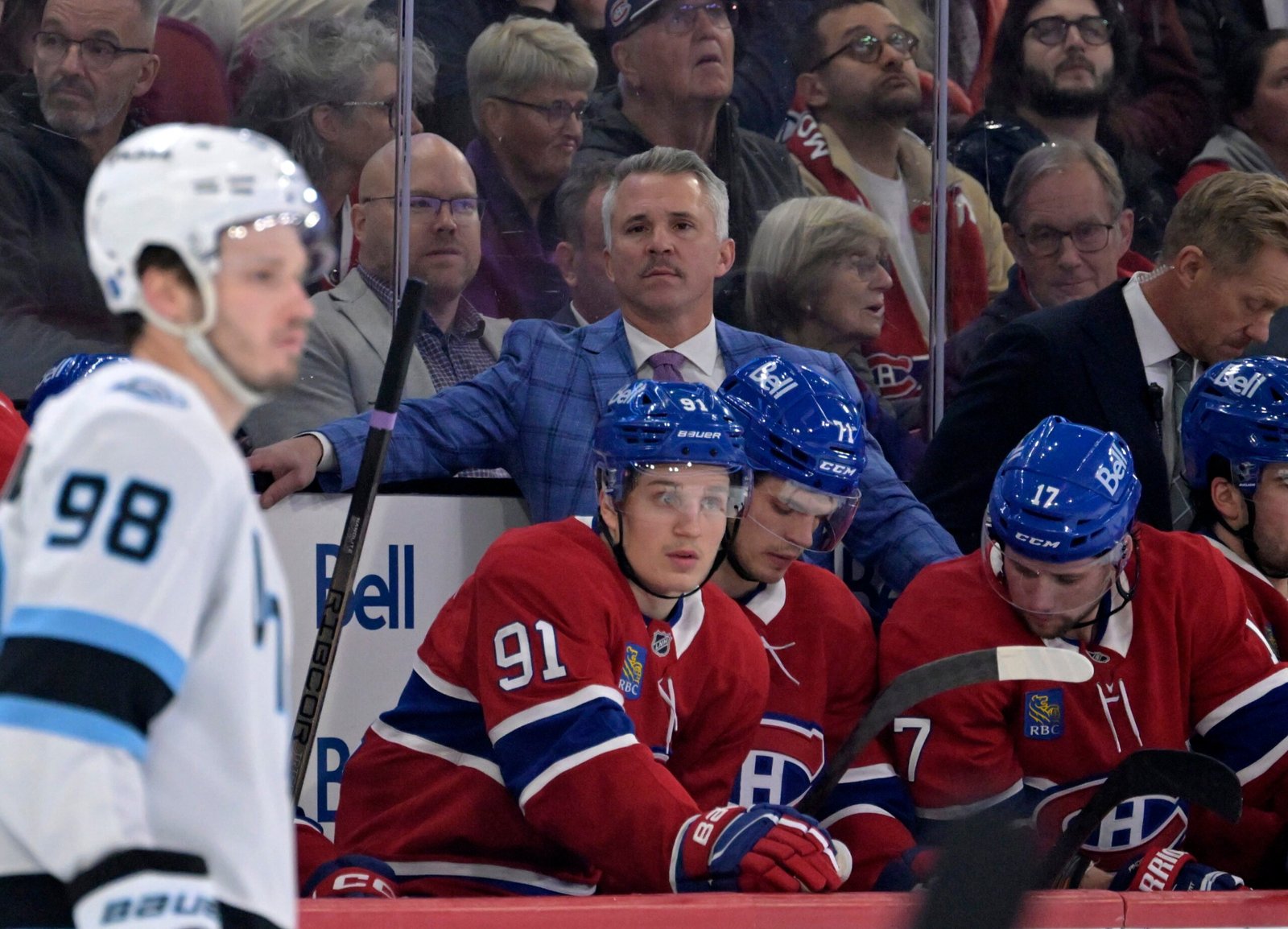
Somehow, through geography, personal familiarity, and sheer hockey intellect, the Canadiens landed a real coach, a rare one, Martin St. Louis.
A Quarter-Century of Canadiens Coaching Turnover Since Jacques Demers
It is one of the great ironies of modern Canadiens history that the best coach they have employed in the last 25 years, arguably more, also happens to be a former player. The only other name that belongs in that conversation is Guy Carbonneau. That’s not nostalgia. That’s evidence.
Coaching matters more than this organization has wanted to admit.
Since 1993, the Canadiens have employed 12 different head coaches across 17 coaching stints. Jacques Demers won the Stanley Cup in 1993 and then exited the stage. Since then, it has been rotation, recycling, and reset after reset: Michel Therrien (twice), Claude Julien (twice), Bob Gainey (parachuted in as a stabilizer twice), Mario Tremblay, Alain Vigneault, Jacques Martin, Guy Carbonneau, Dominique Ducharme, and Randy Cunneyworth.
With one exception, Cunneyworth, every one of them spoke French. Most were Francophone. Bob Gainey wasn’t, but he was Bob Gainey. Here’s the part that never gets said loudly enough: none of them won a Stanley Cup except Demers. Most didn’t come close.
You can’t hang all of that on the coaches. General managers deserve their share of the blame. Roster construction matters. Timing matters. Goaltending matters. But coaching still matters a lot.
How Martin St. Louis Reframed Development and Accountability in Montreal
Not just systems. Not just matchups. Development. Teaching. Accountability. Growth. Ask yourself this: which of those coaches can you honestly point to and say this group of players got better because of him? Not played harder. Not survived longer. Actually improved. The list is short, and it ends with St. Louis.
What makes this even more revealing is how St. Louis arrived. He didn’t climb the coaching ladder. He didn’t grind through the minors. He didn’t wait for his turn. He backed into the job. He knew Hughes. Their kids played together. They lived nearby. They talked hockey. That was enough. Hughes gets the general manager job. Ducharme, unpopular, overwhelmed, and in retrospect never truly viable, is dismissed. St. Louis gets the call.
Yes, once again, thank God he speaks French. Because if he didn’t, none of this would have happened. Not because the players wouldn’t listen. Not because the room wouldn’t respond. But because the politics wouldn’t allow it.
Related: Martin St. Louis & the Canadiens’ Power of Belief
Ask the uncomfortable question: if St. Louis were unilingual English, would he be coaching the Montreal Canadiens today? The answer is obvious.
So who would they have hired instead? Pascal Vincent? A capable coach, perhaps. A transformational one? Unlikely. Outside of John Cooper, Paul Maurice, and Joel Quenneville, true difference-makers behind the bench are rare. Most NHL coaches are transitory, placeholders until the next reset. St. Louis is not.
Politics, Language, and the Stanley Cup Path for the Montreal Canadiens
If he chooses to stay, if he commits fully to the craft, St. Louis has the potential to become one of the most influential coaches this organization has seen in decades. He isn’t doing it alone. Hughes and Jeff Gorton have provided him with skill, youth, intelligence, and a culture that finally feels coherent. The alignment between management and coaching is real, and that alone separates this era from many that came before it.
Which brings us back to the core issue. The language requirement is not about hockey. It never has been. It is about politics, optics, and public messaging. In a league where competitive edges are microscopic, self-imposed limitations make no sense. The Canadiens haven’t iced a truly dominant team since the 1970s, and even their last two Stanley Cups required extraordinary goaltending and favorable chaos.
Hockey in Quebec isn’t bigger than politics. It’s different. It’s an escape. A place to feel, not argue. A place where passion runs hotter than anywhere else in the world. The Canadiens are supposed to be a refuge, a reason to cheer, and a reason to hope. For everyone born after 1990, it’s simple: see a Stanley Cup lifted before it’s too late. Nobody cares what language the coach speaks.
Nobody cares about optics. They care about winning, about belief, about finally being more than a memory. Politics should step aside. Let the game do the talking. Let the joy of being Canadiens fans speak. Maybe, just maybe, we’ll see that Cup hang from the rafters for the first time in their lifetime.
Maybe St. Louis is the coach who finally brings the Canadiens another Stanley Cup. Maybe he isn’t. Either way, if this team is going to give itself the best possible chance to win again, politics has no place on the ice. None. Leave it out. Let the game decide. Let the players, the coaches, and the fans do the talking. That’s how Montreal wins.

