

Montreal Canadiens fans may have their sights set on Michael Hage becoming the second-line centre of the future, but it will be a few more seasons before he’s ready to take on the role. General manager (GM) Kent Hughes could always make a trade to fill the role, but they might have a solution already within the organization.
Related: Montreal Canadiens Displaying the Power of Team Culture in NHL’s Salary-Cap Era
Rookie forward Oliver Kapanen has emerged, unexpectedly, as the Canadiens’ second line centre (2C). Is he an effective 2C? Is he able to fill the role for the next few seasons? Can he lift his game in the playoffs? If Kapanen is the team’s answer to these questions, then management can start to fill other holes in the lineup, such as scoring depth on the wings.
Canadiens’ Needs From a 2C
Stanley Cup champions always have depth at centre. The Florida Panthers, Colorado Avalanche, and even finalists like the Edmonton Oilers all have undeniable top-line centres, Alexander Barkov, Nathan Mackinnon and Connor McDavid, and quality second-line centres behind them, like Sam Bennett, Nazem Kadri and Leon Draisaitl. This one-two punch allows teams to let their top line be the offensive catalysts while the second provides strong two-way play, focused on matchups, while also producing some offence.
Nick Suzuki is the Canadiens’ top-line centre, and while he doesn’t have the star power of those named above, he provides similar offensive output and defensive abilities. But can Kapanen perform the duties of the 2C listed above? Head coach Martin St. Louis thought he could do it at the start of the season:
“I think he’s got the potential to be a complete player. I think he’s a guy who can kill (penalties), could play the power play…I feel like his offensive game is gonna keep evolving…His all-around understanding of the game is his ticket (to the NHL).”
Teams hoping to compete for more than just a playoff berth require a lot from their 2C. They need size. Successful 2Cs are bigger or more physical and can hold their own in puck battles in the corners and in front of the net. At 6-foot-2 and 194 pounds, Kapanen fits. The next is two-way play. Kapanen has shown that he can contribute at both ends of the ice, being defensively responsible enough to handle tough matchups against an opponent’s top six.
That also highlights his hockey IQ, which St. Louis has already praised. Scoring? He is on pace for 27 goals this season, ranks second on the team in that category, and is tied for the lead among NHL rookies. He also provides depth and versatility. His ability to slot in on the power play (PP), the penalty kill (PK), and be trusted at five-on-five allows St. Louis to spread talent across the lineup and create matchup problems for the opposition.
His faceoff prowess is still a work in progress, but he sits at 49% as a rookie and is improving. Offensively, he doesn’t carry his line as a prototypical 2C is expected to, but he can complement a play driver like Ivan Demidov while also insulating him defensively. His ability to identify gaps in coverage and give playmakers a target in front of the net who can finish is what Montreal needs outside of their first line.
Kapanen’s consistency has quietly been the secret to Montreal’s continued progression. His strong play has earned him the attention of Team Finland’s management staff ahead of the Olympics. Injuries to Kirby Dach and Alex Newhook have sapped the Canadiens’ centre depth, yet Kapanen has found a way to progress, produce and contribute, helping the team stay competitive every night. Montreal hasn’t had that type of player since, maybe, Tomas Plekanec.
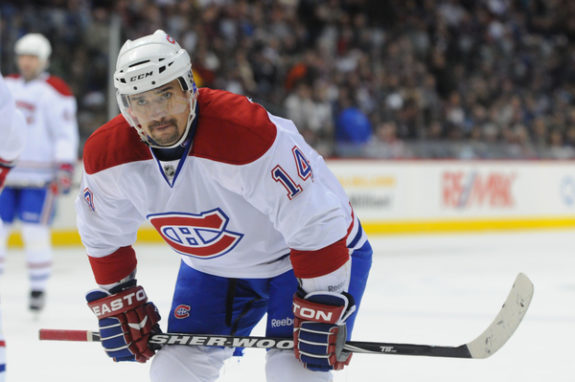
Plekanec and Kapanen are both responsible, high-IQ, two-way centres. Plekanec proved he could be a defensive pest against the best players in the world. While Kapanen may never get to that level, his strong positional play, ability to cut passing lanes and forecheck make him a difficult player to play against as well. While their offensive focus, physicality, and overall skill ceilings differ, there are similarities between the two, and that is a high compliment to the young Finnish centre.
(Icon SMI)
Part of Kapanen’s impact has been to cover for Newhook’s absence, who was on pace to score roughly thirty goals and may not return this season. Then there’s the loss of Patrik Laine, also to injury, who was a major contributor on the power play. Yet, Kapanen has also helped fill that hole by adding a shooting option to the second unit. He also allows Hughes to focus on more than just finding a centre; he can look for a scoring threat who plays on the wing.
Teams like the Nashville Predators, St. Louis Blues, Vancouver Canucks and Calgary Flames may be ready to sell, and some have been following the Canadiens closely this season. Montreal should be interested in any winger with speed, pace and two-way ability who can add 25 to 30 goals. More specifically, they could use someone on the left side in the top six, as Juraj Slafkovsky has been the only consistent threat in that role.
In essence, the ideal 2C is a reliable, all-around player who can effectively bridge the gap between the elite offensive talent of the first line and a more defence-oriented second line, which Kapanen has been able to do, for the most part. While most believe he will become an elite third-line centre when the team becomes a real contender, Kapanen has forced himself into the 2C discussion. If anything, his solid play has bought management time to assess their depth without the team going into a nosedive.

