
There’s a lot to like about how the Detroit Red Wings’ 2025-26 season has played out thus far. Detroit owns the eighth-best record in the NHL at 33-19-6, and their star players—Dylan Larkin, Lucas Raymond, Alex DeBrincat, Moritz Seider, and John Gibson—have led the charge.
That said, there’s no guarantee they make the playoffs. The Red Wings have the fourth-most difficult schedule remaining thanks to their membership in the uber-competitive Atlantic Division. They cannot cruise to the finish line.
This is not intended to be fearmongering or rage bait — it’s an honest assessment of where the Red Wings are at, and what they need to do to reach the postseason. Let’s dive in.
2025-26 Red Wings By the Numbers
Here’s a snapshot of how the Red Wings have performed through the first 58 games of the season. Note that the offense- and defense-specific metrics are at five on five.
Red Wings: Overall Performance
| Metric | Value | Rank |
| Points Percentage | .621 | 8 |
| Goals For/Game | 2.97 | 20 |
| Goals Against/Game | 2.97 | 12 |
| Power Play | 23.1% | 9 |
| Penalty Kill | 79.6% | 15 |
Red Wings: 5-on-5 Offense
| Metric | Value | Rank |
| CF/60 | 57.61 | 15 |
| GF/60 | 2.11 | 27 |
| xGF/60 | 2.66 | 14 |
| HDCF/60 | 10.96 | 23 |
Red Wings: 5-on-5 Defense
| Metric | Value | Rank |
| CA/60 | 59.57 | 25 |
| GA/60 | 2.43 | 13 |
| xGA/60 | 2.66 | 15 |
| HDCA/60 | 11.56 | 17 |
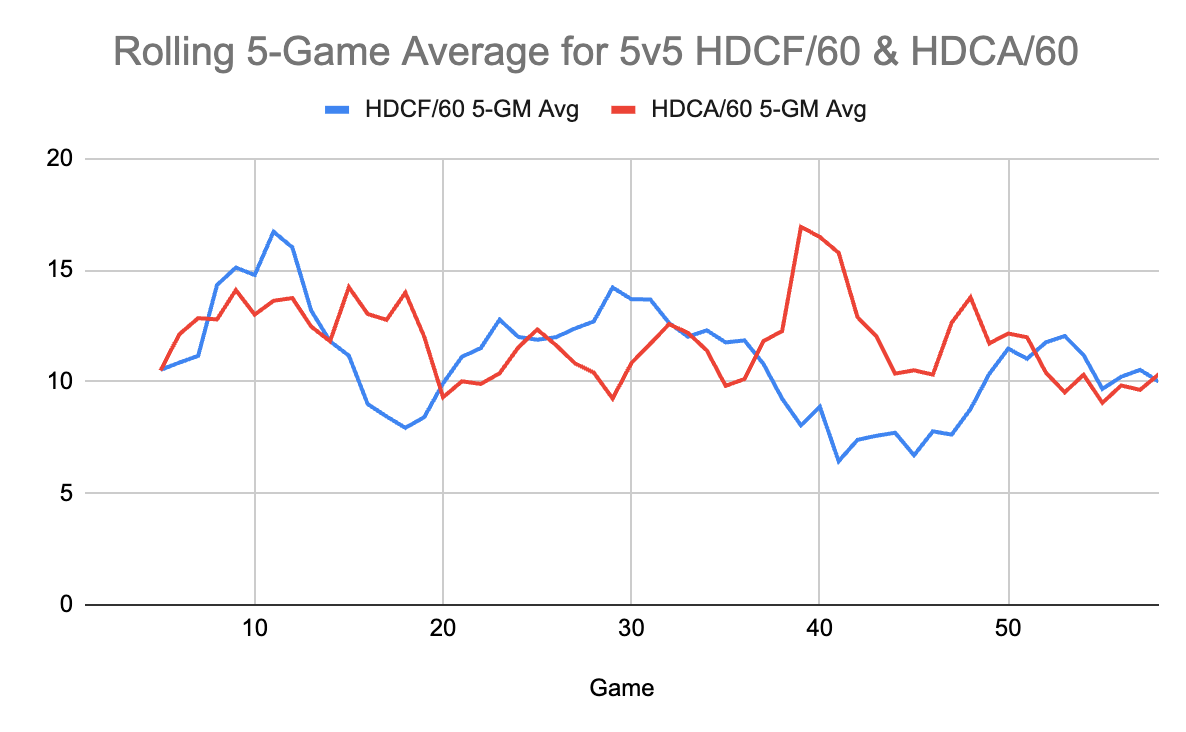
My personal preference is to utilize high-danger chances as a proxy for a team’s offensive creation and defensive suppression. It’s not cumulative like expected goals, and is purely location-based.
Here is how the Red Wings have trended over time when it comes to high-danger chances:
Now that we’ve covered the numbers, let’s dig into what they mean.
Analyzing the 2025-26 Red Wings
We’ll start with the offense. Detroit’s goal scoring hasn’t been particularly impressive this season. But, hey, it’s been good enough to win 33 games.
That said, the misaligned GF/60 and xGF/60 caught my attention early on. In my opinion, these numbers should be roughly the same. If not, it’s worth digging into why.
Detroit’s GF/60 and xGF/60 discrepancy can be explained two ways:
- They’re due to score more goals, given the lower GF/60 number
- xGF/60 is being inflated by shot attempt volume
Given Detroit’s below-average HDCF/60, I’m inclined to think it’s the latter – that they overindex in low- and medium-danger chances, and that adds up into an above-average xGF/60 figure that’s not fully indicative of what actually happens on the ice.
I don’t think anyone will disagree that the Red Wings’ five-on-five offense has been lackluster this season. They just aren’t generating enough high-danger chances in the dirty areas around the crease and inner slot. They’re called high-danger chances for a reason, after all.
In fact, Red Wings forwards have only scored 14 five-on-five goals since Jan. 1 – eight by the top six and six (four from J.T. Compher alone) from the bottom six.
This has to change when the team returns to action after the Olympics. The Red Wings need to score more – especially at five on five. (The power play has slumped as of late, too – Detroit needs to reignite their man advantage.)
This can be viewed as a development opportunity for the team. Can they dig deep and step their game up during the all-important stretch run? Can Todd McLellan maximize the lineup and squeeze some more offense out of his forwards?
Personally, I wouldn’t bank on it. We’ve had a sufficient enough sample size to show that reinforcements are needed. A trade deadline acquisition would certainly help. There’s a case to be made that a particular AHL call-up could be effective, too.
During his nine-game stint with the Red Wings earlier in the season, Michael Brandsegg-Nygard produced impressive high-danger numbers, including 4.92 iHDCF/60, 1.23 rush attempts per 60, and 9.22 individual scoring chances per 60 (iSCF/60). He ranks in the top-three among Red Wings forwards for all of these metrics. It’s a small sample size, yes, but his strong performance (and physical style of play) warrants another NHL look.
Moving on to Detroit’s defense, the report is a bit rosier. Their GA/60, xGA/60, and HDCA/60 have all improved since Jan. 1. In addition, their high-danger shots against per 60 (HDSA/60)—a subset of HDCA/60—ranks very favorably when compared to the rest of the league, indicating that while the Red Wings allow their fair share of HDCA/60, a small percentage actually hit the goalie/net.
Another plus – Simon Edvinsson is expected to return after the Olympic Break. Deploying two top-pairing-caliber defensemen 22-plus minutes a night should improve the team’s defensive numbers that much more.
If you asked me in December what the Red Wings’ biggest need was, I would have said defensive depth. Arguably, that’s lower on the totem pole now with the offense sputtering. Still, there’s risk in maintaining the status quo given the ebbs and flows that take place throughout the season. Adding defensive depth would be a prudent move – reinforcing the second-pair with a true top-four blueliner would have a cascading effect, slotting the rest of Detroit’s defensemen into more appropriate roles.
Related: Red Wings Have Earned Trade Deadline Reinforcements
The Red Wings should also mitigate their risk when it comes to their goalies. John Gibson has been stellar, but there’s risk of overuse, especially when you consider his age an injury history. It would be wise to get Cam Talbot more starts down the stretch to ensure both goalies are fresh (and healthy) once the postseason begins.
Final Word
The Red Wings were fortunate to bank a lot of points early in the season. And, as of now, they have a 78.3 percent chance of reaching the postseason, according to MoneyPuck.
There’s no guarantee they snap the playoff drought, though. The Atlantic Division is tight, and Detroit cannot afford to slip up down the stretch. You already know that Tampa Bay, Montreal, Buffalo, and possibly Boston will add at the trade deadline, and Ottawa and Florida aren’t planning to back down.
So if the Red Wings want to reach the playoffs, they need to:
- Improve their goal-scoring, both at five on five and on the power play, through internal and external sources
- Get greater contributions from the bottom six
- Add defensive depth in order to slot their blueliners more appropriately
- Manage Gibson and Talbot’s workloads to keep both fresh
Accomplishing these four objectives will put them in a great spot to reach the postseason for the first time since Dylan Larkin’s rookie year. Mitigating potential slumps for Olympic participants and not letting the pressure of ending the drought/experiencing another late-season collapse get to them will help, too.
A playoff berth is within Detroit’s grasp. They need to seize the opportunity before it passes them by.
Data courtesy of NHL.com, Natural Stat Trick, and MoneyPuck.

