
If you are a Montreal Canadiens fan who values a good night’s sleep, the recent road trip through California was likely a nightmare. For the rest of us, those who thrive on high-event hockey and the chaotic unpredictability of a young team finding its legs, it was a fascinator.
The Habs returned from the West Coast with a mix of results that perfectly encapsulates where this franchise sits in its development. We saw an offensive engine humming at a top-tier rate, a defensive structure that occasionally looked like a sieve, and a front office that remains stubbornly, perhaps correctly, obsessed with the long-term view over immediate gratification.
The Defensive Dilemma
It is no secret that the Canadiens are a fun team to watch right now. They rank near the top of the league in scoring, sitting in third for total goals. However, as the old adage goes, you cannot outrun your problems forever. The “Wild West” shootout mentality followed them through San Jose, Anaheim, and Los Angeles against the Kings, exposing a defensive core that is still very much a work in progress.
During this three-game stretch, the Canadiens surrendered 15 goals. While the 7-5 loss to the Sharks and the 6-5 shootout heartbreaker against the Ducks were entertaining for the neutral observer, they highlighted a glaring lack of physicality and spatial awareness in the defensive zone. Opposing forwards are finding it far too easy to set up shop in front of the net.
The Crease Conundrum
Compounding the defensive lapses is a lack of consistency between the pipes. To win in the NHL when your defense is leaking, you need your goalie to make a save. Right now, neither Samuel Montembeault nor Jakub Dobeš is providing that on a regular basis. Both sit in the bottom third of the league in terms of their ability to stop the shots they should be stopping.
The Anaheim game was a particularly tough watch for Montembeault. Allowing goals from beyond 50 feet, shots that NHL netminders are expected to swallow up, deflates a bench that is working overtime to provide offensive support. While the team’s philosophy is built on speed and skill, a lack of reliable goaltending remains the quickest way to exit the postseason conversation, regardless of how many goals your top line puts up.
Hughes Plays the Long Game
As the trade deadline passed, the atmosphere around the team was one of quiet frustration. General manager Kent Hughes opted to stand pat, a move that didn’t sit well with a segment of the fan base that feels this group is one or two pieces away from being a legitimate threat. The reality, as Hughes later revealed, was more nuanced. The front office was active, reportedly working on a significant deal right up until the final buzzer. The deal fell through, and it’s a file Hughes expects to reopen this summer.
Related: What’s Next for Patrik Laine and the Canadiens After a Disappointing Trade Deadline
Critics will argue that by failing to acquire a right-shot defenseman or an experienced goaltender, the Canadiens missed a window to shore up their biggest weaknesses. But Hughes’ stance is clear; he refuses to mortgage the future. Having already brought in veteran presence like Phillip Danault earlier in the season, he is unwilling to pay the deadline tax for rentals that don’t fit the championship window he’s trying to build. It’s a disciplined approach, even if it feels like a missed opportunity in the short term.
Resilience in Hollywood
Despite the defensive chaos and the lack of deadline reinforcements, the trip ended on a high note in Los Angeles. If the first two games were about what’s missing, the win against the Los Angeles Kings was about what this team has.
Specifically, it has a top line that is bordering on elite. The trio of Juraj Slafkovsky, Nick Suzuki, and Cole Caufield has been reunited, and the chemistry is undeniable. They aren’t just scoring; they are dominating shifts. Watching them work, it isn’t hard to envision them becoming a 100-goal unit in the very near future. Their ability to trigger third-period comebacks, which the Habs did in all three California games, speaks to a mental toughness that belies their age.
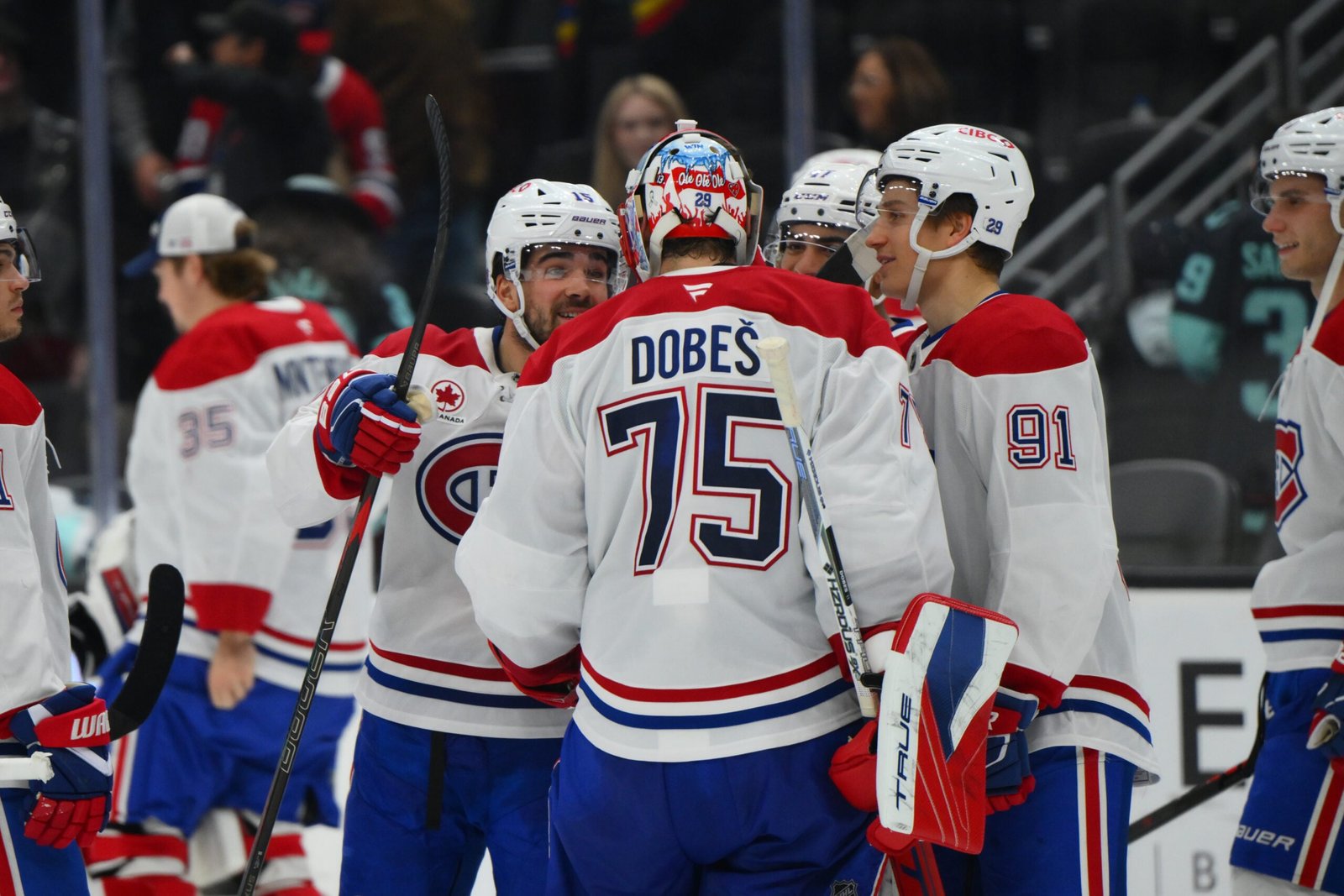
But let’s be honest, they don’t win that game in LA without Dobeš. After a rough outing in San Jose, he stood on his head against the Kings. The Canadiens were utterly dominated in the opening frame, at one point being outshot 16-1. Dobeš’s performance was a “robbery” in every sense of the word. That performance has already sparked a debate in Montreal: Is it time to let the kid run with the starting job?
The California trip was a microcosm of the 2025-26 Canadiens. They are fast, they are resilient, and they can score their way out of almost any hole. They are also young, occasionally soft in their own end, and prone to the kind of mistakes that only experience can cure. Hughes is betting that the internal growth of Slafkovsky and Suzuki, coupled with a major off-season addition, is a better path than a panicky deadline trade. Based on the grit shown in Los Angeles, he might just be right.
AI tools were used to support the creation or distribution of this content, however, it has been carefully edited and fact-checked by a member of The Hockey Writers editorial team. For more information on our use of AI, please visit our Editorial Standards page.
