
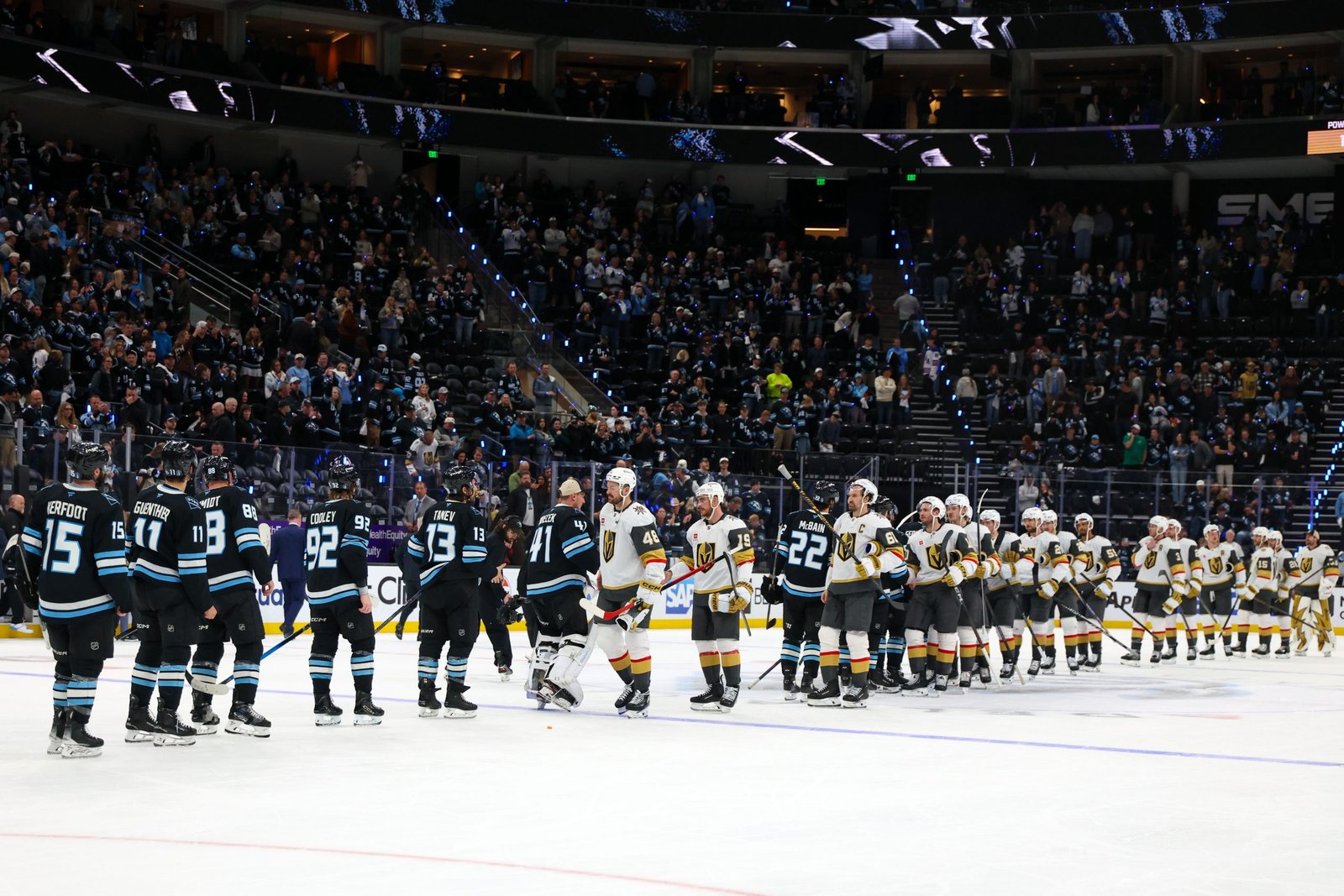
Friday was the final day of the Utah Mammoth’s season, with the team losing to the Vegas Golden Knights in Game 6 of the Stanley Cup playoffs. There were a lot of positives throughout the season that were highlighted by the team’s ability to clinch the franchise’s first-ever playoff spot.
However, after six hard-fought games against the Golden Knights, the Mammoth now find themselves in summer mode. There is and should be a sense of pride around the organization, considering they pushed a Golden Knights team who have only lost in the first round twice in their eight postseason appearances. Additionally, seven of the Mammoth’s top prospects have yet to be regulars in the lineup. This is not the complete or best team we’ll see play in the Delta Center.
Despite all of that, it’s easy to pick apart the reasons why the Mammoth lost this series, especially because they had the chance to win it. Those issues are things the Mammoth need to address in the offseason because a lot of them plagued the team in the regular season as well. These are the reasons why the Mammoth lost their first-round series against the Golden Knights.
The Golden Knights Had More Experience
The biggest reason why the Mammoth lost this series is something out of their hands. Something they couldn’t control. Experience. We’ve talked about it all series long, and the players have been asked repeatedly about it. Finally, when it came to the final postgame interviews of the season, there was no denying it.
“I think experience (was the biggest difference), they know how to win,” Mikhail Sergachev said. “They won not a long time ago. They play well, even though sometimes we were outplaying them; they were still in the game. They were never out of it because of their experience. In the right moments, they put the game away. That’s the difference. But I believe in the future, we’re going to be there.”
When you look at this team, there are some players who do have prior playoff experience. Sergachev, Ian Cole, Kevin Stenlund, Nate Schmidt, and Vítek Vaněček all won Stanley Cups before coming to Salt Lake City. Alex Kerfoot, John Marino, MacKenzie Weegar, Brandon Tanev, and Kailer Yamamoto have all played in playoff games.
However, most of those players play supporting roles. The big names are the ones who had never experienced playoff hockey before the past couple of weeks. Clayton Keller, Lawson Crouse, and Barrett Hayton all played in the postseason in the bubble, which is nothing like what they just went through. Nick Schmaltz played just four playoff games back in his rookie season, when the Chicago Blackhawks were swept by the Nashville Predators.
Logan Cooley, Dylan Guenther, JJ Peterka, and Karel Vejmelka all had zero NHL playoff games going into this season. Those are two top-six forwards and a starting goaltender. On top of that, head coach André Tourigny had never coached a playoff game as a head coach in the NHL.
All of that showed. Keller, Crouse, and Schmaltz’s line was slow to start. While all three eventually found their game after Game 2, they never hit the heights they were expected to hit. Crouse was the best, producing three goals and five points. Keller and Schmaltz, despite being two of the top three goal scorers in the regular season, only had one goal each in the playoffs.
Cooley and Guenther started out strong but trailed off in the final few games. Cooley didn’t produce a single point after Game 3. Guenther, while recording two points in the final three games of the series, didn’t dominate as he did in the first three games. Carter Hart learned how to read his usual rocket of a shot after being tortured by it earlier in the series.
Cooley, in particular, took some really bad penalties throughout the series. A really bad holding penalty and high-sticking penalty in Game 5, and another bad high-sticking penalty in Game 6. That’s six minutes where the Mammoth could’ve been playing five-on-five, where they were better than the Golden Knights. They could’ve scored goals, generated chances, anything. Instead, they killed a pointless penalty.
It wasn’t just Cooley taking bad penalties. Sergachev took a bad one as well in Game 5. While it’s not the biggest issue that happened in the series, it was an issue.
Vejmelka also had some bad turnovers and giveaways throughout the series. In Game 4, the overtime winner was scored because the goaltender lost control of a rebound. Shea Theodore’s goal in Game 5 was turned over by Vejmelka. He is no means the reason why the Mammoth lost either of those games, but he did have some bad goals given up throughout the series.
FROM HIS OFFICE 🐻 pic.twitter.com/DFT1OreevK
— Vegas Golden Knights (@GoldenKnights) April 30, 2026
The Mammoth also lost back-to-back games in overtime. That all goes back to not having experience. The Golden Knights knew how to play and score despite being tired because they’ve been through this grind plenty of times. Their effectiveness in overtime won them Games 5 and 6.
Finally, it’s worth noting that the Mammoth were without Jack McBain and Hayton for most of the series. McBain only played two games, and Hayton only appeared in Game 5. Those are two players who just scream playoff players, each bringing a physical presence. However, the Golden Knights were without William Karlsson the whole series. Injuries, in this case, cannot be an excuse.
The Mammoth Had an Awful Power Play
There are only two teams that have a worse power play than the Mammoth in the postseason. One of those teams only played four games before being eliminated (granted, scoring once on 21 opportunities is abysmal). The Mammoth scored the same number of goals as the Ottawa Senators did on the power play, but on five fewer opportunities. They are third to last in power play success rate, scoring just 4.3% of the time. That is a problem.
For most of the season, the power play was a problem. Before the Olympic break, the Mammoth were at the bottom of the league with the Colorado Avalanche in the category. After the break, the Mammoth all of a sudden became dynamite on the man advantage, pulling themselves back up to 18th place in the league.
However, at the worst possible time, the Mammoth’s power play cratered. The unit was consistently good last season, so what happened?
Well, the Mammoth got way too cute with passing. They made a lot of fancy passes but never got the opportunity to shoot because the Golden Knights’ penalty kill would intercept those passes. The second unit, in particular, didn’t find itself with too many scoring chances.
It also has to be mentioned that the Golden Knights have been extremely good at killing penalties. They were a top 10 team in terms of penalty kill during the regular season, and that didn’t change in the playoffs, scoring two shorthanded goals, including Game 5’s double overtime winner.
WE COULD RUN THROUGH A BRICK WALL RIGHT NOW pic.twitter.com/Nuk9tnjHyW
— Vegas Golden Knights (@GoldenKnights) April 30, 2026
“There’s a handful of things I think (that went wrong), not just the power play,” Crouse said. “Yeah, would we like to capitalize more? Yes, but Vegas has a great kill, and it is our job to go out and score goals and find ways to score goals on the power play.”
Failing to score on three chances in an elimination game with guys like Keller, Cooley, and Guenther on the power play is not great. While Crouse is right, it’s not the sole reason why the Mammoth lost this series, but it is a big one. It’s a big reason why the Mammoth lost some of their regular-season games. It needs to go back to a top 15 unit in the NHL next season; otherwise, there will be some questions.
The Mammoth Historically Failed to Maintain Leads
In all of NHL history, 29 times a team has found itself trailing to start the third period in the first five playoff games of a series. 28 of those times, that team has either trailed in the series or lost the series in five games. The one exception was the Golden Knights this postseason.
Just as a reminder, the NHL is over 100 years old. That is an insane stat that showcases how good the Golden Knights were when pressure arrived and how bad the Mammoth were in those situations.
In NHL history, there have been 29 instances of a team trailing in the 3rd period in each of the first 5 games of a playoff series.
Of those 29 teams, 28 were behind in the series or had already lost the series after 5 games.
The lone exception is this year’s @GoldenKnights. pic.twitter.com/ccIzGgPyLQ
— OptaSTATS (@OptaSTATS) April 30, 2026
Games 1 and 2 weren’t particularly offensive. In Game 1, the Mammoth were only up by a goal in the third when the Golden Knights came back and tied it. It wasn’t a good showing, but it happens. Game 2 was won by the Mammoth.
Game 3 is where we began to see just how bad the Mammoth were when defending a lead. Up by three goals in the third, it seemed like the team could just hit cruise control, but this Golden Knights team is one where you have to apply consistent pressure. They were even being selfless, trying to give Crouse the empty net goal for a hat trick. However, Nic Dowd scored, and the Golden Knights had all the momentum. The Mammoth were lucky they ran out of time.
Game 4 wasn’t that offensive either, with the Mammoth actually coming back in the third to take the lead before Brett Howden tied it halfway through the period. However, in Game 5, the Mammoth couldn’t ice the game with an empty net goal, and Pavel Dorofeyev made them pay, scoring a six-on-five goal with 53 seconds remaining to send the game into overtime. The Golden Knights eventually won that game in double overtime.
While the Mammoth never had the lead in Game 6, it was the period where the Golden Knights’ offense really broke through, scoring three goals to end the series. In total, the Golden Knights outscored the Mammoth in the third period 10-6 across the series.
“We have the lead five times out of six in the third period,” Tourigny said. “That is what the difference is in the series. There’s no doubt about it. That’s something I can say without being afraid of talking too much. That’s something we need to be much better at.”
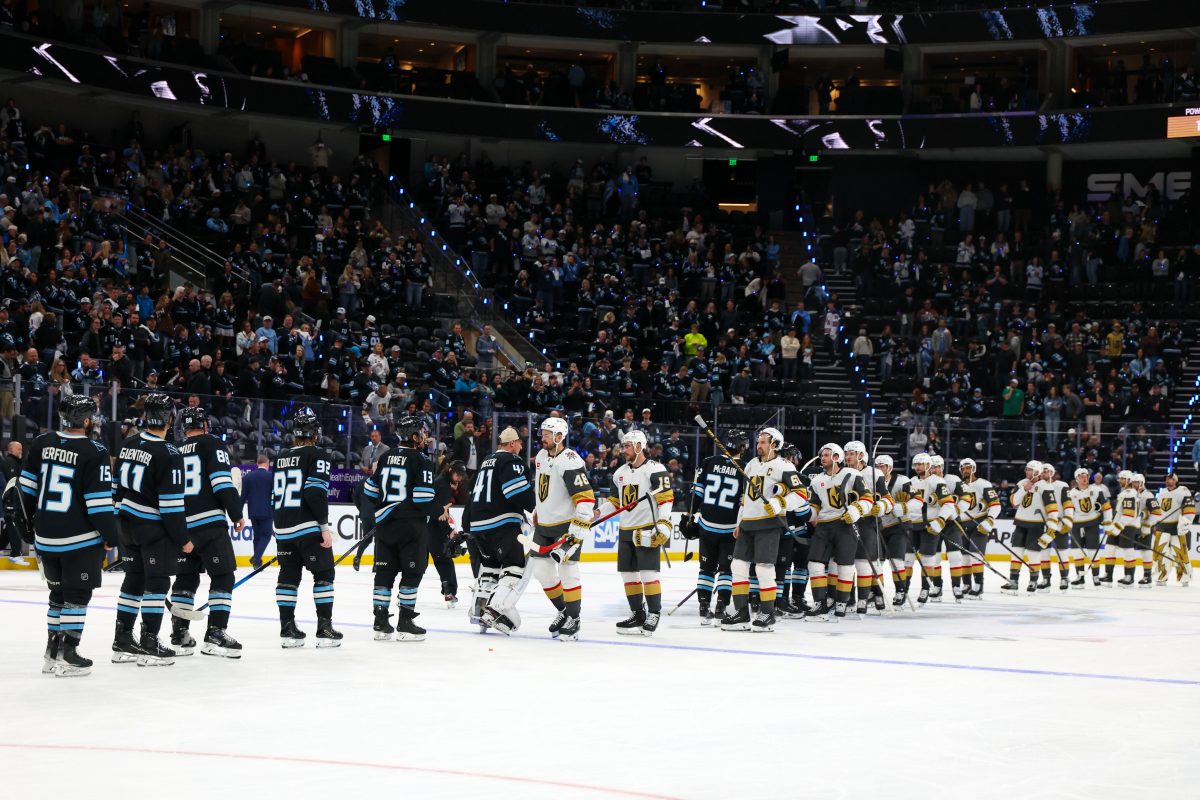
The Golden Knights consistently had a better start than the Mammoth as well. In total, the Mammoth were outshot 56-39 in the first period across the whole series. Game 1 was the only game where they outshot their opponents. A bad start and a bad finish can make all the difference. You can play 50 minutes of great hockey, but sometimes, the team that plays only 10 minutes of good hockey can win the game. The Golden Knights knew how to build off momentum. The Mammoth did not.
You can critique individual players. Sergachev and Weegar didn’t have a great series. Peterka was benched for most of Game 5. The first and second lines traded off games in the series, where they were invisible. However, this was a team loss, and it all goes back to experience.
Everything that was mentioned was a problem, but they are problems the Mammoth now know they have. Those are problems that this playoff series may fix simply because when/if the Mammoth makes the playoffs next season, they’ve been through the grind before.
You can be mad, sad, or disappointed about all of the aforementioned problems that eliminated the Mammoth in the first round. At the end of the day, they accomplished the goal they set at the beginning of the season: making the playoffs. They now have some experience under their belt for next season.
If the same problems come up next season, then there’s a problem. However, this was a big learning moment for the Mammoth, and it’s a season they can use to build off of and improve in 2026-27.
Free Newsletter
Get Utah Mammoth coverage delivered to your inbox
In-depth analysis, breaking news, and insider takes – free.
