
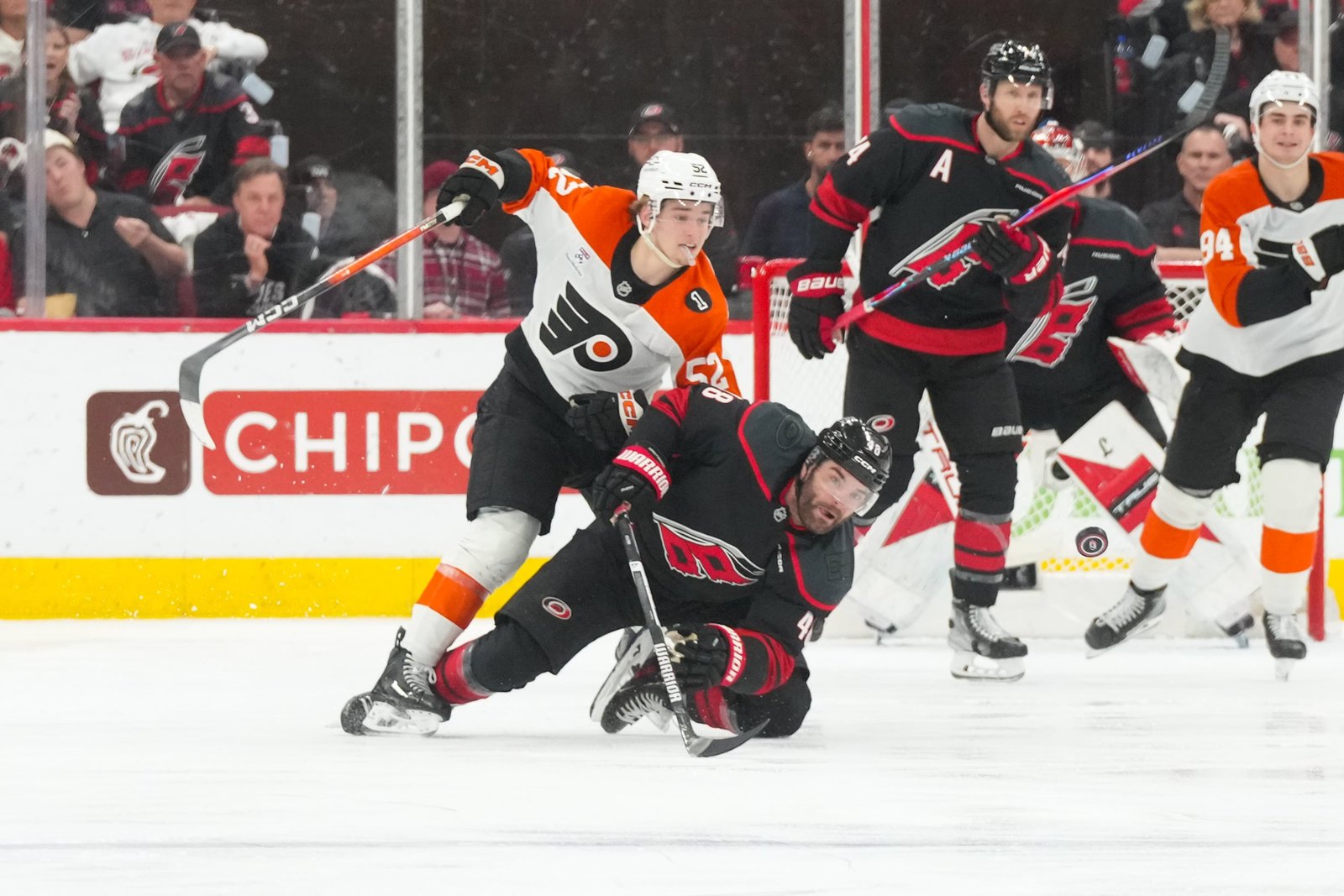
On the road, the Philadelphia Flyers built a 2-0 lead against a Carolina Hurricanes team that hadn’t trailed at any point in the 2026 Stanley Cup Playoffs previously. That lead was squandered, however, which forced overtime. Late in the period, Hurricanes forward Taylor Hall scored the winner from the crease, putting his team up 2-0 in the series.
The Flyers nearly split Games 1 and 2, but they now face a no-margin-for-error deficit heading back to Philadelphia. Here are three takeaways from the loss.
Flyers Controlled the Overtime Period
Following the Flyers’ two-goal lead, they looked similar to how they did in Game 1. While they weren’t sloppy, Carolina heavily outshot and out-possessed the Orange and Black. Despite excellence from goaltender Dan Vladař, the home side rallied back to even the score at the 11:21 mark of Period 3.
There was the occasional chance from the Flyers, but overall, they didn’t muster much of anything for basically 55 minutes (their first two goals came five minutes into the game). It was not an effort to hang your hat on.
Then, overtime happened. In the period, the Flyers outshot the Hurricanes 15-8, utterly dominating at times. Better yet, it was the top guys making a difference—Matvei Michkov had his best shift of the postseason, and Trevor Zegras set up a breakaway for Travis Konecny.
The ultimate irony of it all was that the Hurricanes won in that overtime period, anyway, off a zone entry that seemed innocent enough. Still, it was one of the few times in this series that the Flyers showed some life. Even with the loss, that was refreshing to see.
Power Play Didn’t Take Enough Chances
The Flyers’ power play did record a goal in this one, but it went 1-for-7 (14.3%). With the season virtually on the line, you have to convert more than once on that many attempts. But when you’re not taking chances on the man advantage, that’s the result you should probably expect.
After Jamie Drysdale’s power-play strike early, the Flyers didn’t generate much of anything. Michkov and Porter Martone had arguably the best looks—the latter set up by the former—but they couldn’t beat Hurricanes netminder Frederik Andersen.
Perhaps the biggest reason for the Flyers’ underwhelming man advantage has to do with an aversion to taking chances. Given the system they run, it makes sense—nobody wants to have a cross-ice pass lead to a rush opportunity the other way, potentially resulting in a goal.
But at least by my eye test, the Flyers’ power play was at its best when riskier passes were attempted. You’re unlikely to get into those high-danger areas using danger-free methods. In Game 3, especially given the series deficit, it might be a good idea to open up the power-play offense a bit.
Barkey Center Experiment
This was an interesting storyline. With Owen Tippett’s absence, the Flyers tried 21-year-old forward Denver Barkey at the center position, instead of his usual wing spot.
While Barkey’s line got caved, with him having an expected goal share of 32.2% at 5-on-5 via Hockey Stats, that doesn’t mean this was a failed experiment. If anything, he fit in quite well.
Barkey was mostly a winger at the junior level, but he had plenty of experience at center. Now, in the second round of the Stanley Cup Playoffs, it’s just like old times.
The obvious knock on Barkey’s fit down the middle is his size: 5-foot-10, 171 pounds. But he has a play style that works there—high-energy, all-three-zones engagement, wins board battles, skates well, and has some skill.
They don’t play the same way, but look at Logan Stankoven. He has been one of the best skaters in these playoffs, and he’s a 5-foot-8, 165-pound center. If he can do it, Barkey can, too.
If you’re looking at things logically, Monday’s loss was most likely the dagger for the Orange and Black—winning four of five against the Hurricanes would be quite challenging. However, this team’s playoff odds were famously just 3.8% at one point, according to MoneyPuck. Overcoming this hole is highly improbable, sure, but the Flyers have at least shown some bite. Game 3 will be on Thursday at 8 p.m. EDT.
Free Newsletter
Get Philadelphia Flyers coverage delivered to your inbox
In-depth analysis, breaking news, and insider takes – free.
