
The Winnipeg Jets regressed badly this season (by 21 wins and 34 points) and became one of just five teams all time to fail to make the playoffs the season after winning the Presidents’ Trophy.
Here, as we continue to sift through the rubble of their disastrous season, we’ll dive into seven stats that illustrate that regression.
Goals by Players Not Named Connor, Scheifele, & Vilardi
- Last season: 168
- This season: 124
A lack of secondary scoring plagued the Jets all season long, and for many stretches, they were a one-line team offensively.
The top guns in Kyle Connor, Mark Scheifele, and Gabriel Vilardi did their part by scoring 39, 36, and 30, respectively. Unfortunately, those 105 goals represented 45.8 per cent of the team’s total 229-goal output.
The Jets had eight players this season record 10-plus goals, down from 12 last season (nine in addition to Connor, Scheifele, and Vilardi). One of the things that made the 2024-25 squad so formidable is because all four lines were a threat to score.
This season, a number of players with decent-to-good track records of offensive success — those the Jets were relying on to make up for some of Nikolaj Ehlers’ lost production — underperformed, as the chart below illustrates.
| Player | Points last season | Points this season | Differential |
| Adam Lowry | 34 | 21 | negative-13 |
| Vladislav Namestnikov | 38 | 14 | negative-24 |
| Nino Niederreiter | 37 | 19 | negative-18 |
| Gustav Nyquist | 29 (Nashville Predators/Minnesota Wild) | 12 | negative-17 |
| Tanner Pearson | 27 (Vegas Golden Knights) | 15 (13 Jets/two Buffalo Sabres) | negative-12 |
| Cole Perfetti | 50 | 32 | negative-18 |
| Jonathan Toews | Did not play | 29 | N/A |
The dropoff between third and fourth in goals was also much sharper this season: Josh Morrissey finished fourth this season with 14 — 16 fewer than Vilardi — while last season, Ehlers finished in fourth with 24 to the third-place Vilardi’s 27.
Connor Hellebuyck’s Goals Against Average and Save Percentage
- Last season: 2.00 GAA, .925 SV%
- This season: 2.86 GAA, .890 SV%
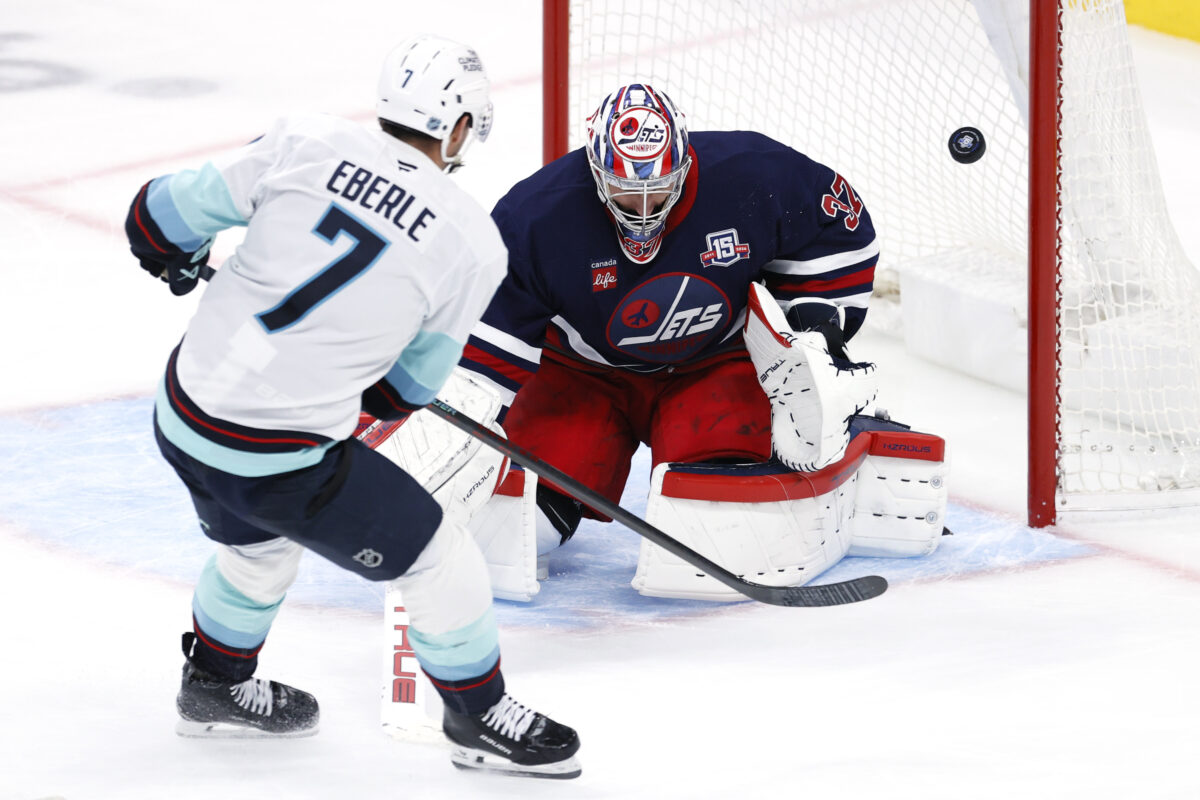
There’s no denying Connor Hellebuyck’s game declined sharply after he captured his third Vezina Trophy and became the first goaltender since 2015 to win the Hart Memorial Trophy last season.
He truly never looked very comfortable or “big and boring” in his crease for any long stretch, and having to undergo arthroscopic knee surgery didn’t help matters either.
His record was 23-23-11, his GAA jumped all the way to 2.86 from 2.00, his SV% fell to a career-worst .895 from .925, and he didn’t post a single shutout after having eight last season. By comparison, Eric Comrie, who makes one-tenth of the money, had a 3.13 GAA and .890 SV%.
The only time Hellebuyck looked close to his 2024-25 self was at the 2026 Winter Olympics, where he backstopped the United States squad to their first gold medal since 1980 by posting a 5-0-0 record, 1.18 GAA, .956 SV%, and stopping 5.92 goals above expected.
In the gold-medal game, he was simply outstanding, making 41 saves — many of the 10-bell variety — and even snagging the secondary assist on Jack Hughes’ overtime golden goal.
Jets fans, the vast majority undoubtedly cheering for Canada, were probably a little frustrated after watching the legacy-making performance and wondering: where was that Hellebuyck this season for their team and in the past few playoffs?
Speed Bursts 22-Miles-Per-Hour Plus
- Last season: 9th place
- This season: 23rd place
It was obvious early on in the season that the Jets — and particularly, Toews, Nyquist, Pearson, and Luke Schenn — were simply too old and too slow to keep up with youthful, speedy up-and-coming opponents.
The Jets were the oldest team in the league entering the season, with an average age of 29.84, and sure played like it. Prior to the 2026 NHL Trade Deadline, the Jets had 15 players and 13 skaters 30 or older and struggled against younger, quicker teams both in preventing high-danger chances off the rush and creating them.
Nyquist, Pearson, and Toews’ slowness was even more evident because they were brought in over the offseason to compensate for the loss of Ehlers, one of the league’s most dynamic skaters who kept opponents on their toes with his speed over his 10 seasons in a Jets jersey.
NHL EDGE stats measure speed bursts within or above certain mile-per-hour (MPH) ranges, and the numbers reveal just how slow the Jets were:
| Speed burst | League placement |
| 18-20 MPH speed bursts | 27th |
| 20-22 MPH bursts | 28th |
| 22-plus MPH bursts | 23rd |
Of the 57 22-plus MPH bursts they had this season team-wide, fourth liner Cole Koepke had 22 of them.
Last season, when their average age was 28.13 and they had Ehlers, they were 28th in 18-20 MPH bursts, but 21st in 20-22 MPH bursts and ninth in 22-plus MPH burst.
Thankfully, the Jets got younger and faster after the deadline, when Pearson, Schenn, and Logan Stanley were shipped out in separate trades with the Buffalo Sabres; Namestnikov and Niederreiter went out with injuries; and Nikita Chibrikov, Brad Lambert, Isak Rosen, Elias Salomonsson, and Brayden Yager all got into the lineup for different lengths of time. But by then, it was too late.
Power Play and Penalty Killing Percentages
- Last season: 28.90 PP% (first), 79.40 PK% (13th)
- This season: 18.50 PP% (24th), 77.63 PK% (21st)
A big contributing factor to the Jets’ 56 wins last season was their much-improved special teams. Their power play was lethal for most of the season and scored almost a third of the time under then-new assistant coach Davis Payne, and the penalty kill jumped into the league’s top half under then-new assistant coach Dean Chynoweth.
Unfortunately, Payne and Chynoweth’s units both tumbled drastically this season when it came to consistency and results, with the power play plummeting more than 10 percentage points to 24th overall and the penalty kill dropping back into the league’s bottom third. Contending teams generally have their combined power-play and penalty-killing percentages equal 100 or more, and the Jets were short of that by five.
The Jets scored 42 power-play goals while giving up 51 this season for a negative-9 differential. Last season, they scored 63 power-play goals and gave up 41 for a plus-22 differential.
Record When Leading After Two
- Last season: 41-0-1
- This season: 23-3-6
If the Jets were leading after the second period last season, it was pretty much an automatic win for them as they went 41-0-1 in that situation thanks to a combination of a stout defensive structure and elite goaltending.
This season, a win when ahead after two was by no means a guarantee — they lost nine times in that situation, and at many points, were extremely fragile up multiple goals.

Third periods were the team’s worst periods, as they had a negative-28 goal differential in the final frame (outscored 98 to 70) compared to a plus-1 goal differential in the first period and plus-3 goal differential in the second period.
Most painfully, the Jets squandered nine points in seven notable third-period collapses throughout the season. If they had not blown the leads they had in these contests, they would have snuck into the second Western Conference wild-card spot with 91 points rather than the Los Angeles Kings with 90.
Free Newsletter
Get Winnipeg Jets coverage delivered to your inbox
In-depth analysis, breaking news, and insider takes – free.
