
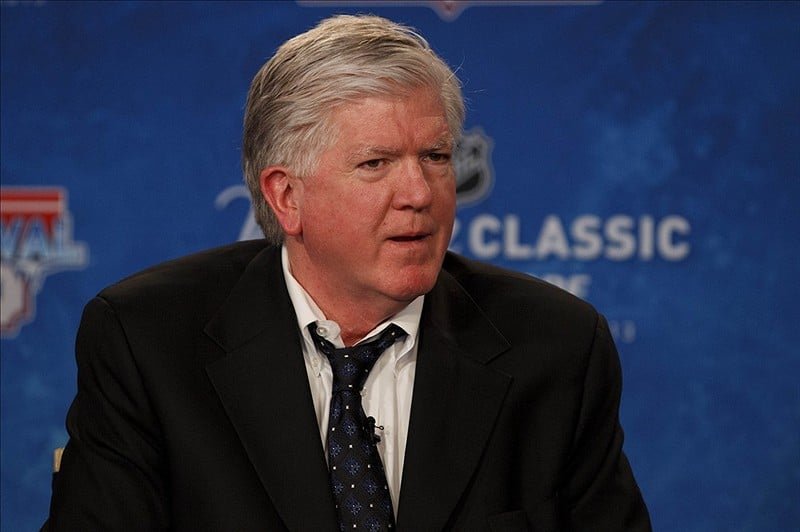
It has been 17 years since Brian Burke held a leadership role with the Anaheim Ducks, and yet his name still carries weight in every serious conversation about what it takes to build a winning team. That does not happen by accident.
Burke was hired as executive vice president and general manager of the Ducks in June 2005, on a four-year deal. He did not have a blank canvas. The foundation was already there, with Ryan Getzlaf, Corey Perry, and the legendary Teemu Selanne already in the fold. Critics have never let him forget that. The argument, repeated endlessly, is that Burke inherited a championship-ready team constructed by his predecessor, Bryan Murray, and that the 2007 Stanley Cup was the fruit of someone else’s labor.
That narrative is too easy and not completely true. When he arrived in Anaheim, he immediately went to work reshaping the team’s identity and closing the gaps that stood between a good team and a great one. The two most significant moves of his tenure, landing Scott Niedermayer and acquiring Chris Pronger from the Edmonton Oilers, were the kind of blockbuster transactions that define a front office career.
Yes, Niedermayer wanted to play alongside his brother Rob. Yes, Pronger requested the trade. Burke’s critics point to those details as if they disprove something. They do not. Knowing who to target, building the relationships, and executing the deals under pressure is the job. Burke did the job.
The Pronger acquisition, in particular, was a calculated risk of the highest order. Burke sent Joffrey Lupul, Ladislav Smid, and a package of draft picks to Edmonton in exchange for one of the most physically dominant defensemen of his generation. It was a bold move that changed the Ducks’ ceiling and anchored the blue line for a deep playoff run.
What “Truculence” Actually Meant
To understand Burke, you have to understand his doctrine. In his book Burke’s Law, he laid out a philosophy that went beyond hockey and leaned toward organizational psychology. He believed that a team needed a clear, intimidating identity above all else. He used the word “truculence” — pugnacity, belligerence, a refusal to be pushed around.
Although fighting would be part of this culture, it would not be the focus. It was about establishing that opponents would pay a price for every shift. Burke built rosters that were uncomfortable to play against. He signed George Parros from the Colorado Avalanche, brought in Shawn Thornton as a free agent, and added Todd Fedoruk to give the Ducks an edge that statistics cannot fully capture but that every player in the locker room could feel.
From a management perspective, truculence meant culture first. Talent alone was never enough. Every player had to fit the identity – had to buy into the idea that the team was going to be hard, physical, and relentless. The 2007 Ducks were all of those things, and Burke’s fingerprints were on every line of that blueprint.
Burke brought the same philosophy to the Toronto Maple Leafs when he was named GM in November 2008. He traded for Dion Phaneuf, signed Colton Orr, and built the roster around the idea that opponents needed to feel consequences every shift. Phaneuf was the centerpiece – physical, vocal, and legitimately feared.
He also brought a layer of transparency to his leadership that was unusual for the era. Burke was known for telling players and staff exactly where they stood. If you were being traded, he called you himself and told you why. If you were being let go, it came from him. In a league built on rumors and back channels, that directness was rare, and it earned him genuine respect from the people who worked for him.
The NHL Draft and the Long Game
Burke also deserves credit for his work building through the draft. His most important selection was Bobby Ryan, taken second overall in 2005, who developed into a legitimate top-line forward and a core piece of the Ducks’ future. Burke also added Jonas Hiller from European free agency, a signing that looked like a depth move at the time but eventually produced a starting goaltender who carried Anaheim for years.
“I made some horrible trades. And you’re gonna if you ‘swing for the fences’ and if you’re gonna make great trades”- Brian Burke
Later picks like Jake Gardiner in 2008 showed that Burke was thinking beyond the immediate championship window, investing in the pipeline even while competing at the highest level.
The Tragedy That Follows Burke
No honest account of Burke’s life in hockey can ignore what happened on February 5, 2010. His son Brendan, who had been serving as a student manager for the Miami University RedHawks men’s hockey program, was killed in a car accident. He was 21 years old.
Brendan had come out publicly just months earlier, in November 2009, becoming one of the most prominent people connected to the NHL ever to do so. He spoke openly about homophobia in professional sports and called for tolerance at a time when those conversations were almost entirely absent from hockey culture. His courage was recognized immediately. His death devastated the hockey world and hit his father in a way that no Stanley Cup victory could balance.
In Brendan’s memory, USA Hockey established the Brendan Burke Internship to honor his work in hockey management. His story was also the catalyst for the founding of the You Can Play Project, the campaign to end homophobia in sports that has become one of the most meaningful advocacy initiatives the hockey world has ever produced.
Burke has carried that loss publicly for over 15 years. He has spoken about Brendan in interviews, at events, and in his book with a grief that is palpable and real. It adds a dimension to the man that goes far beyond wins, losses, and salary cap decisions.
Burke: A Different Kind of Executive
There are not many executives built like Brian Burke anymore. The league has moved toward analytics, toward quiet process-driven management, toward a certain kind of polished corporate front-office persona. Burke was the opposite of all of that. He was Harvard Law-educated and was exceptionally well-read, but he managed like a man who had grown up in rinks and locker rooms and believed that respect was earned through confrontation, not diplomacy.
He won a Stanley Cup. He made bold trades. He built cultures. He buried a son and kept going. Whatever you believe about the 2007 Ducks – whether he built them or inherited them – the man behind them is one of a kind.
Free Newsletter
Get Anaheim Ducks coverage delivered to your inbox
In-depth analysis, breaking news, and insider takes – free.
