

Game 4 between the Dallas Stars and the Minnesota Wild gets underway at 4:40 CT on Saturday afternoon, exactly seven days after the Wild embarrassed the Stars at the American Airlines Center to open Round 1 of the Stanley Cup Playoffs. Now, however, the Stars are up 2-1 and aim to take a commanding 3-1 series lead back to Dallas on Tuesday night.
Heading into Round 1, both teams were looking to exercise some playoff demons, even though one fanbase has been significantly more tortured than the other. While the Stars have been eliminated in three straight Conference Finals, the Wild have not won a single playoff round since 2015, when they eliminated the St. Louis Blues in the opening round.
The Wild put their best foot forward in Game 1 and looked poised to make good on the hope that has been building in Minnesota. The Stars, on the other hand, looked like a team that was saying, “Wake me up in May,” as if May were guaranteed to come.
With Game 4 rapidly approaching, the Stars have settled into their strengths and their experience, while the Wild, despite being the better team for a large stretch of the series, are staring down a familiar fate.
The Wild have been here before, but haven’t been able to get to the other side. The Stars have also been here before and know what it takes to finish the job. Come Saturday night, we’ll know who is one step closer to their desired outcome.
After Slow Start, Key Players Have Taken Control of Series
At some point in time during a long playoff run, every team needs unsung heroes. Someone out of the ordinary. Colin Blackwell and Tyler Myers have been effective using the body, and Oskar Back and Radek Faska have helped make the bottom six hard to play against. Their offensive moments haven’t come yet, but they most certainly will, especially if the Stars play into the first week of May. But for now, it’s been the Stars’ stars that have done the heavy lifting offensively, and at the right moments, at that.
In Game 2, after a 6-1 loss in Game 1, Wyatt Johnston scored the more-necessary-than-usual opening goal of the game at 8:58 of the first period. Brock Faber evened up the game less than three minutes later, but the Stars were in the game, something they couldn’t say at any point in the series opener. From there, Matt Duchene and Jason Robertson extended the Stars’ lead to 3-1, and Johnston scored his second of the night into the empty net to seal the 4-2 victory.
In Game 3, it was Mikko Rantanen and Robertson who helped build a 2-0 lead in the first, before Marcus Johansson made it a one-goal game heading into the second. Twenty minutes later, the Wild came back to lead the Stars 3-2 and carried that lead into the final 11 minutes of the game.
When the Stars needed it the most, Duchene tied the game with a power-play goal at 10:18. The Stars then killed off five penalties between the game-tying goal and Johnston’s game-winning power-play goal in double overtime. Key penalty kills, coupled with key power-play goals scored by key players, and the Stars took a 2-1 series lead.
There’s a lot of talk going on right now about the special teams battle that is going on in this series, and we’ll get into it, too. But the fact is, whether it’s 5-on-5, down a man, or up a man, the Stars are executing in key moments, both offensively and defensively. Not to mention extraordinary play from netminder Jake Oettinger after a concerning Game 1.
It’s a Battle of the Special Teams in Round 1
In playoff previews across the nation, including mine, it was highlighted that the Stars and Wild owned the second and third-best power-play units in the NHL, respectively, during the regular season. On the penalty kill, the Stars were 12th, and the Wild were 15th. We all knew it would be a factor, as it usually is in the postseason, but that narrative has surpassed what any of us thought, or me, at least.
No teams have had more opportunities with the man advantage than Dallas (17) and Minnesota (15). The Stars have scored six goals on the power play, putting them at 35.3%, which leads all playoff teams that have had 10 power plays or more. The Wild have scored three.
While three goals more is a decent advantage, it’s more about when those goals were scored. In Game 1, the Wild scored two, while the Stars scored one. In Game 2, the Stars scored two (one on an empty net), and in Game 3, the Wild scored one while the Stars scored three.
As much as the “when” matters when it comes to goals scored, it might matter more when it comes to the goals that weren’t scored. In Game 2, the Stars were up 3-2 when they took a too-many-men penalty at 16:16 of the third period, and the Wild couldn’t convert.
Game 3 is when this narrative really came to life. Much is being made about Duchene’s power-play goal to tie the game and Johnston’s to win the game. As we already mentioned, though, the Wild had five power plays of their own between the third period and overtime and couldn’t do a thing with them.
We can talk all we want about the Stars’ ability to score with the man advantage, and we should. But their ability to kill off penalties in key moments won them the last two games just as much as the goals did.
“It was great,” Johnston, the overtime hero, said after Game 3. “We had some huge kills, and then it’s important to capitalize when you get those (power-play) chances. I just try to pitch in and do what I can to help.”
“You look around the league, it comes down to (special teams),” Robertson added. “Every team is so tight, every team defends hard. You’ve got to take advantage when you can. We definitely think we can improve a little bit of our 5-on-5 offense, and we’ll look at that and try to improve for Game 4.”
Oettinger’s Quick Redemption
Game 1’s debacle was in no way on Oettinger entirely, but there was one goal, maybe two, that he wanted back.
“We all have to be better,” Oettinger said after Game 1. “I think the last goal was bad, but I think I did good things, and I think I have a lot that I need to be better at.”
Oettinger followed up his opening performance with 28 saves on 30 shots in Game 2, including a phenomenal first period that kept the Stars tied 1-1 rather than down by multiple goals. In Game 3, he stopped 29 of 32, but only seven shots on seven penalty kills, thanks to terrific defensive play with a man short. Finally, his teammates gave him some much-needed help in a big spot.
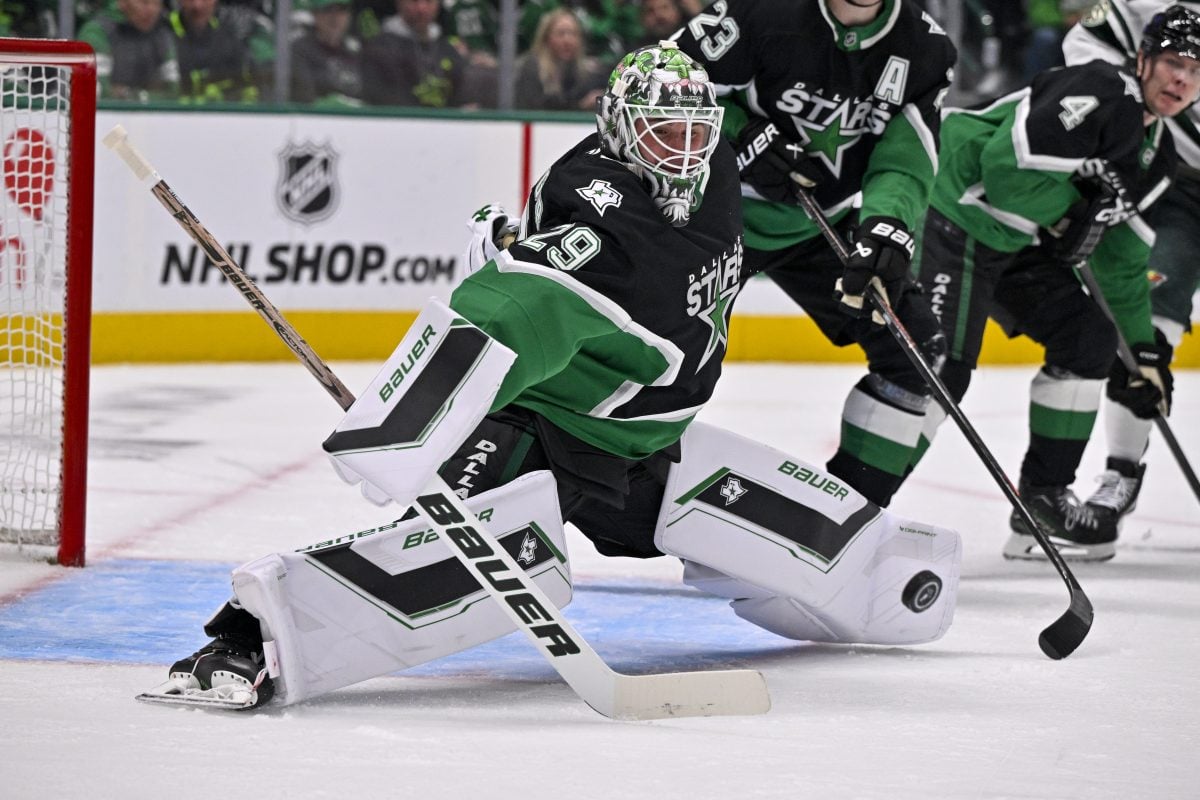
It was a down season by Oettinger’s standards, but his track record speaks for itself, and while his postseason numbers have dipped over the last couple of years, a lot of it has to do with the progressively sloppy play in front of him as the playoffs roll on. There’s no question that Oettinger is their guy and will have to be their guy if the Stars have any success this spring.
Any idea that backup netminder Casey DeSmith will take over between the pipes after a rough start is foolish. Sink or swim, Oettinger owns the Dallas crease, and he has proven why in Games 2 and 3.
Nils Lundkvist Extended Through 2027-28
On April 17, general manager Jim Nill announced that the Stars had extended Nils Lundkvist to a two-year, $3.5 million contract. This is a really big deal and bodes well for both the 25-year-old defenseman and the team moving forward.
“We’re excited to lock up Nils for two more years,” Nill said. “He is a highly skilled defenseman with excellent mobility and vision. His ability to move the puck and create offense makes him a valuable piece for our team moving forward.”
Once full of promise, Lundkvist has had some trouble finding his game over the last few seasons, and it hasn’t entirely been his fault. He has always been a solid puck-moving, offensive-minded defenseman, but under former head coach Pete DeBoer, he was encouraged to change his game to a more defense-oriented style, which ended up taking away from what made him such a promising young player.
While he has been bitten by the injury bug, he also found himself in DeBoer’s doghouse quite a bit and never really had an opportunity to thrive.
Now, under Gulutzan’s leadership, Lundkvist has blossomed and finds himself playing alongside Thomas Harley in big minutes every night. He still has a lot of growing to do, but he has clearly shown what he has needed to for the Stars to make him a key part of their defensive core for at least the next two seasons.
Roope Hintz Resumes Skating
No. 1 center Roope Hintz has resumed skating after being out of the lineup due to a lower-body injury. He has been ruled out of Game 4 and is doubtful to play Game 5. Hintz was originally ruled out of Games 1 and 2, and his status has been updated game by game since then.
“He’s not traveling,” head coach Glen Gulutzan said before Game 3. “Game 3, he won’t be there; Game 4, I would say is very doubtful. Hopefully by the time we get back (to Dallas for Game 5) we’re in a good spot and he’s in a good spot.”
As is the case with most injuries this time of year, Hintz’s true status and timeline are unknown. To me, this smells like we won’t see him for the rest of Round 1, and who knows when we will see him after that.
The fact that he is skating is obviously a good thing, but he still seems a ways away from seeing game time.
Hintz has not skated with the Stars since suffering his injury against the Colorado Avalanche on March 6.
Up Next For the Stars
Game 4 is on Saturday afternoon in Minnesota, while Game 5 will be in Dallas on Tuesday night. Games 6 and 7 will be on April 30 and May 2 if necessary.
Free Newsletter
Get Dallas Stars coverage delivered to your inbox
In-depth analysis, breaking news, and insider takes – free.
