
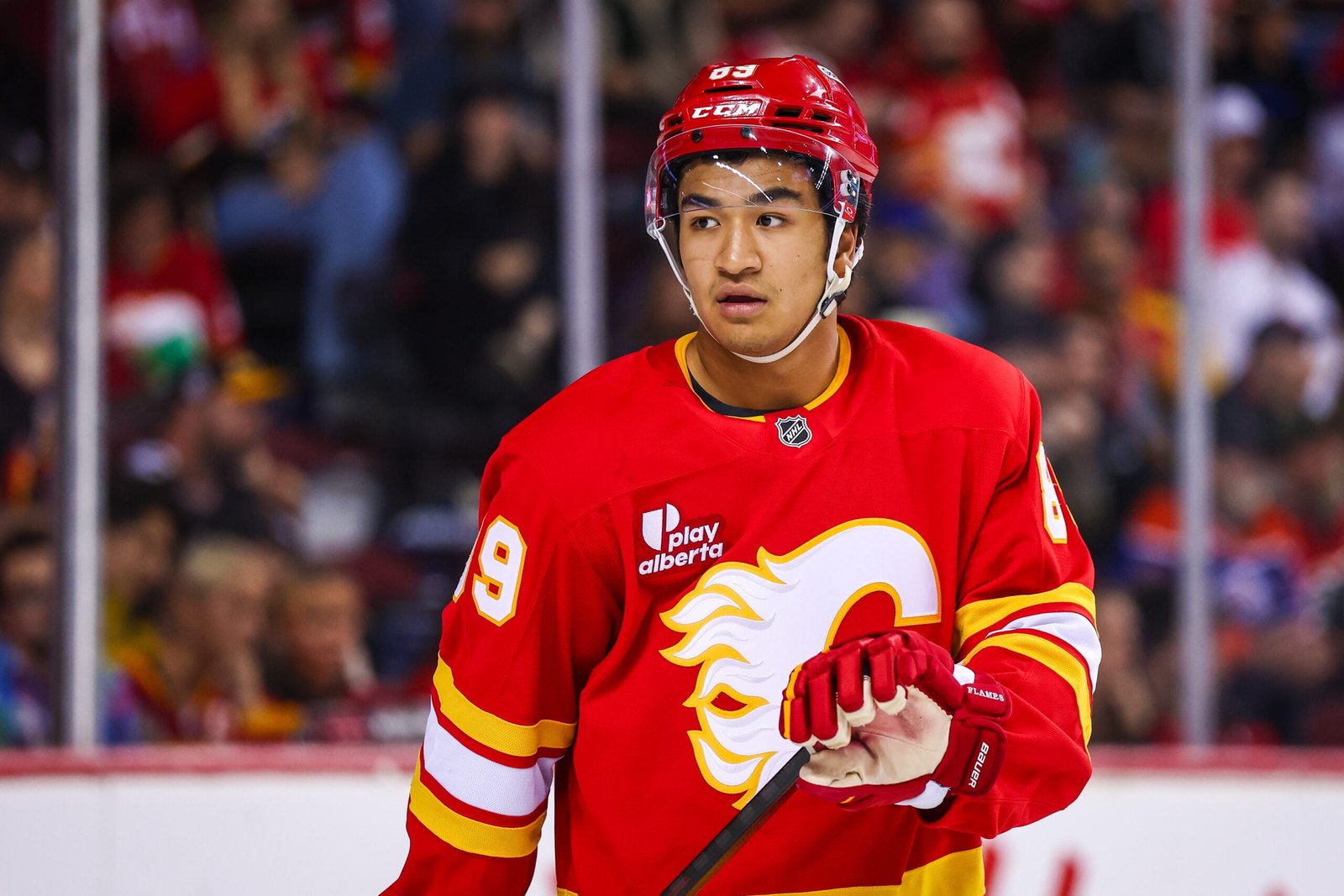
There may not have been high expectations for the Calgary Flames for the 2025-26 season. However, there were pretty high expectations for their 2024 ninth-overall pick, Zayne Parekh.
Part of the expectations comes from a couple of defencemen breaking out the minute they set foot in the NHL. You may have heard of them: Lane Hutson and Matthew Schaefer. These two somewhat reset expectations for top defence prospects coming into the NHL, but that’s not to say Parekh didn’t have an underwhelming rookie season, even by fair expectations.
However, given the situation Parekh was walking into, he was never going to be set up for an explosive rookie campaign that could have exceeded anyone’s expectations. Many may have been hoping for more from him this season, but don’t let that get in the way of your expectations for the future.
Zayne Parekh’s Rookie Season
With a couple of games left in the season, Parekh had four goals and five assists for eight points in 37 games. Or, for the per-60 lovers: 0.38 goals, 0.47 assists, and 0.85 points per 60. Either way you look at it, it’s not that impressive for someone whose strength coming into the league was expected to be his offensive play.
The on-ice numbers aren’t any better with Parekh having a 49.36 shot attempt percentage, a 45.42 shot on goal percentage, 45.93 high-danger chance percentage and a 44.12 goal share while on the ice at five-on-five for the Flames this season (via Natural Stat Trick).
In fairness to the rookie blueliner, those numbers aren’t quite as underwhelming when you look at them relative to the Flames’ team average. His shot attempt share was actually 1.82% better than the team’s average, and his expected goal share was 1.97% better than the team’s at five-on-five. But it still wasn’t pretty, as his actual goal share was 1.42% lower than the average.
The numbers aren’t everything, but they do paint the picture of the up-and-down season Parekh had with the Flames. Earlier in the season, we were seeing the flashes, but there were also the obvious mistakes.
Recently, we’ve been seeing much more consistency, with six of his eight points and all four goals coming in his final 12 games of the season.
Parekh Wasn’t in a Position to Have an Explosive Rookie Season
To stick with the Schaefer and Hutson comparisons, whether unfair or not, just as a point of reference, both of these talented offensive defencemen quickly walked into situations where they showed they were undeniably the best offensive options on the blue line.
Parekh could have done this, but it has to be said that neither the Montreal Canadiens nor the New York Islanders had weapons comparable to MacKenzie Weegar and Rasmus Andersson, who were eating up top-four minutes and coveted power-play time.
The other thing the Islanders and Canadiens had, compared to the Flames, was more consistent offensive firepower. Both of these teams ranked outside the bottom five in expected goals per game in Hutson and Schaefer’s rookie seasons, while Parekh was on a Flames team that ranked amongst the bottom five in expected goals and dead last in goals for per game.
The other setback Parekh faced early in the season was the injury that kept him out from early November until after the World Junior Championship, when he finally played his next game with the Flames on Feb. 2, following a short conditioning stint in the American Hockey League (AHL) in late January.
Why Not to be Concerned
As Scott Wheeler of The Athletic put it in his recent top-100 prospect ranking, “This season, [Parekh] would have benefited from next year’s rule change permitting select first-rounders to play in the AHL, but was still 19 and so had to play in the NHL, where he has played to fine results in sheltered usage but has at times struggled with the physicality — as all 19-year-old D do.”
With time, his defensive game will improve. Will it ever be elite? Probably not, but it doesn’t need to be. Another thing Wheeler mentioned is “Parekh plays an aggressive and natural offensive style, where he looks to attack off the line into the slot or even the front of the net or below the goal line. He’ll also regularly involve himself in the rush much like a winger does, driving down the wall in control to challenge defenders and attack into his shot or create an odd-man rush” (from ‘Top 100 drafted NHL prospects ranking: Michael Misa, Porter Martone lead Wheeler’s 2026 list’, The Athletic, April 13, 2026).
The sheltered role Parekh played this season with the Flames didn’t allow the team to play to his strengths; instead, it more so exposed his weaknesses.
While these offensive-minded defencemen still have to be good defensively, many of the best ones around the league have their teams’ game plans tailored to support guys like Cale Makar, Quinn Hughes, Schaefer and Hutson, which allows them to make plays, without putting their team at too much risk.
With Parekh playing mostly third-pairing minutes, no coach is going to implement a special system for a guy averaging around 14 minutes per game at five-on-five.
The perfect example of this is Hutson on the Canadiens. He, by many metrics, is not a great defender, ranking in the bottom-five percent of defencemen in entry denial rate and possession entry prevention. Despite consistently giving up the zone, Hutson still boasts a tremendous 62.59% goal share and 54.75% expected goal share while on the ice for the Canadiens at five-on-five, thanks to the support he receives in the defensive zone or when he takes off to join the rush (from ‘NHL Microstat Player Cards, Hockey Stats, April 16, 2026).
It may seem basic, and teams cover for defencemen all the time. However, with supremely talented offensive defencemen like Parekh, you have to build your entire game plan around them, because you want the puck on their stick trying to make things happen as much as possible.
The Flames definitely didn’t use Parekh in the best way to showcase how valuable a prospect he is this season, but that can be chalked up to circumstances rather than to coaching or the players’ fault. He came into a blue line that had two of the top right-handed defencemen in the NHL at the start of the season, on top of injuries.
Playing in a sheltered role, you’d think, would give Parekh easier matchups, and to an extent, it did. However, that also typically meant he drew the opponents’ more physical forecheckers. It would have been a new role for him to adjust to, on top of the game’s increased speed and physicality.
Regardless of whether the Flames used him in the most efficient way for a player of his skill set or not, the experience he gained this season playing over 500 minutes will be invaluable to him and the Flames as he likely takes on a bigger role with this team next season and is given more freedom to make an impact offensively.
Yes, it was an underwhelming rookie season. Yes, Parekh could have dominated, just as Hutson and Schaefer did, to earn top spots on their teams’ blue lines. However, despite using the comparison throughout this piece, it’s a little unfair to compare the Flames’ situation with Parekh to the two best rookie defencemen seasons we’ve seen in recent memory.
The situations were vastly different, and because of that, I don’t see Parekh’s rookie campaign as concerning, more just a product of the situation he was put in. Given more opportunity and freedom to make plays in an expanded role next season, he will show why he is ranked as a top prospect in the NHL.
Free Newsletter
Get Calgary Flames coverage delivered to your inbox
In-depth analysis, breaking news, and insider takes – free.
