
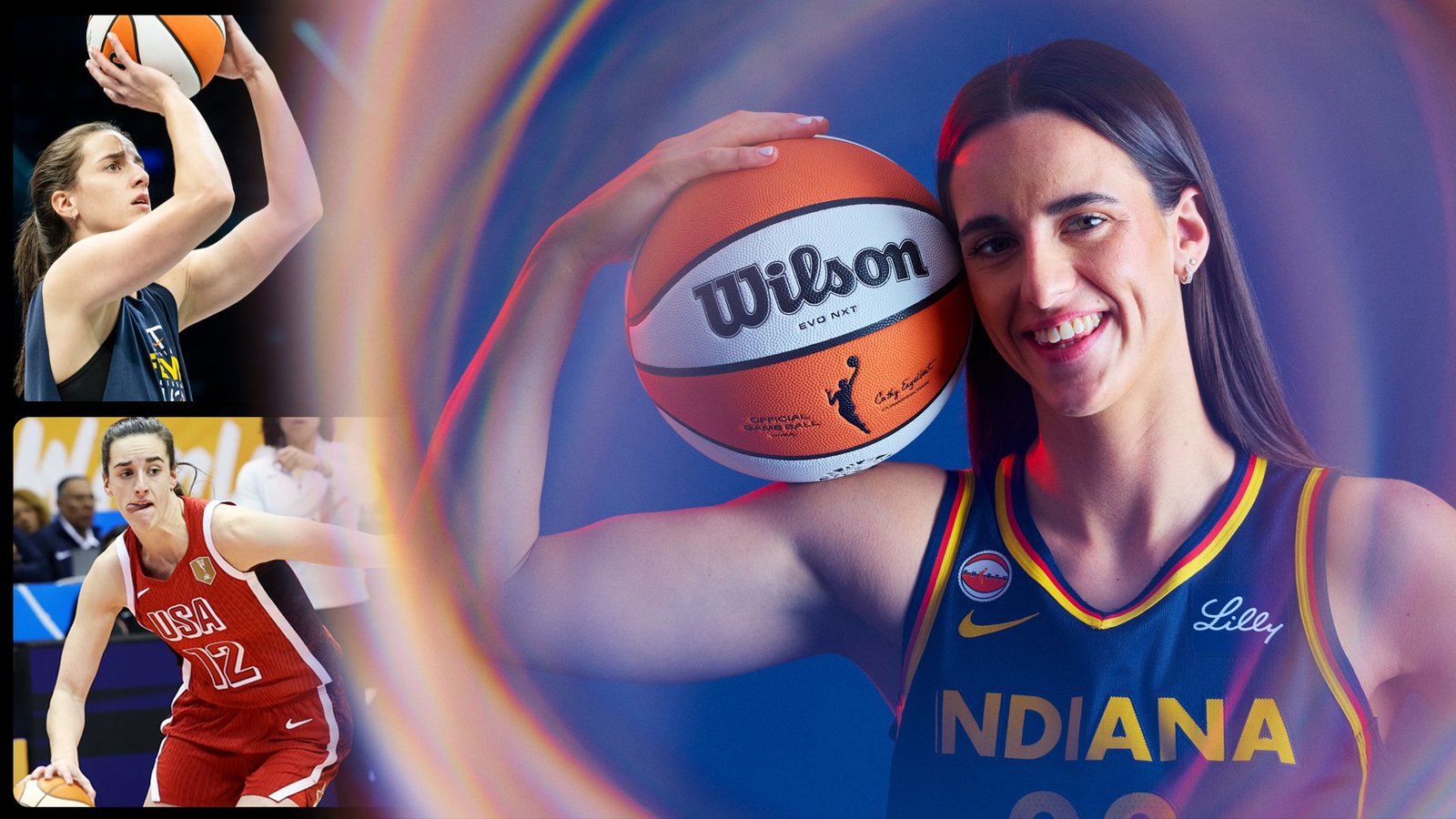
INDIANAPOLIS — Caitlin Clark received a handoff on the left wing, took two dribbles past a screen and split a pair of defenders with a pinpoint bounce pass to her rolling big for a simple layup.
It was Clark’s first meaningful game in eight months, but the scene looked awfully familiar.
Barely over a minute later, she had two more assists. For good measure, and before the first quarter was over in Team USA’s FIBA World Cup qualifying tournament opener, Clark pulled up five steps from beyond the 3-point line and buried one of her trademark treys.
It was exactly what Amber Cox had raced to San Juan, Puerto Rico, to see. The Indiana Fever general manager was eager, anxious and optimistic about her star player’s first actual game since July 15, 2025. She had gotten glimpses of Clark through months of rehab and some spirited pickup games in Indianapolis, but this was different. After a 2025 WNBA season that plagued her with injuries, Clark was back on the hardwood with some of the best players in the world and going against elite international talent.
She answered any questions quickly, putting up 17 points and 12 assists — off the bench — in the tournament’s first game on March 11. Six days later, she was named tournament MVP after averaging 11.6 points and 6.4 assists while shooting 52.9% from the field and 40.0% from behind the arc over five games in Puerto Rico.
“I had so much excitement and anticipation to see her back on the floor, and to see her deliver at such a high level and casually walk away with the MVP,” Cox told ESPN six weeks later, ahead of the Fever’s media day. “That’s when we all felt great about the fact that she was fully back.”
THE REHAB PROCESS was long and annoying for the then-reigning Rookie of the Year. It started a year ago in training camp, when Clark was dealing with a left quad injury. Four games into the season, she suffered a different left quad sprain. A month later, a left groin sprain. Less than a month after that, Clark went down with a right groin injury. She missed the WNBA All-Star Game — held in Indianapolis for the first time — and never played again, suffering a left ankle bone bruise during her attempt to return for the postseason.
A singular significant injury that ends a player’s season is one thing. A variety of soft tissue injuries that spring up as someone gets closer to returning from a previous injury can be especially demoralizing — particularly for a player who appeared in every one of Iowa’s 139 games during her four-year college career.
“I put together a pretty incredible stretch of never missing a game,” Clark said. “The fact is when you’re a professional athlete, it’s going to come at some point. … It’s honestly taught me more than I probably ever learned over the course of my career. How to take care of your body. How to get right. How to stay healthy. And then just taking time for yourself.
“Being hurt is an incredibly isolating thing, and you don’t really understand it until you go through it.”
A FEW MONTHS in, Clark’s patience was running low.
Rehab gets really monotonous quickly, and the basketball junkie hadn’t been cleared for actual basketball. There’s no way to rush the process — the steps are the steps. At some point, drills get more complex and physically taxing. Noncontact drills give way to contact drills. Individual work leads to 3-on-3 and that advances to 5-on-5.
“Eventually, skill workouts get a little bit boring, so you just want to play and play and play,” Clark said. “Injuries [are] really mentally taxing, as well. People don’t always realize that, especially when you’re at the point of trying to come back and trying to get over the hump of, like, trusting your body. That’s the hardest part, you’ve done everything you can rehab-wise to get back on the court, and then it’s like the mental block of trusting your body and knowing you put the work in. So, I feel like it’s a little more mentally exhausting from that standpoint.”
Much of Clark’s rehab was spent in Indianapolis where she could take advantage of the familiar facilities, trainers and medical staff. The two-time all-star gushed about head athletic trainer Maria Witte, labeling her “the most selfless person” for the long hours she put in. Finally, after all that rehab with Witte, Clark was cleared for pickup games. The challenge was finding the right people to play against. The Fever employ a handful of men as practice players, but they’re part time, with other responsibilities. A concerted effort was made to find the right people to play with Clark. Her boyfriend, Connor McCaffery — a former player at Iowa who was an assistant coach at Butler last season — did some recruiting. Player development coach Rob Dosier did the same.
They couldn’t just announce an open run for anyone to join and face off against the most famous women’s basketball player in the world. They had to be vetted but also had to understand the goal.
“Oftentimes, when you play pickup, it’s like 3-point line to 3-point line, chuck, not really working on offense or defense,” Fever coach Stephanie White said. “It’s about being really intentional about what we’re working on in the moment. It’s not enough just to go out and play. It’s, hey, we’ve got to play on the defensive end. We’ve got to move corner to corner, not just top of the key to top of the key. We’ve got to get movement patterns off the ball.
“And you’ve got to play with guys who understand that when she gives it up, this is how we get it back. To be real intentional about making it flow into how we want to play, as opposed to just getting up and down the court.”
Some college players in the area participated, as well as others who had experience playing overseas. The formats were very specific, mimicking WNBA game scenarios. They would play a game as if it were the first quarter leading up to the first timeout. There was no way to simulate an actual game, but they could put Clark in game-like situations. During the entire process, Clark wore technology that tracked her movements and gave data for her and the medical staff — how far she’s running during a workout or how she’s accelerating. The Fever have been using the technology for years, so Clark was able to compare her rehab data to data previously collected. The information would help make training decisions.
For someone such as Clark, who obsesses over details, that was invaluable.
“It gives me a really good gauge,” Clark said. “I’m not guessing. I’m understanding what the data is telling me … and then I can kind of relate that to how my body’s feeling and then go from day to day.
“Do I want my load to be heavier? Do I want it to be a little bit lighter? Do I want it moderate? And then you can kind of stack those days from there.”
U.S. WOMEN’S NATIONAL team coach Kara Lawson didn’t have a previous relationship with Clark. The Duke University coach didn’t recruit her and had never spent much time with the NCAA’s all-time leading scorer. So, one goal of this winter’s training camps — the first held in Durham, North Carolina, in December and the tournament in San Juan in March — was to get to know Clark. Lawson believes having those close player-coach relationships are important, even on the national team.
The difference in Clark’s play, even just between the two camps, caught Lawson’s eye.
“She just looked like she was working her way back [in December],” Lawson said. “And I thought there was a big difference in my observation of Caitlin from December to March, for sure.
“It’s all the stuff — the timing, the quickness with which she’s able to get to her spots, and just the reps of playing games.”
The national team’s camps were Clark’s first opportunity for full and live games, which was a needed part of the comeback. Because of her meteoric rise, it’s easy to forget Clark is just 24. There’s still plenty of room to grow and develop, and that was a concern for White. The Fever were spending so much time getting her physically prepared to play, but were they doing enough to further her development?
Being in the Team USA atmosphere — being around established veterans such as Chelsea Gray, Kelsey Plum and others — made that task easier. Lawson, an Olympic gold medalist as a player, spoke from experience when she noted that young players get to pick up little habits when being around their elders all the time. The competition is also so high — this is a program that has won eight straight Olympic gold medals and 10 of the past 11 — that it forces players to improve. Things a player might get away with against lesser competition won’t work against the best in the world.
So what did Fever and Team USA teammate Aliyah Boston notice as they went through the training camps and the World Cup qualifier?
“Honestly, if I said nothing, would that be surprising?” Boston said. “I mean, Caitlin is Caitlin. Yes, she was out with injury, but when we were at USA together, she looked like herself.
“I feel like that made me just so happy, because having an injury is hard, and missing a season is hard, but being able to come back, turn the page and be ready to go — I mean, that’s Caitlin.”
THE 2026 SEASON opens Friday, and the weekend continues with a meeting between the past two rookies of the year — Clark and Paige Bueckers — on Saturday when the Fever host the Dallas Wings (1 p.m. ET, ABC). Indiana selected Clark No. 1 in 2024 and Dallas took Bueckers No. 1 in 2025. The pair represents the future of the point guard position in the WNBA, with different styles. Both have elite vision, though Clark seems to be a slightly better passer; she set the league single-season assist record as a rookie. Bueckers has a stronger frame and tends to be a bit more efficient. Both averaged 19.2 points as rookies.
After a 2025 season in which they reached the WNBA semifinals even without Clark, pushing the eventual champion Las Vegas Aces to the brink, the Fever have championship aspirations this year, with a core of Clark, Kelsey Mitchell and Boston, the 2023 Rookie of the Year. The Wings are making their first steps toward reaching that level with Bueckers, 2026 No. 1 overall pick Azzi Fudd and Arike Ogunbowale. Including Boston, that’s the past four No. 1 picks all on the court at the same time.
As free agency wrapped up, it was clear that playing alongside Clark is a selling point.
“Being able to play with Caitlin Clark, I think that was a huge eye opener,” Fever forward Myisha Hines-Allen said. “I have the opportunity to play with one of the greatest players that’s ever going to play in the game of basketball. So for me, once I also heard that, oh, she really wants me here, too? I was like, oh, well, let’s get it done then. There’s no questions about it.”
After ending the 2025 season with a roster ravaged by injury, the Fever hope that won’t be an issue this season. They gained additional depth from the signings of Monique Billings, Hines-Allen, Shatori Walker-Kimbrough and first-round pick Raven Johnson.
And though Clark is cleared, the team is still actively thinking about her health and workload. Having more ball handlers was a priority for Indiana as it hopes to play Clark off the ball more than in the past. Opposing teams have pressed her 94 feet when she’s playing point guard, so the idea is to save energy — and wear and tear — while still on the court by having others initiate the offense. They’ve also managed her practice reps in training camp more than in the past. She’s cleared for everything, but there’s no need to have her take every single rep in every single drill — like Clark is naturally inclined to do.
The focus is on a deep run into October, not overstressing her body in May.
“There’s definitely days where I still sometimes feel sore, but … it’s like the mental battle,” Clark said. “Like, your body’s fine, you put in the work and it’s just kind of getting over that mental hurdle.
“There’s definitely still days where I experience a little bit of a mental block, but I know I’m doing every single thing I can to be healthy, and that’s why I’ve been healthy and why I will remain healthy, as well.”
