
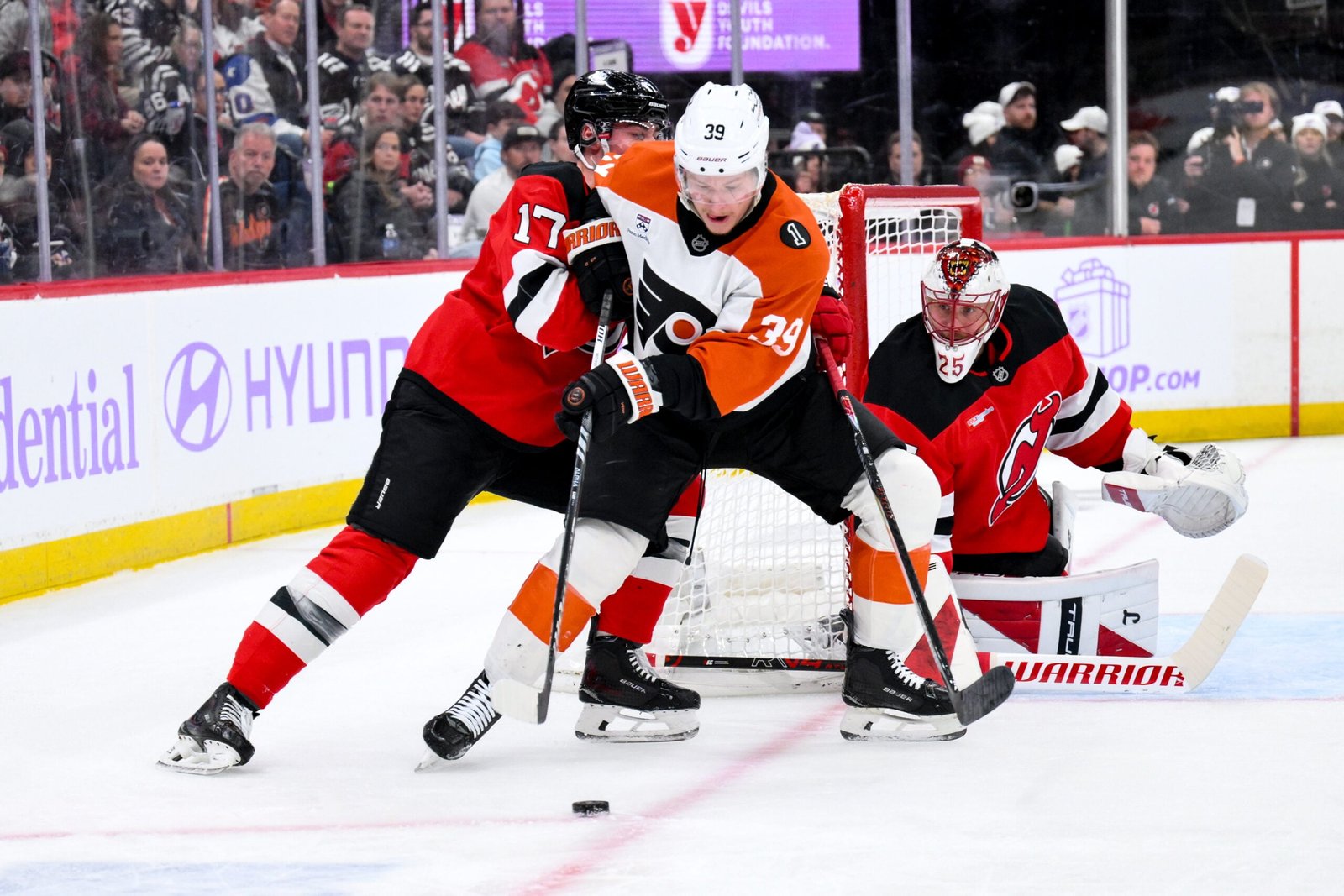
The Philadelphia Flyers have a 3-1 series lead in their first-round matchup with the Pittsburgh Penguins—a comfortable spot for the Orange and Black. But after dropping Game 4 by a 4-2 decision, sophomore winger Matvei Michkov has come under fire. With head coach Rick Tocchet taking the 21-year-old out of the main lineup at practice, Michkov is almost definitely going to be a healthy scratch for Game 5.
Michkov is with Garrett Wilson and Carl Grundstrom in line rushes. Alex Bump is with Noah Cates and Tyson Foerster.
Looks like Michkov might be out for Game 5.
— Charlie O’Connor (@charlieo_conn) April 26, 2026
If you look at the numbers, that’s not too surprising. Michkov has zero points, a minus-1 rating, and six penalty minutes through four games.
However, a lot of the surrounding discourse has been unfair to Michkov. That’s been the overarching theme of this season, too. It’s getting out of hand—again.
Adding Context to Michkov’s Stat Line
The way I see it, the general fan consensus is this: Michkov is a big-name player, and he hasn’t made an impact on the series. He’s been, at best, replacement-level. That’s cause for concern.
But that leaves out important context. Yes, Michkov is a big-name player, but he’s averaging the second-lowest usage (10:06) among Flyers forwards in these playoffs. That’s not nearly enough to make a notable impact on a series—even for someone of his perceived caliber.
To put that in perspective, let’s take a look at Michael Raffl and Matt Read’s 2015-16 campaigns. In the regular season, they recorded 31 points in 82 games on 14:18 of average ice time and 26 points in 79 games on 15:15 of average ice time, respectively. In the playoffs, their average ice time sank to the 12-minute mark, and they were limited to just one combined point in a six-game series vs. the Washington Capitals.
Now, to be clear, I’m not arguing against Michkov’s deployment. The Flyers lead the series 3-1. They’ve ridden solid goaltending, defense, and a couple of highlight-reel goals to victory. I’m just pointing out that it’s unfair to expect him to have anything more than a couple of points, let alone take over a game. He hasn’t played well, but his performance shouldn’t be that surprising, either. In Game 1, he was on the ice for just 11:25—his series-high usage mark.
In a similar vein, Michkov hasn’t had many puck touches. When he has gotten the puck, it’s typically been in the defensive zone, as he has been deployed there a ton (44.6% of the time, per NHL Edge—much higher than the 39.6% league average). You could argue that it’s on him to advance the puck up the ice, but that’s been hard to come by for everyone in this defense-first series.
Shifting gears, Michkov’s penalty minutes are also somewhat misleading. With two of his infractions being offsetting, he has a penalty differential of minus-1. While a Penguins power-play goal did result from his lack of discipline, he joins seven other Flyers skaters who have taken more penalties than they’ve drawn. Two-fifths of the team have had the same issue—it’s disingenuous to focus on just one guy, even if he hasn’t put up points.
This section isn’t meant to be an excuse fest for Michkov. My intention here is to provide the “why” of his stat line. In my eyes, it’s not as concerning as it looks. He hasn’t been good, but he hasn’t been truly bad, either.
What to Make of Michkov’s Playoffs
What should we make of this situation? Well, personally, I’ve already heard some “trade Michkov this summer” arguments. But I think that’s a silly angle.
The reality of Michkov’s playoffs is simple: Tocchet doesn’t trust him in this environment yet. That’s pretty evident when a player who finished tied for third on the team in points gets 11:25 of ice time in Game 1 and averages under 10 minutes after that.
I don’t expect Tocchet to budge on that front during this run. Unless Michkov somehow goes above and beyond in his role, things will stay this way.
That said, I’m cautiously hopeful for the future. Michkov will give Tocchet no choice but to give him consistent top-six looks. If and when that happens, a door will have been opened that can’t be closed.
To reiterate, this isn’t a criticism of Tocchet. It’s an acknowledgement that the passage of time is probably the only way for Michkov to play impactful minutes in these moments.
Michkov Deserves More Respect for His End-of-Season Run
The last point I want to make is that there has been a bit of Michkov erasure here. Specifically, his end-of-season run to get the Flyers into a playoff spot in the first place.
In the month of April—a pivotal one for the Flyers—Michkov was tied for ninth in points (11) across the NHL. He accomplished that with an average ice time of 14:23, which was by far the lowest of anyone who reached double-digit points, per Natural Stat Trick.
Michkov’s excellence spanned back even further, though. From March 19 until the end of the season, he ranked first in 5-on-5 points, with 13. Everyone else tied for that first-place mark received over 200 minutes of ice time, whereas Michkov only had 176. During that stretch, the Flyers won 11 of their 15 games, making them one of the best teams in the league.
So, not only was Michkov producing and convincingly the Flyers’ best skater, but he was also doing it during the winningest—and most important—stretch of the campaign. His late-season dominance shouldn’t be forgotten (although you’d be forgiven for not knowing about it, since it didn’t get any media coverage).
Michkov will all but certainly be a healthy scratch in Game 5. In some ways, that’s deserved. But to say that he has been awful on his own accord in the series and/or that he should be traded is, in my eyes, missing the point. He has shown he can be the face of the franchise—now it’s about earning trust from the organization.
Free Newsletter
Get Philadelphia Flyers coverage delivered to your inbox
In-depth analysis, breaking news, and insider takes – free.
